Walk Derbyshire – Chatsworth to Haddon Hall

The two great houses visited on this walk are within four miles of each other as the crow flies, but each has made a unique impression on the face of the Peak District. Chatsworth, ancestral home of the Dukes of Devonshire has developed following the fashions of house-building nobles. Additions have been made since its first owner, the redoubtable Bess of Hardwick, founding matriarch of the Cavendish dynasty almost bankrupted her husband, the Earl of Shrewsbury. In its development, Chatsworth has grown to well deserve its unofficial accolade, as the ‘Palace of the Peak’. On the other side of a forested ridge, Haddon Hall the Duke of Rutland’s country seat has remained virtually unchanged since its Tudor founder Sir John Manners first developed the house above this secluded bend in the River Wye. Renowned as one of Thomas Hobbes ‘Seven Wonders of the Peak’, Chatsworth ranks in architectural merit alongside the finest of all Britain’s great houses. The original hall which once held the captive Mary Queen of Scots was a Tudor manor. It was built on the site of an older dwelling by the Countess of Shrewsbury, better known as Bess of Hardwick. All that is left of that house is a raised walled garden where the imprisoned Scots Queen took her ease; another remaining feature is the hunting tower overlooking the house from Stand Wood. The house we see today dates mostly from the late 17th century when the 4th Earl, later to become the 1st Duke of Devonshire. Apparently a man who was hard to please as he used several architects before he was satisfied with the resulting magnificent Palladian mansion. The last major changes were made by the 6th Duke of Devonshire, the Bachelor Duke who had Sir Jeffry Wyatville design the north, or Theatre Wing. This was when the awe-inspiring Painted Hall also came into being. It was this duke who employed as his head gardener, Joseph Paxton, the horticultural genius who designed what is still one of the finest attractions of a visit to Chatsworth. Children visiting Chatsworth automatically make for the adventure playground and farmyard, one of the late Duchess Deborah’s innovative schemes. Haddon Hall is hidden amongst trees, set away from the A6 south of Bakewell. Standing on a slight rise above the River Wye, the medieval manor house is a unique example of building styles from the 12th to the 17th centuries. Abandoned in 1640 by its owners the Manners family, Earls then later Dukes of Rutland, when they moved to Belvoir Castle in Rutland. Rather than pull down the neglected building, in the early 1900s the then Duke decided to scrupulously restore Haddon. The result of this careful work is there to see, ranging from the family chapel to the impressive Long Gallery and banqueting hall with its minstrels’ gallery beneath which Sir John Manners, self-styled King of the Peak held long and boisterous Christmas celebrations. The popular romantic story of Dorothy Vernon’s elopement with John Manners in 1563 tells of her crossing the terrace garden and meeting him by the low bridge below the hall. Unfortunately this story is pure myth as both garden and bridge along with the steps down which Dorothy is supposed to have fled, were not built until at least 26 years later. The medieval time capsule of Haddon Hall and its setting have been used several times by film makers. Large screen and TV productions ranging from ITV’s Moll Flanders, BBC’s Chronicles of Narnia and the Prince and the Pauper, together with Franco Zeferelli’s The Princess Bride and Jane Eyre have all used Haddon along with other locations around the Peak District. While this walk describes the route between these two great houses, it is accepted that to visit both or even one of them as well as following the walk, will be too much for one day. What the walk attempts, is to give an introduction to the houses and the countryside of their setting. Starting from Chatsworth, the route first goes through the estate village of Edensor, a village moved from its original setting because the then Duke felt it spoilt the view. A lane climbs through the village and then joins a minor road which is followed until it joins a path down towards Bakewell. Reaching the cattle market, the walk turns left along the valley almost to Haddon Hall; here tracks and woodland paths lead back over Lees Moor, first across Calton Pastures and then over Chatsworth Park and back to the great house itself. The Walk : From the car park walk past Queen Mary’s Bower (raised garden) and go down to the river. Cross the bridge and bear right on to a path climbing over the slight rise ahead. Go down to the road. Cross over, go through the gates and follow the side lane climbing through Edensor village. Edensor village replaced the old estate village which being closer to the main house was thought by the 6th Duke to rather spoil the view. Being shown a catalogue of house designs he could not decide on one in particular, so he is said to have asked for one of each. Climb out through the village, continuing ahead where a side track leaves on your right. Walk on until the lane reaches a minor road. Turn left and follow the road, gently uphill for little over a half mile. Where the road starts to descend steeply right at a sharp bend, go forwards on to a path descending into woodland. Cross the railway bridge and continue downhill to join a road. Go forwards down the road until it reaches a side turning into Bakewell cattle market. Follow the hard surface to your left around the perimeter of the market and turn left along its access track. Bakewell is a popular place for shopping or as in this case, a mid-morning coffee. The market café has excellent home-made food designed to satisfy the hungriest farmer (or walker).
Attracting Wildlife into your Garden
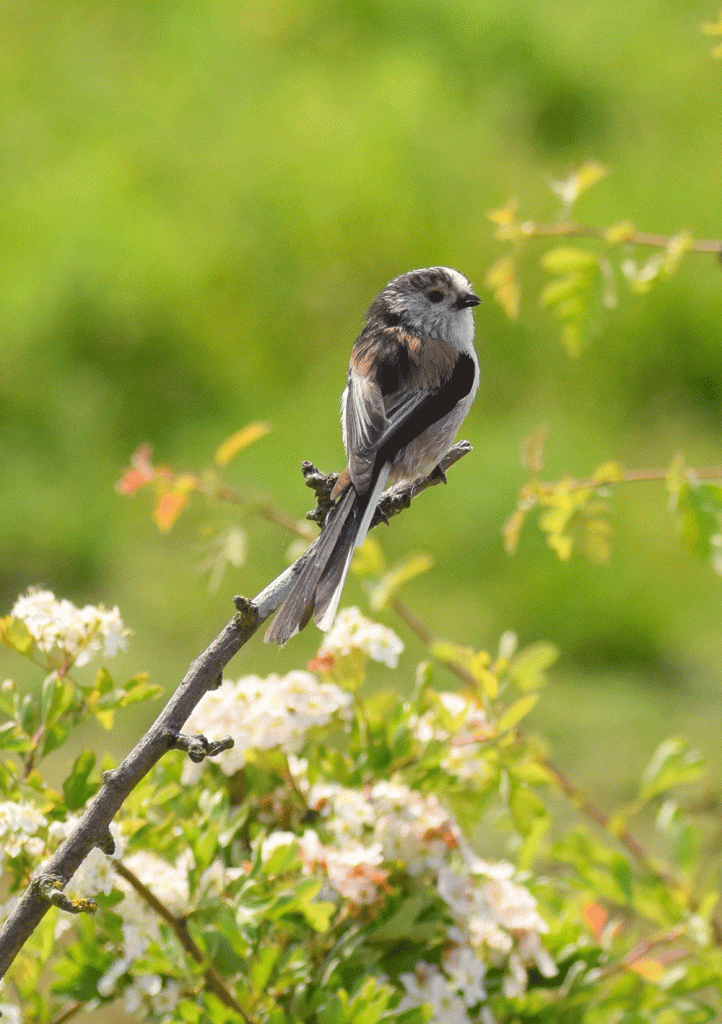
People often asked me “What can I do to attract wildlife into my garden?” I ask them what they already do to try; most often they tell me that they have bird feeders and put out bird food but not much seems to visit them. Firstly, we need to understand the needs of any visiting creatures, be they four legged or flying. Like us, they need to feel safe. It’s nice to be fed. It’s great to have something to wash it down with and if you can have a wash and brush up in the same spot, so much the better. In the 70s and 80s many hedgerows were taken out to make bigger fields for growing crops and allow use of larger machinery. This made many hedgerow birds homeless and numbers have plummeted. Not only have they been deprived of suitable nesting sites but have also lost a valuable food supply in the form of the spiders and insects living in those hedgerows, and the berries that grew on them too. Other creatures also lost their wildlife corridors and the safety to move around in the landscape. Many small ponds were filled in; again depriving creatures like frogs, toads and newts of vital habitat. We can all do something to help mitigate the loss of habitat and in doing so begin to encourage visitors to our backyards. Access can be an issue. Many gardens now have a wooden or concrete fence line which forms a barrier to four legged visitors. Hedgehogs are in trouble right across our island and I have to admit that I have not seen one in our garden in a long time. A hole the size of a drainage pipe in the bottom of the fence will give them a way in and a through route across the back gardens that they rely on to forage in safety at night . For birds to feel safe in a garden they need shelter before they will consider visiting a feeder or bird table. Put it into context… how would you feel sitting down to your tea on the patio and the local velociraptor catches you out with nowhere to dart for cover? Birds are acutely aware of the threat of predators in the form of either local cats or passing sparrowhawks and will not visit if they do not feel secure. To afford some shelter you could plant a few shrubs; the thicker a bush they form, the better . If you choose something like berberis, firethorn (pyracantha) or cotoneaster you will get the benefit of flowers to provide nectar for insects and also later on in the year, berries to feed the birds. Thick shrubs will also provide a nesting site for smaller birds. By providing something like a log pile habitat you will encourage a good selection of invertebrates to take up residence. You could introduce a bug hotel if you have not got the room for a log pile. Consider planting nectar rich flowers and shrubs to encourage bees and other pollinators and have a selection that will provide nectar from spring when they are emerging from hibernation, right through to autumn when they will be feeding up for the big sleep. One of the best nectar providers in the spring is pussy willow which will feed bumble bees and butterflies alike. Spring flowers such as snowdrops, crocus and lungwort will also be a magnet for insects as they wake up. Water in a garden is vital. Three years ago I installed a small pre-formed plastic pond, within days it was frog central! We always knew there were frogs in the garden, just not quite how many. Do remember to put a rock or ramp at the side of any pond you may have to allow hedgehogs to get out if they fall in. They are good swimmers and can climb but will need a little help. I now have another tiny water feature and a round pebble pond. Our resident sparrow flock, (making an almighty racket to announce their arrival!) soon took to the idea that there was a place to drink and bathe, they are now regularly joined by the blackbird family, dunnocks and resident robin. I recently invested in a Trail Cam to explore the nocturnal goings on in the garden. We have Urban foxes around and we were delighted to find that they too stop by for a drink. If you like the idea of providing water in the garden, have children and are worried about their safety, you don’t have to install a pond. We have a bowl that we use to soak potted plants in. We keep it full and the frogs and birds are not in the least bit fussy; they use that just as easily. We can all do our little bit to help the local wildlife by giving them what they need. The rewards can be staggering. I promise you will not be disappointed if you give it a go. I wish you good fortune in your own endeavours! 00
Modern Collectibles – Gentlemen’s Stickpins

Last year, I bought my wife a complete boxed set of The Avengers. So many episodes does it contain that we are still ploughing through them and, indeed, enjoying the kitsch nostalgia and humour of them enormously. The late actor Patrick McNee, as John Steed, the one constant protagonist of the series, was increasingly presented as an immaculate dandy in dress, despite his prowess in practically every other field of endeavour (the better to overcome a truly bizarre assemblage of enemies). This attire included racily cut three-piece suits by Pierre Cardin (as the credits aver), variously coloured bowler hats, outstandingly slim rolled cane-handled umbrellas (in varying hues – to match the suit and hat), such dandyism extending even to his appearing in the titles of the first colour series wearing a stick pin in his tie. Whilst I doubt if a true-bred English gentleman would have been seen dead in a Pierre Cardin three-piecer in those days, he certainly would neither have worn a brown or grey bowler, nor a stick pin in his tie, and even more certainly would have baulked at tying it in a Windsor knot (as Steed): frightfully non-U! The only acceptable place for a stick pin to be worn these days (and then) is with morning dress. Indeed, I inherited my father’s morning dress in my twenties and, from occasional formal wedding to occasional formal wedding, have been gradually growing into it ever since. He also left me his 14ct gold and pearl-headed stick pin, which I wear on such occasions with a light grey tie, although a cravat would be even more appropriate, but a trifle de trop for me. The jewelled stick pin, though, is essentially a thing of the past, having been brought to perfection in the Belle Epoque, when late Victorians like Oscar Wilde and eminent Edwardians like the King wore them as a matter of course in tie, stock or cravat. Indeed, they ranged from gem-set examples made for Tsar Nicholas II by Carl Fabergé, others by Lacloche Frères, Cartier and Tiffany, to simpler ones like mine, or another I inherited, of silver set with an abalone shell in a miniature oval of chip diamonds. Edward VII was a great wearer of stick pins and, as a leader a fashion was duly emulated at most levels of society. British made examples tended towards the sporting: examples may be found topped with fox heads, horseshoes, diamond-set racehorses with enamelled jockeys up, finishing posts, riding whips, playing cards, dice and cameos of the pin-ups of the day. Indeed, one could signal one’s predilections with them: a pin topped with Alexander the Great, or the Emperor Hadrian’s boyfriend Antinöus, sent out a very specific message at a time when being openly gay was essentially illegal. Likewise, an image of Bacchus would suggest the wearer was a person of convivial inclinations. Unfortunately, they fell out of fashion to some extent in the 1930s, when they were often re-made into brooches, and completely after the Second World War, when austerity impacted as much on fashion as on everything else. Stickpins and tiaras were most definitely passé. Yet these eclectic items are much collected, if not worn, and are available to suit all pockets. Indeed, even wearing them has undergone something of a revival, the lapel now being the favoured point of show for them, rather than a tie or cravat. Even so, it is hardly to everyone’s taste, especially in this age of studied informality, where ties seem to have given way to scraggy necks amongst the celebrities of the day. Yet it is this unfashionableness which keeps prices of the more ordinary examples low. Although a Fabergé, Wartski, Tiffany, Cartier or similar one from over a century ago will set you back a four- or even a five-figure sum, simpler ones, even with gold or silver shafts, can be picked up for less than £50, and ‘costume’ ones in non-precious metals with marcasite or enamel tops can be bought for a lot less. Many are nevertheless attractive and styles infinitely varied. My pearl topped pin has the obligatory twisted groove ascending the shaft, with the head tilted at 45˚ and a length of 21/2 inches – English ones always measure out in Imperial round figures; Continental ones generally are metric and the correct length should lie between 5.5cm and 6.5cm – anything longer is probably a hat-pin, an entirely different field of collecting. The use of 14ct. gold (or 9ct) was universal, even amongst the most expensive examples, as any higher purity would risk the shaft bending too easily. A similar pin to mine sold at Bamford’s recently for £44. The silver one, with its chip diamonds and abalone set head, might make £50 or £60. Base metal examples can range from £1 to £30 or £40, depending on the quality of their workmanship and general attractiveness. If you look for them at auction, the less exotic ones are usually sold in groups, or occasionally with mixed lots of other jewellery or costume jewellery. Yet with the current trend amongst the international set for wearing a stick pin in the lapel, the glitterati are probably rescuing an outdated piece of male jewellery from obscurity (John Steed excepted) and as James Sherwood has remarked, ‘re-opening the floodgates of fashion’ once more. Furthermore, Carole informs me that there seems to be a growing trend for ladies to wear them about their costumes when attending the glitzier occasions too, so we must assume that prices might well soon start to move up. In which case, aspiring collectors in this esoteric field ought to begin investing right away! 00
Lost Houses of Derbyshire – Knowle Hill, Ticknall, Derbyshire

Knowle Hill, which lies atop a sequestered valley west of Ticknall and just south of Ingleby, is really two lost houses, albeit that we have no idea of the appearance of the first, and only a limited idea of the appearance of the second. What is there today, are the sensitively restored remains of a Georgian Folly, now in the care of the Landmark Trust. The first family of note to have lived at Knowle Hill was that of Franceys, which had come by a portion of the manorial land at Ticknall, once held by the King with part of Ingleby, by inheritance from the de Ticknall family, via the Beaufoys of Trusley. They had a capital mansion on this land, and it is thought that it stood on the level ground on a ridge, to the immediate west of a bosky defile with a brook at the bottom. At the time of its destruction it was described as ‘very large and romantic.’ Timber framed and gables, suggesting that it had probably been rebuilt more than once and would have looked sixteenth century by that time. In the late sixteenth century the heiress of Franceys married the head of the distantly related family of Franceys of Foremark and their daughter, their only surviving child and heiress, married into the Warwickshire family of Burdett. At this stage, the new owners had no interest in moving to Derbyshire, and let the house at Knowle Hill to the Abells of Stapenhill. After the Civil War, however, they moved there, built a new seat at Foremark and installed a younger son of sir Thomas Burdett, 1st Bt., Robert in Knowle Hill, but in due course he pursued a successful career in London and eventually moved to Ireland. It was then settled on another younger son, Walter, third son of Sir Franceys Burdett, 2nd Bt. Walter Burdett demolished the ancient house and rebuilt it nearer the edge of the ravine in an ‘extraordinary mode of structure’ the result, which ran actually down the side of the slope in tiers, regarded by his contemporaries as a ‘curious house.’ Again, we have little clue as to its actual appearance, but a limited archaeological excavation carried out before the Landmark Trust restoration of its successor began confirmed that it must have indeed been curious in occupying a steep east facing slope! He also created exotic landscaped gardens, dammed the brook near its source at Seven Spouts farm (anciently Knowle Hill’s home farm) and created a lake and cascades, opening the view towards the NE and Swarkestone Bridge. William Woolley in 1713 wrote of it: Mr. Walter Burdett, an elderly bachelor….has made a very agreeable habitation….suitable to his humour and circumstances, where two Knowles or hills covered with woods and two pleasant valley on each side, with two murmuring rivulets running along them, to which natural disposition he has added a great deal of art which renders it a most delightful place which, with his kind of hospitality, causeth it to be much resorted to. Sic sciti laetantur Lares Oh quis me geldis submontibus Haemi Sistat et ingenti ramorum proteget umbra’ In the longer term, Walter, who was nothing if not personally eccentric, fell out with his family so that upon his death, unmarried, it was bought from his heir by a neighbour and drinking chum, Robert Hardinge, MP, a son of Gideon Hardinge of King’s Newton Hall (ancestor of the present Viscounts Hardinge). He also died without issue, in 1758. At this precise moment, Sir Robert Burdett, 4th Bt. was having a new house built for his family at Foremark, to a design by David Hiorne of Warwick and with the work being undertaken under the direction of the young Joseph Pickford. This had necessitated the family moving out, and to this end he rented Knowle Hill from the Hardinge family so that they would have a house nearby to live in until the much grander new Foremark Hall was completed. In 1761, the new house was able to be re-occupied, and after a gap of five years, Sir Robert managed to buy the Knowle Hill estate. The old house was thereupon demolished, and in its place a courtyard (once the stables) was created, with a long low range facing west, incorporating timber elements, possibly from the old Franceys family house. On the opposite side of the courtyard a bow-ended summerhouse range was built with a crenellated tower and Gothick windows, the main room boasting an Ashford black marble bolection chimneypiece from Walter Burdett’s old house, a stucco dado, frieze (of glyphs) and cavetto cornice, and was decorated in trompe l’oeuil, possibly by Nottingham artist Paul Sandby (1731-1809) who had done much the same for the dining room at Drakelow Hall (see Country Images May 2017). Beneath this were landscaped – probably by local Capability Brown follower William Emes, who had just finished landscaping the park at Foremark – a 44 acre series of monumental terraces with stone niches, ponds, cascades and a bosky chasm, whilst the landscape generally was re-engineered, waterworks and all, to become one of the very earliest Picturesque movement landscapes in the Midlands, making the place highly romantic and, in the catchphrase of the era, sublime. Only William Aislabie’s Hackfall in Yorkshire really rivals it. The courtyard itself was walled to the south where a fine lawn was laid out, once walled throughout in stone and possibly more ancient than the house. From the first terrace below the house, opened a narrow passage giving onto a brick lined domed cave beneath. Bottle shaped niches along the entry clearly indicate that this was designed for convivial occasions. The fact that Burdett, a Whig, was a close friend of Sir Francis Dashwood, Bt. of West Wycombe Park (later Lord Despencer), famed for his Hellfire Club, probably says it all! Antiquarian stone heads from the site survived until some 40 years ago in a garden at Repton. The one caveat that might be entered is that
Celebrity Interview – Paul Carrack

He takes nothing for granted and continually strives to make “a great, great album – the next one will be better”. This is despite his latest one, ‘These Days’, being described by some people as “the finest album of his distinguished career”. Not sure who Paul Carrack is? He wrote and sang ‘How Long’ with Ace which has been covered by many artists since it was released in 1974. Later his soulful, instantly recognisable voice was on ‘Tempted’ which wasn’t a huge hit for Squeeze but was used for several commercials. He then joined the supergroup Mike + the Mechanics which had been formed by Genesis founder Mike Rutherford. Paul sang classics such as ‘The Living Years’ and wrote some of the band’s hits including ‘Over My Shoulder’. These days a huge number of people appreciate Paul’s talents. He does concerts with a German big band every Christmas and for the past five years has toured with Eric Clapton. During our conversation Paul eventually admitted that he thinks his latest album is the best he’s done for a number of reasons. “I think the songs are quite strong and there’s some fabulous playing with some top-flight musicians, people like Steve Gadd on drums who I met by playing in Eric Clapton’s band. Steve’s played with everybody from Paul Simon to James Taylor. He’s one of the greats.” Paul explains that he doesn’t feel compelled to write music every day but when he has an album to make, he’ll usually write it all in one go. “I only write about things I know about – there’s no political slant and probably no original thoughts whatsoever! It’s just about life in general and relationships.” Five of the songs on the new album are written with his old mate Chris Difford from Squeeze. “He’s a great lyricist. It’s just good to have another slant, otherwise I think 11 songs by me might get a bit samey. He brings another flavour to the table.” Paul Melvyn Carrack was born on 22 April 1951 in Sheffield. His musical vocation began with his playing a home-made drum kit in the attic. He also picked up his brother’s guitar and in his teens he started to teach himself the organ, seeing it as a way of joining a local soul band. “I have a natural instinct and musical gene, I guess, that helped me,” says Paul. “I don’t really have a lot of theory or technique but I get by on musical instincts and that’s stood me in good stead.” He admits he struggled academically and didn’t enjoy school. A trip down a pit concentrated his mind on his future career. “I had to go through the motions of pretending I might be interested in a proper job. There was a school outing with a careers master to go down the local colliery. It was pretty grim. I take my hat off to those guys – you got in a cage and went a long way down and got on a train on a track and went a long way again. And then you crawled to the coal face. That was a pretty hairy experience. “I don’t think there was any serious chance of me ever going down there and earning a living doing that because I’d have had a job picking up a shovel. I was a skinny little wimp back then. If I needed any confirmation that I wanted to make music work, that was it.” Paul did get a job in an office at the gas board for a short time. But he was also playing in a semi-pro band which passed an audition to go to Germany for a month’s residency in Hamburg. “I wasn’t really cut out for any kind of a proper job. I don’t mean that disrespectfully to people who are. To make matters worse I wasn’t very practical – I wasn’t very good at anything. If the sink gets blocked here it’s my missus that sorts it out!” Paul has lived in and around London for the past 30 years. He married a London girl and they’ve brought up four children. “I just had to make music work. Otherwise I don’t know what I would have done. I was fortunate. I had a bit of God-given musical talent.” Paul left school at 15. Eight years later ‘How Long’ reached number 20 in the UK singles chart and peaked at number three in the US and Canada. Paul describes those first few years as a “hand-to-mouth existence” and things didn’t change overnight. It was all an adventure to him and the band. “We were struggling but we were doing what we wanted to do. ‘How Long’ was the first glimmer of any kind of success. “Since then it’s been up and down, up and down until we’ve reached the point where we’ve established something of a niche. If it all turns pear-shaped tomorrow I’ll have to say ‘thank you, life’s been great’. It stills seems to be going okay.” With the sales of CDs falling over the past few years, promoting music through touring has taken on increased significance. “That’s fine because it’s all I’ve known. That’s where I came in. It’s a little more comfortable now – I go around in a nice car with a driver and we stay in a clean hotel whereas before it was all about sleeping on people’s floors and living in the van. “It was tough but we didn’t grumble – back then it was accepted. That’s what you had to do. The tougher it was the more you liked it in a perverse kind of way because you were doing it for the music.” The new tour comprises 30 dates over ten weeks, including one at Nottingham’s Royal Concert Hall which Paul has played several times. He says his seven-piece band isn’t just a greatest hits group and will feature half-a-dozen songs from the new album. But they daren’t leave out old
The City that Never Sleeps

Only ten minutes after my wife and I had settled into our hotel, we set off to explore a city we’d last been to 20 years ago. But the area was in lockdown. How could this be? This was the city that never sleeps, the one so good they named it twice. Yet we could go only a few yards in one direction and a few hundred more in the opposite one. This had the potential to ruin my wife’s birthday trip. I asked a shopkeeper what was going on. “There’s only one reason why they close the roads: the President.” “Really?” “Don’t you get that in England with Theresa May?” I told him we might do it for the Queen but the Prime Minister didn’t get such preferential treatment. We moved up to the next corner to see the biggest motorcade you could ever imagine. There must have been 50 motorbikes with lights dazzling everyone before armoured trucks announced the arrival of two limousines, one containing Trump himself. More armoured vans were followed by three television trucks – The Donald never misses an opportunity to put over his message – and another platoon of motorbikes. Nice of the President to give us a personal welcome, I thought… It was a surreal opening to a five-day break in the Big Apple which proved that New York is like no other city. It’s such a vast, diverse place that there’s something for everyone; it’s what you make it. It can be cultural, educational, manic, relaxing – whatever your taste, New York will satisfy it. As we’d been to New York before, we didn’t want to repeat what we‘d done two decades earlier – with one exception which I’ll come to later. So after our encounter with Trump we had a quick look at the Chrysler building from the outside, the tallest brick building with a steel framework in the world although there are five taller buildings made of a different construction in New York. Then we marvelled at the art deco magnificence of Grand Central Terminal, otherwise known as Grand Central Station. It’s one of the most visited tourist attractions in the world, with more than 20 million visitors a year checking out the 65 shops and 35 places to eat as well as gazing at the fabulous chandeliers in Vanderbilt Hall. More than 250,000 people commute through Grand Central every day on trains, the subway and buses. The best way to see New York is on foot. The open-top tourist buses and taxis get caught up in the horrendous traffic, so it’s quicker to walk everywhere. We headed towards Times Square, one of the world’s busiest pedestrian areas, and for our first evening meal settled on a place called the Brooklyn Diner which boasts that it serves the best burgers in New York. I can’t verify that because it was the only one I tasted. But it was delicious. We started day two with a walk to Central Park. It’s incredible that within such a bustling, frenetic city there’s this huge oasis of calm. Only cyclists and horse-drawn carriages are allowed in the park, so you can walk around without fear of being run over or suffering respiratory problems from suffocating traffic. A popular place in the park is Strawberry Fields, an area dedicated to John Lennon. Walk out of one of the nearby exits and you can see the apartment where Lennon lived and was shot dead. One of the customs you have to get used to in the States is tipping. A gratuity of between 10 and 20 per cent is expected. There was even a receptacle for tips at a Central Park stall where we bought a pretzel and water. Sue said to me afterwards: “I’ve got a tip for the stallholder: put a smile on your face when you serve people – then they might give you something!” A quick detour took us to department store Bloomingdales – a disappointing experience where nothing seems exclusive yet the prices are especially high – before we headed back to Times Square. The sales booth TKTS opens at 3pm and has seats for most major theatre shows on that evening. We decided to bypass a production which had just been nominated for 12 Tony Awards – Spongebob Squarepants the Musical – and queued up instead for 45 minutes for tickets for Phantom Of The Opera. Although we’d seen it on Broadway before as well as in the West End, the cast has changed several times and we took the opportunity to see one of our favourite shows again. One of the joys of New York is meeting many fascinating people who tell great stories. In Central Park we met a supposedly homeless man who told us about his deep, insurmountable problems with several wives and how he’d recently met Ozzie Osbourne. You couldn’t make it up. After we’d got our Phantom tickets a man presented us with a leaflet for a discount at a nearby upmarket restaurant. He claimed to be a retired scriptwriter for one of the top TV comedy shows in the States and was working a couple of days a week just to get out of the house. Our walk from our hotel, the DoubleTree by Hilton on Lexington Avenue, to the theatre and back meant on that day we clocked up an astonishing 15 miles. On the third day we decided to head downtown – too far to walk, so we used the subway, a clean, efficient train taking us to Fulton Street and Ground Zero. The monument to thousands of people who died when the Twin Towers were inconceivably reduced to rubble is a strange place: I expected it to be a peaceful, possibly eerie location where people silently paid their respects. But it was heaving with tourists, some of whom hurriedly snatched selfies without even looking at the engraved names of the victims before dashing off to the next tourist attraction. Heading
Product Test – Temple Spa

Time for luxury with Temple Spa Palm Balm £19 Our award-winning hand cream is very popular in the Autumn and Winter, as it protects and moisturises your hands when the seasons are changing and during cold and frosty weather. Luxurious skincare for your hands. More than just a handcream this luxurious skincare treatment fuses together extracts of aloe vera to soothe and moisturise dry chapped hands, jojoba oil to soften the skin and vitamin E to hydrate and diminish signs of ageing. The cream texture will sink quickly into skin leaving your hands softer, smoother, naturally fragranced and non-greasy. Sole Balm £19 Relaxation starts with the feet, so your soles and your soul are going to love, love, love some amazing SOLE BALM treatment. A powerful blend of 22 essential oils will help alleviate tension and tiredness, and a plethora of botanicals including cocoa butter, honey, wheat germ plus oils of olive, soy and avocado deeply moisturise. Clever salicylic acid, papaya and pro-vitamin B5 gently nibble away dead skin cells, so those rough bits will get softer and softer, whilst peppermint oil and menthol gently soothe and cool. A spa pedicure indeed! Sugar Buff £23 An all over anti-ageing body scrub that leaves your skin smooth, fragrant and buffed to perfection. Our best body scrub for all skin types. For all year round and top-to-toe sexy, soft skin that radiates with a healthy glow. SUGAR BUFF is a deliciously fragranced, Mediterranean inspired sugar exfoliator with the most luscious texture that removes dead skin cells and encourages cell renewal to reveal silky smooth skin. A gorgeous anti-ageing blend including hydrating olive and grape seed oil, fig, pomegranate, vitamin E plus a relaxing cocktail of essential oils including lavender, patchouli, clove, grapefruit, eucalyptus and rosemary. Treats your body from top to toe! Tried & Tested Sole Balm The cocoa butter, honey, wheat germ and oils make this a beautifully soothing product. I was especially surprised to see how after only a couple of days this really improved the skin on my feet. I use this straight after a shower, and will continue to use this regularly, an excellent cream. JP Palm Balm A little goes a long way with this hand cream. It melts in quickly and leaves skin feeling soft and nourished. VP Palm Balm A little goes a long way with this hand cream. It melts in quickly and leaves skin feeling soft and nourished. VP 00
Taste Derbyshire – Derby’s Bustler Market

Market food used to be all about simple, rib-sticking snacks like hot dogs piled with fried onions and thick wedges of cheese on toast. The height of sophistication was asking for a serviette with your bacon butty. But times have changed. Avocado is now our national fruit of choice; you can get liquorice in your gin and the pop-up street market is the place to find exciting young chefs producing daring, cutting-edge food. I’m ashamed to say – even though it was launched in May 2017 – I am a late-comer to Derby’s own Bustler Market; a monthly gathering of some of the best street food vendors in the country. Formed by four friends – Liv Pritchard of Hide Burger Bar, Stuart Costen, founder of Love Derby website, Ben Edmonds of Blok Knives and Tom Erskine from Marketing Derby – Bustler Market came about out of their mutual passion for the city and food. “We came together to create something fresh and less formal than the atmosphere in many pubs and restaurants,” explains Liv. We were all fans of street food events like Peddler Market in Sheffield and the Digbeth Dining Club in Birmingham and we wanted to create somewhere different for Derby people to come and eat, drink, socialise and relax.” The friends were thrilled with how well visitors embraced the concept; “I think we knew young people would love it but it appeals to all generations,” explains Liv. “We can get upwards of 5,000 visitors through the doors over the two days.” What adds to the excitement is the ‘pop-up’ nature of the market. It’s on for only two days (Friday and Saturday) on the last weekend of every month and there’s a rotating list of street food vendors. There’s always an air of anticipation to see which stall-holders will set up and, according to Liv, people like to ‘mix and match’ from all the different outlets. “Our visitors often sit together to socialise and share their plates,” Liv says. “Yes, we do get people asking if they can reserve their own table but generally most are happy to muck-in and have fun. For the visitors and traders alike, we’ve become a tight-knit community united by our love of good food.” Visitors Gemma Byrne and Chris Wilson, of Sinfin, are big fans of Bustler; “We’d been to lots of street food markets in places like Copenhagen and it was great when one opened in Derby,” says Chris. Gemma agrees; “We’ve attended nine Bustler markets since it opened and we’ve never had a bad thing to eat. Our daughter Sienna, who is one, really enjoyed the waffles.” ‘Taste Derbyshire’ writer Amanda Volley took a stroll down to Bustler Market to sample some of the food – and drink – highlights. Get Wurst There’s nothing like the aroma of sizzling hot dog sausage on a cold winter’s night to get people flocking Bisto-kid style around a stall. But forget flabby frankfurters. Get Wurst use Bratwursts from the Munsterland region of Germany, sourced by Paul and Lindsay Melbourne of Sheffield. “We had great holidays in Berlin and loved ‘Currywurst,” says Paul when asked what inspired him to put curry and pickles on a hot dog. “We couldn’t get anything like it at home so we launched the business three years ago.” Paul’s assembly of the ‘currywurst’ begins with a portion of rosemary salted fries, topped with his bespoke tomato-based curry sauce. He coats the food with a dusting of curry powder and sticks a few pickled gherkins on top. “I’ve never had anything like this before,” beams customer Will Hughes. “It’s ideal for street food. I love the curry powder – it’s like a massive sock of flavour at the end.” Paul says these reactions make sacrificing his weekends worthwhile. “I used to work as a charity fund-raiser. I don’t miss the office at all – except when it’s really cold.” Find more by visiting www.getwurst.co.uk The Italian Stallion Converted horse boxes are firm favourites of pop-up food companies – but odds are you’ve not seen one sporting a wood-fired pizza oven. “I love street food markets and Italian food and everyone loves pizza,” says Holly Beasley, owner of The Italian Stallion. “I’ve travelled a lot in Italy and wanted to start a career in food. Pizza was a perfect choice. You can put anything on top of it – like wild honey with a chilli infusion.” Small wonder people make a bee-line for her stall. “I always laugh when children run about because they’re so excited to see us,” Holly smiles. “Afterwards, people walk away with a glazed, happy expression we call the ‘pizza zombie’ look.” Holly, who comes from Hinckley in Leicestershire, has a Monday to Thursday job in therapy but doesn’t mind working on weekends. “We go to lots of fun places, meet nice people and make pizza for them – what’s not to like?” Contact Holly via theitalianstallionpizza@gmail.com The Kebab Cartel When two brothers with design back-grounds launch a street food brand – you just know it’s going to be a perfect fusion of on-trend style and yummy substance. Matt Zalepa, of Darley Abbey, left his job in fashion because he ‘had to’ work with street food. “My brother Jay and I asked ourselves what people like to eat – and came up with kebabs. We take our inspiration from the Middle East, Turkish and Lebanese food and they’re seriously addictive,” he laughs. Jay agrees; “Events like this make quality food accessible to all. We also love working in a busy, party atmosphere.” The brothers – self-styled kebab ‘gangstas’ – may have fashioned a brand which is cooler than a hipster’s beard but they become dewy-eyed when they talk about their food; especially their pillow-soft lamb and pomegranate molasses and tahini yoghurt. “And don’t forget to mention the Kurdish flatbreads,” adds Matt. Customer Martin Broadhurst, of Derby, was raving about the succulent lamb and the ‘duvet thick’ bread of his shawarma. “It was delightful
Walk Derbyshire – Kedleston’s Glorious Parkland

It is hard to believe that the ever constant bustle of Derby’s traffic is barely a couple of miles away at its closest point. Kedleston’s park is an oasis of tranquility, with now naturalised groves and plantations, set around hundreds of acres of green-sward and lakes. All this overlooks winding ponds separated by tinkling waterfalls, the breeding ground of visiting and permanent wildfowl, making a perfect foreground for the hall, ancestral home of the Curzons With only a quarter of its park turned over to the golfing fraternity, the rest of Kedleston Park is perfectly designed for enjoyable walking, be it on one of the graded woodland walks or beside attractive lakes made by damming Cutler Brook. Modern walkers seem to have more energy than the Regency ladies and their squires who contented themselves with a gentle stroll of say half a mile in the pleasure grounds. Even though none of the strolls available for today’s walkers is more than 3¼miles, it can be longer, and in fact the walk I describe here links two of the longer walks, covering an easy 5¼miles. There is also the possibility of a visit inside the hall to appreciate its treasure-trove of links to generations of Curzons. One of the finest of England’s stately homes, Kedleston Hall was built in the nine years between 1761 and 1770 by the great architects of the time, James Paine and Robert Adam for the first Lord Scarsdale, designed in the then popular classical style. Greek columns and classical statuary decorate exquisite rooms laid out in order to influence visiting royalty by their abundance of treasures. To improve the appearance of the finished house, the medieval estate village of Kedleston was demolished and rebuilt in its present position as a model village, partly hidden half a mile away to the north-west. Of that village only the ancient church remains as a fine example of Norman and later architecture. North and south sides of the house were the responsibility of each architect and as a result the building offers magnificent aspects of both sides. The most distinguished member of the Curzon dynasty was George Nathanial Curzon, Foreign Secretary and Leader of the House of Lords. He is however, best remembered as the Viceroy of India at the height of Britain’s expansion as a world power. As a result of the influence bestowed upon him as Viceroy, he was showered by expensive gifts from the maharajas of the multitude of states then filling the map of India. Amongst all the silver and ivory on show, there is an elaborately expensive howdah in which he was transported by a huge elephant during the Delhi Durbar. All these treasures are on display in the ground-floor rooms beyond the hall’s entrance, but the most amazing item is the Peacock Dress made for Lady Curzon and worn at the Durbar Ball. The result of hours of painstaking work by craftsmen, its magnificence still shines getting on for two hundred years after it was made. The Lady Curzon who wore the Peacock Dress died quite young and is buried in Kedleston’s church. Lord Curzon’s effigy lies beside her, but as he was still alive at the time, this is made apparent by the fact that his foot is shown kicking aside a corner of the couple’s winding sheet! The 5¼ mile walk even when taken at a leisurely pace should only take a little over two hours, leaving plenty of time to explore other features such as a visit to the magnificent hall. While the map attached to the walk’s description can be used to follow this easy walk, it might help if you pick up a copy of the leaflet on offer at the National Trust’s visitor reception office. The Walk : From the National Park Visitor Centre bear right and go through a metal gate beside a signpost ‘to the footpaths’. Turn right and go past two large stone gateposts and then on to a raised track entering mature woodland. The gateposts are said to have come from the old House of Lords when parliament was being rebuilt following a disastrous fire in the nineteenth century. Ignore the path descending to the left away from the track and continue to walk through the woods. In about a quarter of a mile you will come on an area of disturbed ground with deep wide holes. This is a badger sett, but do not expect to see any because being nocturnal, they will be fast asleep. A little further on a short side path swings to the left past the old stone building known as the Hermitage. In more leisurely times it would be where Regency ladies and gentlemen took their then fashionable (and expensive) tea. Going slightly uphill, continue along the forest track and into the denser woodland of the Pleasure Grounds. Bearing left with the track pause now and then to admire the wide ranging views sloping down towards the hall. A seat marks the highest but still easily accessible point on the walk. Continue to walk through the woods for about a mile and three quarters. Bearing left as the track turns. Go with it, now downhill through the woods in what is known as Derby Screen. In just over half a mile, the track splits three ways. It doesn’t matter which one you take, but the right bearing tracks reach the final dam marking the end of the lakes. Turn left along the lakeside and follow a now grassy path as far as the hall’s access drive. The lakes were dug by hand at the same time as the house was built. Weirs were added to hold back Cutler Brook and so create the attractive lakes. Islands on either side of the bridge offer secluded nesting for visiting and indigenous water fowl. Even though the lakes make a perfect foreground to Kedleston Hall, whoever named them showed little or no imagination by calling them Upper, Middle and
Places of Interest on Either Side of The Lower Wye & Severn Valleys

Beyond Birmingham and before reaching Bristol on the way to the south west, travellers using the M5 gateway to the sun often find themselves in one of the all too frequent bottlenecks, especially around the M5/M60 junction. If they give up and decide to call it a day around Junction 9 (Tewksbury), then the possibility of a completely new experience will make itself known. Assuming the tired motorist has left the motorway at Junction 9 on the M5, it will be a matter moments for him or her to reach Tewkesbury, a town on the Severn steeped in medieval history. In pre-motorway days the journey through this ancient place could be a nightmare of cars and lorries crawling like noisy, fume-spewing snails along the A38. How the half-timbered houses stood up to the vibration is a miracle, but they did and we must be more the grateful for it. One of the fifteenth-century houses has been converted into a Baptist chapel. It hides down a narrow alley near the abbey church, safe from the noise of traffic still using the A38, making it a haven of tranquility on even busy market days. On a sunny day in May 1471, the Battle of Bloody Meadow, part of the Wars of the Roses took place a couple of hundred yards from Tewksbury abbey. The last of the battles between the warring houses, it was won by the Yorkists who pursued the defeated Lancastrians along what became the A38. Many of the survivors took sanctuary inside the abbey, but were dragged out and publicly executed in the main street. While the abbey church is much changed from that awful time, it managed a century or so later to withstand the officials of Henry VIII who had come to close the place down as part of the Dissolution. Today, because the abbey was part parish church it was allowed to survive, one of the few buildings to remain from the conflict between monarch and church. Further along the M5 turning off at Junction 11 will give the opportunity of visiting two attractive places. Gloucester is, as the name suggests, a Roman town, just one of the in-places popular with our sophisticated invaders. This part of the Severn valley and the nearby Cotswolds’ gentle hills had as its residents the early equivalent to early retired Prime Ministers and sacked petrol heads. For centuries the city guarded the lowest crossing of the Severn and routes into South Wales. It became the Roman fortified town of Glevum after taking over the British Caer Glowe; the Normans walled it and built a castle (destroyed in the 17th century). A busy coaching stop in Regency times, the glory of today’s city are its inns and the Cathedral; built mainly in the 12th century as a monastic church, but refounded by Henry VIII as a cathedral. As a hint of its age, the pillars supporting the main fabric, are all of 900 years old, and the glass of its huge east window has seen the dawn and dusk of over six hundred years. In Northgate Street, the 15th century ‘New Inn’ has a galleried courtyard where crowds could safely watch coach-horses being changed. Until quite recently, Gloucester was a busy inland port and the riverside wharfs can still be explored. On the opposite side of the motorway, the A40 leads into Cheltenham. What was once a small village quickly became a popular Regency spa when heavily charged water was found in a farmer’s field. The water is still dispensed in the Town Hall. Well known for its Gold Cup steeplechase horse racing every March and the home of an important girls’ public school, Cheltenham’s town centre is still lined with exquisite Regency buildings on either side of its wide streets. A wealth of trees preserves the character of this beautiful town despite the pressure of modern commerce. No shopping street in England can compare with the Promenade for beauty. The town has many links with music festivals – Gustav Holst was born here; concerts are given in halls around the town as well as St Mary’s Parish Church where its magnificent Rose Window is an attractive distraction. Part of the small garden in front of Cheltenham’s Town Hall has at its centerpiece an Italianate fountain that never fails to delight passers-by of all ages. Behind and to one side, stands the statue of Edward Wilson who died on the return from the South Pole along with Captain Scott and the rest of the polar group. Touchingly, the statue of this Cheltenham man was made by Scott’s widow. Inside a small museum and art gallery close by the Town Hall, a small piece of notepaper within a display cabinet is often overlooked. Grubby it might be, it was found on Wilson’s body and was the last message he wrote to his wife. Still legible, it was obviously written in the knowledge that Wilson was dying, and from its phrases it was likely that his brave colleagues were already dead. Moving across the Severn Valley and into that of the Wye, two features are worth discovering by a first-time visitor. The first and arguably the most attractive is Tintern Abbey, one of the most beautiful Cistercian ruins in Britain. With the wooded hills of the lower Wye Valley all around, it gives an aura of tranquility unspoiled by the vandalism of Henry VIII’s struggle with the church. A much larger structure than at first glance on driving along the valley road, the abbey in its hey-day held hundreds of monks and pilgrims as well as those in need of hospitalization. Careful excavation over recent years has unearthed the ground-plan of many of the rooms needed to support ecclesiastical activity in the main section. The beautifully preserved ruins of Chepstow Castle still seems to guard access to the open Bristol Channel. In fact until the first Severn crossing bridge was built, Chepstow was the first town in Wales accessible to the