PREDATORS OFTHE OKAVANGO DELTA…Botswana
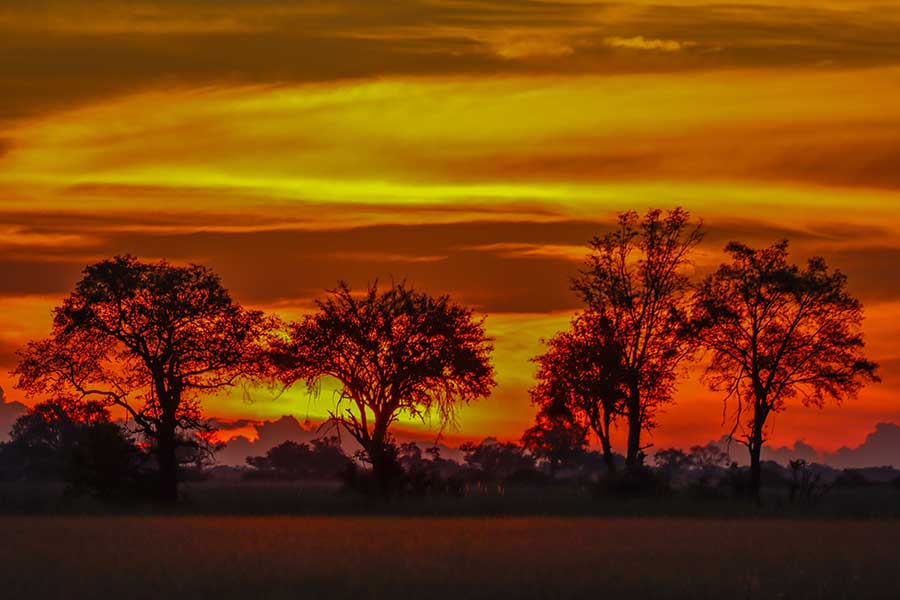
With Martins World Travel My last month’s article concentrated on the rich animal and bird life of this unique area of Africa. Now it’s time to divulge the incredible predators we viewed on the same trip, very close up and personal, with excellent guides to ensure our safety. Guides at our remote lodges and camps are renowned for their professionalism and knowledge. They understand the Okavango like no other and can quickly predict the moods of the rich wildlife which surrounds us… often just a few yards away. When viewing predators like lions, leopards and hyenas often so close you can smell them the best approach is in a purpose built 4×4 vehicle, open sided and open both front and back. A canvas roof acts as a sunshade. By keeping still and quiet when in the close company of lions and leopards these powerful predators appear to ignore the contents (us) ! And view the overall exterior as nothing of interest to them .. thankfully. We slowly approached a mature female leopard resting in a tree after consuming her previous nights kill. A reed buck was almost totally consumed, hung up in the same tree and well out of reach of the next predator down the chain… spotted hyenas. A vulture glided low overhead and she snarled in its direction just yards from us but about 12 feet up the sturdy tree. On another occasion we came across a huge older male lion that was resting next to a dead elephant. Our guide said the elephant would only recently have died of natural causes and the lion would feast on the carcasses for about 3 days. Lions like fresh meat and once it starts to smell as it rots quickly in the heat the lion will move on to find or take down fresher meat. This lion allowed us to approach very close and we filmed and photographed him as he laid on the ground with a bulging belly full of prime elephant meat and hardly able to move. When he chose to move away the hyenas, jackals and vultures would quickly move in and take their fill. Nothing is wasted in nature. On one of our morning “drives” we were covering various trails and bush that ranged from dense to open scrubland. We noticed a few zebra and giraffe feeding and suddenly their demeanour changed to one of apprehension. As they quickly moved out of the area two huge male lions moved purposely towards us coming as close as just a few feet. They appeared to be two fully mature brothers. The fact they hunted as a pair and very successfully too was confirmed by their stunning condition. The lead male had a thick black mane whilst his no less impressive companion had a lighter coloured mane. They walked right by us as if we did not exist and then settled down to rest in the shade of an acacia bush just a few yards from us. Cutting off trail through scrubland and the occasional termite mound and heading towards a thick patch of trees and bushes our guide spotted a young leopard, a 2 year old female, and she was obviously searching for a kill. She moved effortlessly and quietly through the vegetation stopping occasionally and marking her territory on her way. She passed very close to us emerging as if out of nowhere. Her coat was beautifully marked and she was in absolute prime condition. Our guide informed us that leopards would often lie on a tree branch waiting for prey, particularly the Marula Tree whose flowers attracted many an unwary antelope when the flowers dropped to the ground. A favourite food source but sometimes with deadly results. On our bush walks our guide always looked up towards the overhanging branches to ensure a hungry leopard was not lying in wait in search of its next meal. Our expert guide viewed a set of tracks that held his interest and we followed them along a trail to the point where they disappeared in the marsh grasses. He recognised the paw prints as Hyena tracks and slowly drove our vehicle over the scrub and towards an old termite mound that had dense vegetation around it. His sharp eyesight and vast knowledge had led us right up to the den of a Hyena family right on the edge of the marshes. An adult female emerged and wandered off in search of a meal and only a few moments later a young cub came out and looked around.. all the while viewing us with total indifference. Prey species are plentiful in and around the vast Okavango Delta an area covering up to 20,000 square kilometres when water levels reach their annual peak. Year round water is the key to why nature is so bountiful and even when the system slowly shrinks to a third of its size game and the predators that prey upon them are always here to be found. Warthogs can be very tough to tackle due to their speed, aggression and razor sharp tusks. They are often found in small family groups with mothers being highly dedicated to their numerous offspring. Their sociable disposition to each other belies their power and even leopards and lions are cautious about tackling adult warthogs. Warthogs have very sharp and dangerous tusks that can cause serious injury and even death to a careless predator. A cornered Warthog is a creature to be reckoned with. Various species of antelope form the main food for these stunning predators. Southern Reedbuck, Tsessebe, Red Lechwe, Impala, and the biggest being the Greater Kudu. Bigger game such as zebra and blue wildebeest roam from one grassy wetland to another and herds can number up to a hundred animals of all age ranges. Fit adult elephants are rarely taken down even by big male lions but the young are occasionally targeted. It is possible to see a solitary female with her calf but it is more
Walk Derbyshire – An Amble through Ashover
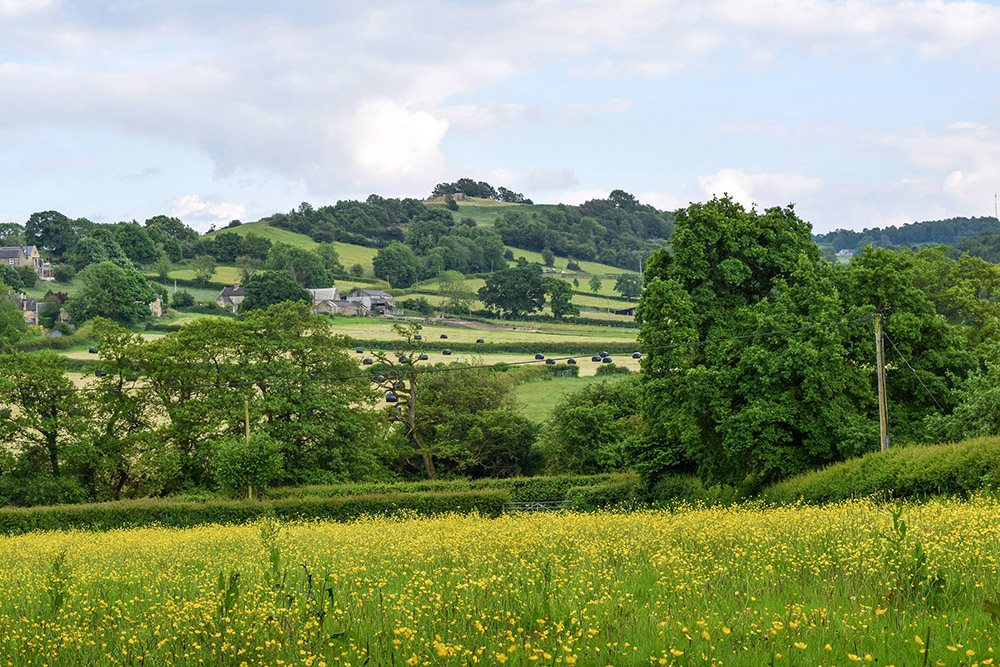
Set alongside the River Amber is the picturesque village of Ashover. Quaint cottages, stone houses and old pubs fill this favourite Derbyshire village of mine. It may take you a while to drive through the village as it is so pretty, with many cute cottages for you to stop and admire. Ashover has a truly rich history with quarries, lime kilns and lead mines. It holds All Saints Church dating from between 1350 and 1419 which was built by Thomas Babington. (One of his family members was executed for plotting against Elizabeth I). Ashover is also the home to the long standing Ashover Agricultural & Horticultural Show – this year’s show takes place on Wednesday August 14th. It is a great day out for all the family. In the village there are three pubs, a cafe, a cute coffee shop and gorgeous little village shop which sells gifts, cakes and ice cream (cash only!). There is a lovely cricket pitch with football goals, a nice children’s park and play area, and tennis courts, so plenty to occupy you. Adjacent to the cricket pitch is Ashover Parish Rooms now the Village Hall, which can be hired for weddings and events. There’s a plethora of walks in and around Ashover featuring stunning views, high vantage points, buttercup filled meadows and babbling brooks. You can see why this is a favourite for myself and many other walkers. USEFUL INFORMATION This walk is pretty easy to do. Takes just over an hour or longer if you are taking time to take in the beautiful scenery. We came through a field of cows with calves so please be careful if you have dogs. It’s a very peaceful walk which goes through fields, meadows, along the river and is easily shortened or extended. Near the end you pass 3 pubs so take your pick! Track with … https://www.outdooractive.com/en/route/hiking-route/central-england-and-the-midlands/drafted-on-2024-06-25/295370954/?share=%7Ezzgg3age%244osstcjj Parking… there is a free car park at the village hall and also plenty of spaces on the road (please park responsibly!) Pubs… three in the centre of the village. The Old Poets Corner, The Crispin Inn and The Black Swan. Distance – 4.35km Time – 1 hour-ish Terrain – Easy to moderate THE ROUTE Starting from facing the cricket pitch we walk to the bottom left hand corner to the small pavillion and follow the footpath to the left as it goes all the way through the fields, through the woods (where you will smell the wild garlic at the moment), till you hit a little junction in the path. Turn right through the gate and you will come to the Fall Hill quarry. Follow the path as this goes head straight onto Hockley Lane so please be careful! Head left on Hockley lane for a few yards where, on your right, you will see a footpath sign which looks like somebodies driveway but this is the footpath – honestly! Carry on down onto the road, don’t go down the bridleway. We are now walking alongside the River Amber and after 20 or so yards on Fallgate you will come to the SLOW sign on the road, here you will see an opening on your right which will take you along the river. Follow along the River Amber and then take the path to the right. This will go down a couple of steps and then up a couple more and through the trees. When you come out onto the lane you have an option of making this shorter by taking the bridle path to your right but this is a little treacherous underfoot, especially if it’s been bad weather. We are carrying on straight up Gin Lane in front of you. When you get to the fork in the road, take a right along the track which slowly makes its way uphill. Climb all the way to the top. You will pass Overton Hall on your right. You will come to a clearing with a path to the right. Take this. You will come to a small gate with the yellow footpath arrow. Take that and go down the stone steps – slippery when wet. Follow the stone steps to the bottom, you will go over a little bridge and following the path up Salter Lane eventually coming out onto Hockley Lane with Old Poets Corner on your left. Once you’ve had a swift pint at one of the pubs, follow straight up past the Black Swan on your left and continue around the corner till you see your car. Enjoy a pint at one of the pubs! 00
Celebrity Interview – Radio Derby’s Ian Skye

Few things in this rapidly changing technological world stay the same, especially in broadcasting where bosses are always trying to attract more and sometimes younger listeners. But there’s one constant for those who listen to BBC Radio Derby: the knowledgeable yet jovial voice of Ian Skye who’s been educating, informing and entertaining listeners for the past 13 years. After a busy mid-morning show Ian sat down with me to chat about his eventful career, how it almost went “spectacularly wrong”, what brought him to tears and the only time he’s been starstruck. Who affected him in that way? The answer may surprise you . . . Ian admits he went into radio entirely by accident. He wanted to act: “I loved acting, I did amateur dramatics which was probably the making of me because I was painfully shy as a kid. It gave me huge confidence.” He went to the University of Kent in Canterbury to study German and during freshers’ week attended a meeting of the drama society with the intention of joining. But the people there were unlike those he’d met in his previous amateur dramatics group. “It was horrible,” Ian remembers. “It was everything you imagine about pretentious dramatic types – it just wasn’t for me.” He wasn’t really interested in radio but went to the student radio station’s introductory meeting. “At the end they said if you’re interested in being an engineer, come out of this door, if you’re interested in being a presenter come out of another door. There was no other way out! “Somehow I ended up getting trained to be a presenter. I did a weekly rock show called The Delicate Sound Of Thunder after the live Pink Floyd album and rapidly fell in love with radio.” When Ian had been looking for advice about a career he was told he should be a stage manager or a civil servant. The truth was he didn’t have any clue what he was going to do and how he could use his degree in German. So he pursued his interest in radio, recorded a demo tape on cassette and sent copies of it to the programme director of every commercial radio station in the country. Radio Wyvern in Worcester which was actually Ian’s home station – he grew up in Lickey End near Bromsgrove – asked him to go in for a chat. “By the end of ‘come in for a chat’ it was ‘we’re going to give you a job, it’s going to be the most we’ve ever paid a presenter, we really like you, you’re going to do the Drivetime show in the afternoons and a Saturday morning shift and you’re on at four o’clock.” Not only was Ian amazed because he had only 40 minutes to prepare for his first programme but also because he was told to change his name. His real name is Wickens but his new bosses said Wickens wouldn’t work in a sung jingle. He liked the Isle of Skye, so Ian Skye was born. He stayed at Wyvern for a couple of years and had a “fantastic time”. Then he was offered some work on the Overnight Express – a sustaining service at night for the GWR group of commercial stations in the south west. It wasn’t a full-time job but he was also asked to present shows in Swindon, so he moved to Bristol. Kent, Newcastle, Teesside and other stations followed. “There’s not many corners of the country I’ve not been on the radio,” says Ian. He was doing the breakfast show on Century FM in Nottingham, which was broadcast across the East Midlands, “when it all went spectacularly wrong”. Ian is careful what he says because he believes a non-disclosure agreement is still in place. “They sacked me and my producer supposedly for a piece of audio that we played but actually it wasn’t. We took them to a tribunal. In the end they settled out of court. That’s the only time in my career when I’ve been out of work.” He returned to the airwaves with The Wolf in Wolverhampton, another station which was prepared to pay him more than they normally would for a breakfast presenter. “I had a fab year or two there. And then Kelvin MacKenzie (the former Sun editor and media executive) bought the company and it went a bit different.” At that time Ian found that presenting jobs in commercial radio were disappearing because stations were merging. And he didn’t like the way presenters were called on to become more like salesmen: “Predominantly you would have to do things like asking people who can’t really afford it to ring a premium rate phone number in the hope that they’ll win a car or something.” He’d always fancied getting into the BBC and was delighted when he was finally accepted. “The BBC was the best thing I ever did because I’ve learned a whole new skillset. They’ve trained me to be an interviewer, trained me to be a journalist. But you also have the freedom to exercise all the skills you learned over the years in commercial radio. It’s been a fabulous place to work.” But it hasn’t been without its problems. Just over a year ago members of the National Union of Journalists at Radio Derby and other parts of the BBC staged a 48-hour strike after the output was slashed and replaced by a number of regional programmes. That led to popular, long-serving presenters including Sally Pepper and Martyn Williams leaving the station. Ian is again cautious with his words about the change to more regional content: “I think it’s silly and it’s short-sighted but it is what it is. I don’t think it’s the best thing we could be offering and I hope it’ll get reversed at some point. “It was a tough time. We all had to reapply for our own jobs but you bite the bullet and you crack on
Derbyshire Villages – Rodsley
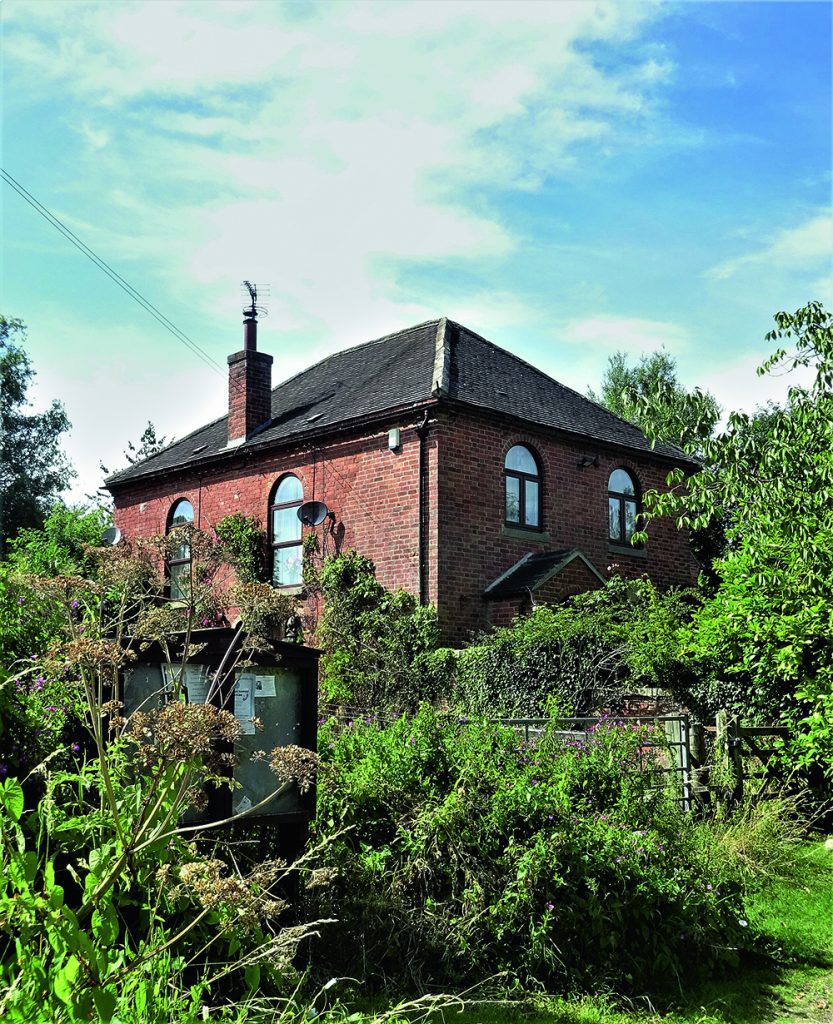
by Maxwell & Carole Craven Having basked in the remoteness and sequestered lanes of Harehill and Muselane, we were much tempted to stay in that wonderfully pastoral and semi-wooded landscape that lies well west of Derby but close to the south western edge of the county. Hence, last August, we ventured between Shirley and Yeaveley in order to re-acquaint ourselves with the delights of Rodsley which Pevsner appears to have forgotten entirely. I suppose that academic 1950s tourist probably got into mental over-load when it came to relatively unremarkable rural brick buildings, but they never cease to delight us and there are gems to be sought. We approached the hamlet from Yeaveley, where we had been doing some research for a privately commissioned history of the Meynells, and travelled east along Rodsley Lane. You should not be misled, however, for almost every road in Rodsley is called Rodsley Lane, for that upon which we were travelling eventually arrives at a cross-roads in the centre of the settlement, from which you can turn left (up Rodsley Lane) to end up in Wyaston, or right, (down Rodsley Lane) which will lead you to Park Lane and eventually to Long Lane, just east of Alkmonton. If you were to go straight across, however, you will actually be entering Shirely Lane which, needless to say, gets you, fairly rapidly, to Shirley. At this juncture a little background might be in order. In 1066, a Saxon freeholder called Brun (Brown in modern parlance) held what subsequently became the manorial estate at Rodsley, although a small portion of the land had earlier been bestowed on the Abbey of Burton as a parcel of the vast manor of Mickleover. Brun clearly failed to survive the Conquest as, in 1086, when Domesday Book was compiled, a Norman called John was holding it, lording it over no less than six villagers and a couple of smallholders. He also had land in Osleston further east. This John appears to be identifiable with (or possibly father of) the John de Turbeville of Rodsley who endowed both the Abbey of Burton and Tutbury Priory with parcels of his land during Henry I’s reign and held a knight’s fee there – that is, enough land to be able to equip and feed a mounted knight (probably himself) for service with the crown. His probable son, another John de Turbeville, died without any surviving children before 1166, when the estate passed to Robert son of William de Alfreton of Alfreton, from whose family it later passed to the Montgomerys of Cubley and thence to the Vernons of Sudbury, who held on to much of the estate until 5th Lord Vernon sold Rodsley to the Cokes of Longford, in which parish the village actually lay. Hence the lords of the manor always had a principal manor house elsewhere, so there was never such a thing in Rodsley, nor consequently, did these lords ever appear to have founded a church. We do not get much of a picture of Rodsley again until the 1664 hearth tax assessment, when we find that every householder – fourteen – in the village had only one (taxable) hearth except Christopher Pegge, who had three but was taxed on only two of them. Christopher Pegge is referred to as ‘Mister’ in the return, and was thus minor local gentry and indeed, was a member of the Pegge family of Yeldersley. Therefore, going towards the village, the first building we encountered was the charmingly named Three Pots Cottage, end-on to the road on the north side. It had been one of Rodsley’s two pubs in the 19th century (and before) – called the Three Pots – although the origin of name seemed to us impenetrable; it certainly was not heraldic, which was my first thought. It was run by a William Mansfield in 1827, but soon passed to the Ratcliff family, who obviously also had worries about the name for, between 1835 and 1846, they re-named it the New Inn, although it had reverted to the Three Pots by 1857, only to become the New Inn again by 1864 but, by the end of the century, it was calling itself the Old Three Pots. It seems not to have survived the first decade of the 20th century, however and was gone by 1908. As the delightful twin range 18th century brick cottage lies a good way outside the village centre and near nowhere in particular, I cannot say we were surprised! Three quarters of a mile further on and one once again encounters some buildings, part of the appropriately named Corner Farm, the entrance of which is set on the NW angle of the cross roads, which here manifests itself. As we approached the crossroads, we saw a long low brick barn on our left, to which is affixed, near its east end, a cast iron plaque erected by the Sherwin Society in 1976 to mark the canonisation of locally-born Catholic martyr, St. Ralph Sherwin in 1970. Ralph Sherwin was born in 1550, younger son of John Sherwin of Rodsley, farmer, and was educated at Eton as a scholar from 1563, which establishes that John Sherwin was no mere peasant farmer. His wife’s brother was John Woodward, rector of Ingatestone, Essex, who was the appointee of local grandee Sir William Petre and the latter clearly helped Ralph to obtain a fellowship at Exeter College, Oxford, after which he converted, went to Douai, was ordained and then on to Rome, after which he was one of a group of young missionary priests sent to re-evangelise England, but was arrested tried and executed in December 1580. His ministry had lasted hardly six months. We were by no means clear which of the farms clustered round the crossroads had been that worked by John Sherwin, but certainly the family was still in the village in 1666, when the saint’s great-nephew, another John died, leaving the poor of the parish £1 yearly out of
The Lost Houses of Derbyshire – Rose Hill, Chesterfield

by Maxwell Craven The publication in 2019 of Chesterfield Streets and Houses by Philip Riden and Chris Leteve throws much fascinating and detailed light on the history of the built environment of Chesterfield, although is a little light on architectural history and evaluation. Yet, when it comes to the early history of Rose Hill, a substantial villa on the western edge of Chesterfield, it fails to address the early history of this important house, which is a shame: however, Country Images to the rescue! Rose Hill stood on rising ground facing south on the norther side of West Bars and indeed, we looked at the history and fate of West House, adjacent, in Country Images some time ago – in September 2019. Indeed, the array of impressive residences there are well encapsulated in the view painted by George Pickering in 1812 (now in the care of Chesterfield library) where they can be seen in their prime with the crooked spire away to the right. The story of Rose Hill begins with Henry Thornhill (1708-1790), fourth son of John Thornhill, who had inherited the Stanton-in-Peak estate through Henry‘s mother Anne Bache, along with extensive lead mining and other interests. Henry was the son (there were many) who showed real flair for carrying on the family tradition in the lead trade. He was set up by his father at the age of twenty as a lead smelter in Chesterfield and it was he who took these enterprises on. Henry not only made a great success of them but pioneered considerable expansion of the family’s interests elsewhere, as well as eventually taking on the Pleasley Vale estate and founding the mills there that gave us Vyella and similar formerly well-known products. Around 1735, Henry took himself off to live in Chesterfield. Indeed, he eventually remained in residence there long enough to have become an alderman of the town and, on the basis of that, a member of the Chesterfield bench. He also served twice as Mayor, in 1750 and 1755. As Chesterfield was the prime lead trading centre in Derbyshire and on the route from the Derbyshire mining areas to Bawtry in Nottinghamshire, where the lead pigs were transhipped onto Trent barges, it was a natural choice of base for the ambitious trader. We also know where Thornhill lived in Chesterfield, for the house, latterly known as Rose Hill, is recorded as having been ‘built by the Thornhills in the 1730s.’ This is re-inforced by the mention of Henry in a deed of 1744 as ‘of Brickhouse in Chesterfield, Gent.’ As Rose Hill was indeed brick, the identification would appear to be secure, although the subsequent destruction of the house seems to have been reflected in the loss of any papers relating to it. In fact, a deed of 1736 reveals that Henry had obtained a mortgage of £330 – 14s – 9d from his wife’s uncle, Alexander Holden of Newark, which suggests that this was to fund the building of his new house. A final clue in the Thornhill records is a lease from the Mayor and Aldermen of Chesterfield of the site of Rose Hill for twenty years at £9 per annum dated 20th March 1735, later converted into a freehold. The lessee was one George Sims (1693-1761), a joiner and builder, acting as Henry Thornhill’s agent, and who was indeed contracted to build his house on the site. Knowing what the house at this period looked like is difficult as no view of it is known. According to some accounts of the house after it was rebuilt, the entrance front was more like that of neighbouring West House – pedimented, with more ornate detailing: quoins and architrave surrounds to the windows – which sounds like an arrangement more closely matching the traditional date for the house of the mid-1730s. Nevertheless, not only does the name ‘Brickhouse’ confirm the basis for the old story – unlikely to be strictly true – that Rose Hill was in its day the first substantial brick house in the town, but also confirms its distinctive name when first built. Indeed, the first reference to the house as Rose Hill (the name of the eminence on which it stood) only occurs in the mid-19th century. To the north of the house was a large quadrangular stable block, and the parkland stretched away west to the municipal boundary. After being constrained by business pressures to leave Chesterfield in around 1761, Henry retained the house as a town residence as well as for the use of his nephew Bache Thornhill of Stanton Hall. However, it was let in the 1770s to Robert Lowndes, by which time it was called The Mansion House. Lowndes, who had been involved with Thornhill in a number of lead-centred transactions, was married to the heiress of Richard Milnes, the second son of James Milnes of Chesterfield, a member of the Ashover branch of that family. It was Lowndes who rebuilt Rose Hill in the plain neo-classical style seen on the garden front, the only aspect of which illustrations are known, which, once rebuilt, was of five well-proportioned bays and two and a half storeys, under a hipped roof. The house was of brick with sparing stone dressings and was beautifully proportioned, the windows having rubbed gauged brick lintels, but was largely devoid of ornament. The only decoration was provided by a plat band below the sill band on the first floor with balustrading below the first floor windows between them; even the cornice was plain. Inside, sales particulars of 1851 inform us that there were four reception rooms on the ground floor (probably drawing room, dining room, library/study and breakfast room) and four bedrooms (three with dressing rooms) on the first floor with further bedrooms above in the attic storey. The date of these works is unknown but they were certainly in place ‘by 1779.’ The architect is not known, but what we see in the surviving views and given the urbanity
The Wreck of Flying Fortress ‘Over Exposed’
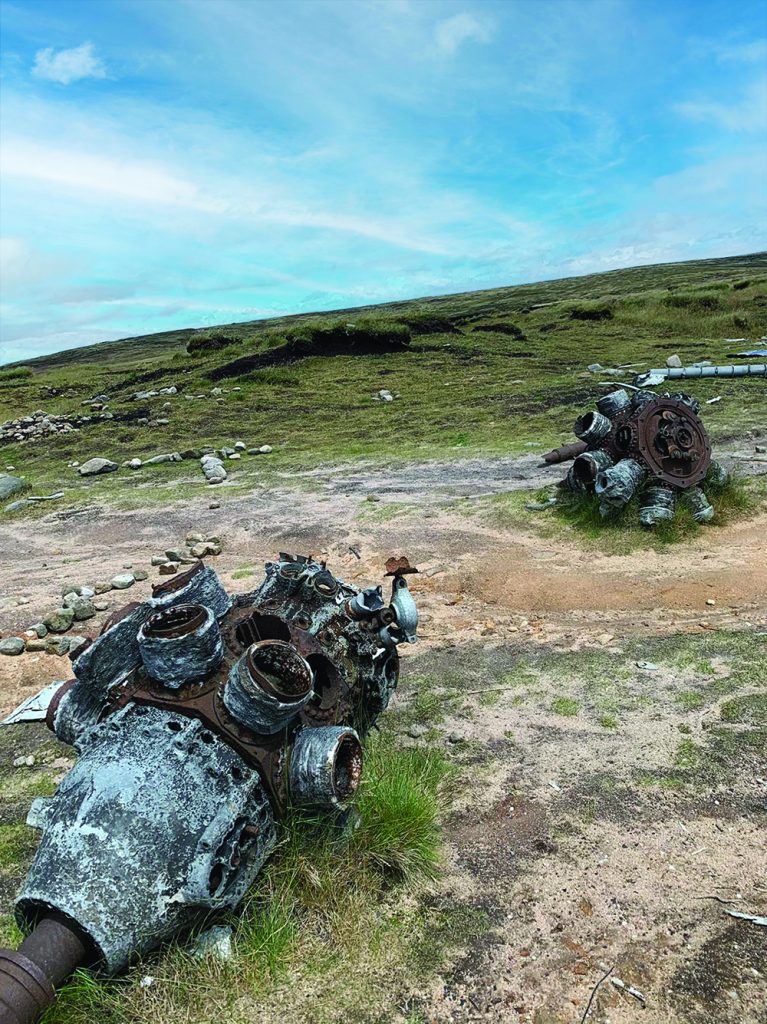
by Brian Spencer Pennine Way walkers almost at the southern end of their epic trek from Edale to Kirk Yetholm look on the crossing of Bleaklow as almost the end of the first day’s section of the ‘Way’. Grateful to enjoy a spell of comparatively easy walking on a path made from flagstones, the walker, if they know the part of Bleaklow where they are, spare a few minutes to make a diversion. About a mile west in the direction of Glossop, Shelf Stones, is a 621 metre high ridge, an unforgiving couple of metres below the moorland crest, the ground is littered with the remains of aircraft wreckage. Closer investigation by those with keen eyesight will spot items stamped with U.S. military reference data. This is all that remains of a U.S. Flying Fortress, once affectionately known as Over Exposed by those who flew in her. Built by Boeing and officially known by its manufacturer’s reference as RB-29A-4-44, she weighed 55,000 lbs fully loaded (36lbbs net), and was powered by four massive rotary engines, two on each wing. First flown in July 1946, she entered military service too late for the actual World War 2 fighting, but was converted to carry photographic personnel and their equipment after joining the 16th reconnaissance Group’s 311st Air Division, photographing the first atomic bomb test, on Bikini Athol, and also took part in the Berlin airlift when the city was effectively held to ransom. Based at Burtonwood American air base near Warrington, Over Exposed ended its working days carrying a team of seven trainee photographers as well as its crew. Weather as we know only too well is, in late autumn, usually damp and misty with poor visibility. The navigator was forced to plan a route by instruments alone, but with all the flight crew fully trained and experienced, the crew and passengers were fully confident of their ability to carry out their planned task. The task they were set was first to fly to Scampton RAF base in Lincolnshire in order to pick up money for the wages of colleagues (and themselves) at their base. This they managed quite easily, leaving Scampton at around 10:15 on 3rd November 1948 in order to give the photographers and navigator’s experience of route finding, probably over hilly country in poor visibility, so a complex cross country flight plan was lodged. This involved changing the route in order to fly west over the highest ground in the District, then flying due west, gradually descending over Glossop and south Manchester to Burtonwood airbase. The navigational task the crew had to answer first involved descending as low as possible in order to get beneath the low clouds. Fortunately the navigator and pilots had the help of scientific instruments to help them find the way, but it is at this point that things went wrong. Was it instrument error? If so it eventually caused the disaster, or maybe sheer carelessness? What ever happened will never be known, the instruments were up-to-date and the navigators experienced. All that is known is that Over Exposed though old in years was flying just a metre or so too low in order to clear the summit of Shelf Stones, almost a matter of inches between life and death. AFTER THE CRASH On the fateful morning of 3rd November 1948 an RAF Search & Rescue team operating from their base at Harpur Hill near Buxton happened to be involved in a training exercise on Kinder Scout. The team arrived at the summit of the Snake Pass at around 4:30 p.m, and despite thick mist, they were able to pin-point the position of Over Exposed crashed on Shelf Stones. Using the summit of the Snake Road as a base they quickly headed for the apparent site of the crash on Shelf Stones. Despite the fairly quick time it took to reach the accident site, as it was readily marked by burning parts of the fuselage; the easiest recognisable item was the tail fin. Only badly distorted remains of crew members were found and the macabre job of carrying them to the Snake Road and eventual identification. The aircraft was found to be carrying about $7400, mainly in paper currency which had surprisingly managed to survive the crash and subsequent fire. All of the money down to the last few dollars was recovered by American Military Police. Immediately after the accident, a large section of the main fuselage was easily recognisable and in fact for several years became a simple bothy providing accommodation for hardy souls intent on spending the night on Bleaklow. Unfortunately less careful visitors no longer look after it so well and, together with vandals, and trophy seekers, very little remains of the original wreckage. However, an attempt has been made to preserve the memory of those who flew on Over Exposed on that fateful day. They are, commemorated on a named military-style grave stone, the centre piece of an annual service at the site. Super Fortress Over Exposed crew and passengers commemorated at the crash site on Shelf Stones Moor. Much of the wreckage of Flying Fortress Over Exposed and items connected to it can still be recognised by those with appropriate training, especially parts of the four turbo-engines, but should be left for future archaeologists to examine. In total there are seven wrecks dating from 1939 to 1956 scattered around Bleaklow and associated moors and are mostly the final resting place of those who flew over the wild moors. Please do not remove any items from the wreck sites without permission. 00
Win Tickets to the Festival of Food & Drink at Thoresby Park.

00
Dining Out – The White Horse at Woolley Moor

Set in what can only be described as the most stunning Derbyshire scenery, with rolling hills and verdant grasslands, The White Horse with rooms combines all this with excellent food. Owned for the last 17 years by David and Melanie, they have gradually developed this lovely old Inn into, in my opinion, one of the best relaxed places to eat in Derbyshire, earning along the way consecutive AA rosettes. 8 beautifully appointed rooms make the most of the setting and snuggle under a roof of wildflowers. This is a lovely place for a short break. But we were here to dine. The atmosphere here is both relaxed and friendly as well as being efficient. Sitting in the comfortable leather sofa by the log burner, we ordered drinks while we made our selections from the menu. The team of experienced chefs led by head chef Daniel Orwin, each bring their own favourite dishes to the menu which means it is varied and innovative. It offers nibbles, starters, mains and a grill section, which changes with the season. Wedges of warm bread with salted and pesto butter arrived to nibble on just providing a relaxed and sociable start. Persuading my husband to be a little more adventurous than usual, he ordered sticky, chilli beef with Asian slaw to start and enthused over the spicy strips of beef in tempura batter, the sweet sauce and fresh slaw a great balance. For me it was the mushroom arancini sitting in a rich lemon and chive beurre blanc, a crisp outer shell and perfectly cooked mushroom risotto within. What is there not to love! From the Specials Menu, it was the right time of year for my husband to choose the oven roasted lamb rump and lamb shoulder served shredded and encased in rich pastry, accompanied by a selection of fresh seasonal vegetables. A lamb jus brought all the flavours together with the added depth of ‘hen of the wood’ mushrooms, much prized by chefs for their meaty texture as well as their health properties. A dish with loads of flavour and perfect on a wet, cold and windy evening. My preference was for a fish dish, and I found the oven roasted plaice was white, succulent and flaky. The scallop mouse was very subtle, and the crisp Palma ham added a saltiness. A lighter dish with a rich sauce. We had taken our time over the meal enjoying each mouthful and taking the time to chat and enjoy the evening after the rush of the day. Consequently, we had room for deserts which were imaginative and seasonal, just as we would expect from these accomplished chefs. My choice was the Raspberry sorbet, a clean fresh note to finish on. My husbands egg custard with rhubarb sorbet was a modern take on a traditional dish and was proving very popular. I find recently that I’m too often disappointed by the food when we have an evening out, and it’s the company I enjoy most. However our meal at the White Horse was delightful and I can honestly say each dish delivered everything it promised…… the company wasn’t bad either! Our thanks to David, Melanie and their team for a thoroughly enjoyable evening, and over the years for providing such a consistently good place to enjoy an evening out. You may also be pleased as I was, to learn that a lunchtime menu is now available, just right for a midweek treat. Head to their website for up-to-date details. www.the whitehorsewoolleymoor.co.uk 00
Walk Derbyshire – A Walk Through Upper Lathkill Dale

It was while I put the final bits and pieces to April – Monyash edition and, mentioning in the text that it starts and finishes in Monyash, it struck me that there is another of my favourites also starting from Monyash old market square. It is only a little under four miles, but it leads to one of the Peak District’s prettiest dales, Lathkill Dale. Over the years, this dale has become one of my favourites and can be tacked on to any number of walks radiating from Monyash, such as the one I am about to describe. It is strictly in two halves, an upper and lower along Lathkill Dale, with the upper having the furthest views. This walk like the Monyash/Flagg walk, can form a figure-of-eight, radiating from the market square and back. In total, when combined with April’s walk to Flagg, the combined distance is just under nine miles. Although further than most of my walks published in Country Images, it should be well within the capabilities of the average fit walker on a day when the sun shines and all the wild flowers are in bloom. There are three main features worth adding to the description of features seen along the way. The first is noted soon after leaving Monyash, where Peakland lead mining history can be traced from the records of Monyash Barmote Court. (The late C.H. Millington from Monyash, was the last of Peakland independent miners). The mass of narrow, stone-walled fields indicate that the land hereabouts was being tilled by Saxon settlers long before the Romans came this way, in their insatiable quest for lead. The turning point of the walk is One Ash Grange farm. It was once a monastic outpost, so far from the parent monastery that it was frequently used as a kind of penitentiary for mis-behaving monks. Water was and still is a rare commodity on the limestone uplands. It is partly cured by allowing rain water to be collected in dew ponds, and in man-made duck ponds on top of the clay bearing areas around Monyash. Finally there is the beauty of Lathkill Dale as it winds towards the dale’s upper exit. USEFULINFORMATION: A 3.75 (6km) mile gentle walk on grassy paths with occasional loose stony sections. RECOMMENDED MAP: Outdoor Leisure Sheet 24 1:25000: Scale 1:25000. White Peak Area. PUBLIC TRANSPORT:Bakewell to Monyash Services PARKING:Jack Mere Public Car Park (Free) REFRESHMENTS:Bull’s Head The Old Smithy Café THE WALK The walk starts at Jack Mere Car Park; 100yds round the corner from the Old Smithy Cafe. With the ancient Market Cross on your left, walk towards the staggered cross roads. Cross over the junction and continue ahead. Ignoring side roads, continue forwards with Fere Mere, the largest man made pond on your left. Walk on past mainly fairly modern houses to your left and right, past groups of houses covering the village’s years of development. When the road turns sharp right, go forward on to a cart track, following it towards a series of fields denoted by dry stone walls. Cross their boundaries stone stiles, or through field gates. Notice the dew pond about 60 yards on your right beyond the start of this section. When the cart track makes a sharp left turn cross a stile and go forwards to where a stile ahead in the wall marks the end of the farm track. Using stiles to mark the correct route, follow the path beside the wall, to your left and keep right beside a series of field boundaries until it reaches another dew pond. Keeping to your right of a boundary wall, go towards a series of farm buildings, usually containing spring lambs in the early part of the year. PLEASE REMEMBER TO KEEP DOGS UNDER TIGHT CONTROL, EVEN THOSE ON LEADS. Keeping to the left of the mainly stone farm buildings, go forwards past an ancient stone pig sty still in excellent state of maintenance. At the end of the last farm building, climb down a flight of stone steps let into the wall. Continue forwards, downhill on a grassy path. The stream in the narrow dale runs down Cales Dale. Do not cross the side stream, but turn left to continue walking downhill to reach a rocky outcrop guarding a rough path down to a footbridge. This is the River Lathkill. It issues from a cave about150 yards on your left. The way is marked by a narrow footpath and this is your route towards the top of Lathkill Dale. Cross a wooden footbridge over the narrow River Lathkill and turn left to continue the walk along a narrow rocky path that will lead to the valley head. Remains of lead mining activity can be found on and around the dale’s tree covered hillsides. Mainly small exploratory holes, there was once a mis-guided attempt to mine for gold lower down the dale. But the major source of any interesting remains can be found clustered around an abandoned aqueduct built to carry water about half a mile along the dale side. A curved wooden bridge reaches the ruins of the mine manager’s cottage. It was built on the east side of the dale and also built to disguise a unique water pump beneath the kitchen. Unfortunately the kitchen floor was not strong enough to bear the weight of the manager’s wife who much to her annoyance disappeared into the depths. The narrow spike of rock spire towering to your right is where the Reverend Robert Lomas, vicar of Monyash fell from his horse to his death in 1776. Amidst the remains of lead mining activity, the section of dale to be walked through has been designated as a Nature Reserve. It seems to specialise in flowers and shrubs that enjoy the conditions found in countryside based on the dry rocky, sun trapping limestone based conditions. Rare flowers only found in these conditions, such as the startling blue Jacob’s Ladder growing in the dry open
Celebrity Interview – Ruby Wax
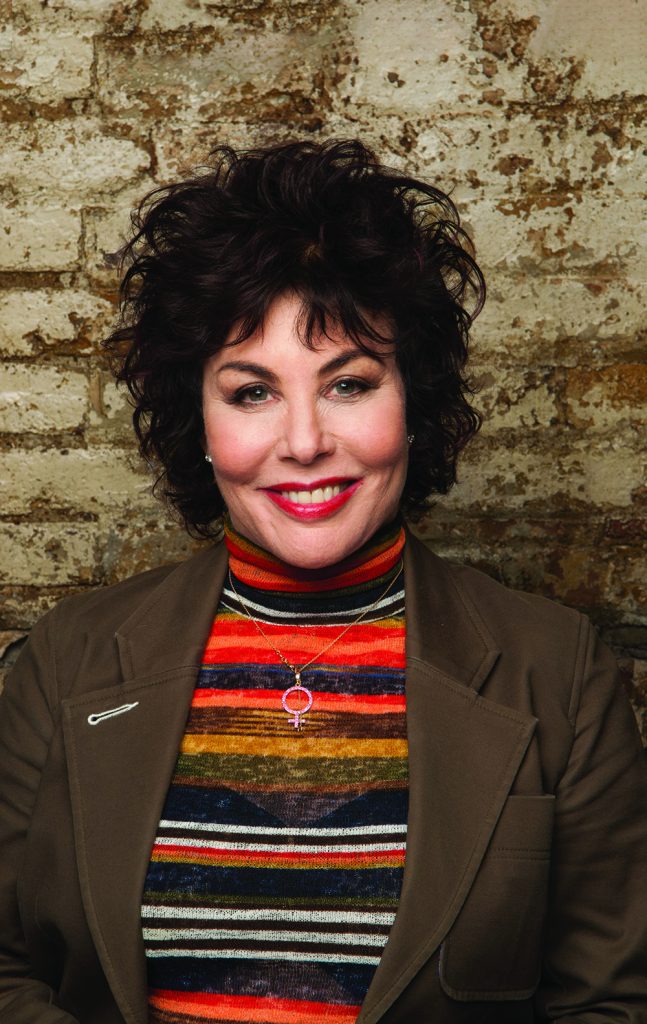
By Steve Orme You probably know Ruby Wax as a brash, forthright, no-holds-barred American comedian. You might not know she has also acted with the Royal Shakespeare Company, toured the world filming television documentaries – and has on two occasions spent time in a psychiatric clinic. Ruby has documented her latest stay in a mental institution in her book I’m Not As Well As I Thought I Was which is out in paperback. She has also turned her experience into a stage show which she will be performing in both Nottingham and Derby. She admits she found the process difficult. “(The stage show) can’t be similar to the book because it has to have movement and it has to stay snappy. You’re getting a theatrical version. It’s like watching any show. It’s very beautiful and it works. You take a journey with me rather than reading about it.” Some comedians these days look to unusual material for their live shows. January’s Country Images interviewee Ed Byrne’s show Tragedy Plus Time is about the death of his brother. So, I ask Ruby, can a show about mental health be funny? “I don’t do tragedy and I’ve done this kind of show for maybe 30 years. I don’t use something like death – I use my mental state and if that’s not good, it’s not good. But it’s always a springboard for people saying ‘oh that’s like me, that’s my story’.” Ruby Wax OBE was born Ruby Wachs on 19 April 1953 and was raised in Evanston, a suburb of Chicago. Her parents Edward and Berthe were Austrian Jews who left Vienna in 1938 to escape the Nazis. Her father changed the spelling of the family surname when they arrived in Illinois. She majored in psychology at the University of California, Berkeley but left after a year without completing her degree. She moved to the UK and studied at the Royal Scottish Academy of Music and Drama in Glasgow. When she joined the Royal Shakespeare Company she appeared alongside acting legend Alan Rickman. “He said you’d better start doing comedy because you’re a cr*p actress!” recalls Ruby who agreed with him. “My skin felt really uncomfortable, especially with an English accent.” So why did she want to go into acting? “It was a fantasy. Every child wants to be maybe not a classical actress but they want to be famous. I wanted to do Shakespeare. But it was an illusion.” She took Rickman’s advice, auditioned for the BBC and appeared in an episode of the satirical TV show Not The Nine O’Clock News. That led to her appearing in the ITV sitcom Girls On Top. She played loud-mouthed, gaudily dressed American actress Shelley DuPont and appeared with Dawn French and Jennifer Saunders. Ruby wrote the scripts with Dawn and Jennifer and later became script editor on their biggest hit Absolutely Fabulous. Her career changed direction again when BBC bosses decided she should present documentaries. “I did Louis Theroux-type documentaries before Louis. I interviewed snake handlers, women who sold their ex on the internet, I did Russia during Glasnost – really interesting. They let me do what I wanted. And then they said do celebrities which was never as satisfying.” She interviewed everyone from Donald Trump to First Lady of the Philippines Imelda Marcos, OJ Simpson to Madonna. She cites Carrie Fisher who played Princess Leia in the original Star Wars films as the best person she interviewed. “She was really smart and we became friends. It was a great relationship. If someone’s really funny or witty, then I pick it up.” But throughout her career Ruby has suffered from depression. She didn’t realise she was going through mental health problems until she was pregnant with her third child. “The doctor mentioned it and I was surprised. I wasn’t expecting that.” In I’m Not As Well As I Thought I Was, Ruby explains she had a difficult relationship with her parents. Her mother was “disappointed that I wasn’t beautiful and didn’t have a model-like figure” while her father “told people he only sent me to drama school because it cost less than having me committed to a mental institution”. She describes a session with a psychiatrist who proclaims she was never taught by her parents that she was valuable in her own right. “It’s not a guide to how to be a great parent,” says Ruby. “They just shouted a lot and tried to punish me like the way you train a dog. They thought that was right. They didn’t know any better.” Ruby says she didn’t find it difficult writing about her second visit to a psychiatric hospital. “I was really good at recording what happened because I can’t make up stories. I don’t have fiction at my fingertips. I wrote it pretty quickly after I got out.” Her first incarceration in a mental health clinic left her with “a depression the size of South America”. It took her five months to recover. Twelve years later she sought help again and “the veil of doom” seemed to be lifting after five weeks. She says in the book: “I’ve spent a lifetime creating a ‘front’ to give the illusion that all is well. It wasn’t and it isn’t.” She agrees that it’s a common problem: “I think everybody has a front. We show that everything is okay. Otherwise it would be a mess. It’s just that when you work with famous people you get a bigger front and you want to defend yourself against possible criticism.” Ruby has been fascinated with mental illness since she was young and discovered she came from a long line of mentally ill relatives. She has been open about her struggles with bipolar disorder and depression, making an online series on mental health issues for the BBC and working with mental health charities. In 2015 she was appointed an OBE for services to mental health. When I ask whether enough is being done these days to tackle