Dining Out – Meynell Langley Garden Centre & Tea Rooms

Meynell Langley gardens is one of an increasingly rare genre of plant nurseries. If you’re looking for gifts or ornaments, silk flowers or garden fairies then you are going to be sorely disappointed. Turning off the busy Ashbourne to Derby road you immediately enter the calming green countryside of south Derbyshire. Winding country lanes soon lead you to the sign directing you down a tree lined unmade lane at the bottom of which high red brick walls, a feature of this area, surround glass houses and nursery beds in what once was Meynell Hall’s kitchen gardens. But here the nostalgia ends as the plants which fill and overflow the garden are mostly grown on site and encompass many of the new disease resistant varieties being developed. The trial gardens which are open over the summer months are resplendent with their vivid colours and blousy blooms. Adapting to our quickly changing climate is a constant challenge, so you can see the success of newly developed varieties. Key too is the advice, freely offered by staff and family members who are very much hands on and can be easily found. On a personal note, over the years we have planted an orchard with a selection of old and new varieties of fruit trees, all purchased from here following the sound advice of Robert and his team. They are all thriving and provide food and shelter for wildlife as well as apple pies and jams for our own table. One newer feature is the cafe, efficiently run by Karen, with its rustic charm where in the winter a wood burning stove ticks quietly away at one end. Light lunches are served, and on our recent visit we enjoyed the homemade mushroom soup. The ploughman’s lunch had pickled yellow beetroot and sweet onion pickle to accompany two generous portions of cheese and pork pie. Seasonal salads and coleslaw are served too with paninis, baked potatoes, quiche and lasagnes. Most of the dishes are homemade and contain ingredients grown on site. The array of cakes is mouth-watering, again all homemade, a particular favourite of mine is the apple and coconut slice although it’s truly hard to choose a favourite. A visit to Meynell Langley gardens is a real pleasure, to be surrounded by so many wonderful plants, shrubs and trees…..and lunch at the cafe after is, well “icing on the cake“ as they say! 00
A Century In The Making – The Grand Unveiling of the Restored ‘Bluebird’ Tram at Crich Tramway Village”

There was quite a hush as the doors to the conservation shed were slid open at an event for special guests and Tramway Museum Society (TMS) members on Friday 13th September 2024 at Crich Tramway Village. Ten years of hard work was about to be revealed. It’s amazing how nostalgia sparks such interest in a fast modern world where technology causes us to rush about, and yet here is a form of transport with a maximum speed of 30 mph and creditable acceleration rate of 3.5 feet per second crammed full of people excited to share in its 100 year history. Twelve years ago a budget was predicted as the cost of restoring London County Council (LCC) No. 1 tramcar ‘Bluebird’. As she rolled out fully restored the budget had been exceeded by only 3%. If only other projects around the country came in at that sort of price HS2 would have reached Carlisle by now! A testimony I feel, to true forecasting and those who work hard to keep tight reign on a budget knowing that exceeding it would result in an unfinished project. No corners have been cut. Skill, graft and careful sourcing of materials plus a workforce dedicated to the cause resulted in the tramcar gracing the tracks ready for all to enjoy at Crich tramway museum. With opening speeches singing the praises of all concerned and a handing over of the key ceremony complete, it was time for all to enjoy a ride. The quality workmanship was immediately visible with the shiny new paintwork and plush upholstery. The ride afforded great views of the surrounding countryside from angles not always appreciated by car. When we hit the end of the tracks it was time to turn round and face the other way for the return journey. We turned, not the tram! Up we jumped pulled the back of our seat back and sat down again. Simple, no expensive turntable and the driver gets to go to the other end. The sunny day made it all the more enjoyable as everyone wandered around in and out of the museum, jumping on another tram for a trip or having a drink and a spot of lunch at the Red Lion. Whilst having lunch I managed to get a chat with 87 year old Eric Smith, a born traveller who goes to Brussels three times a year even though wheelchair bound and who had travelled from Leeds for the day to enjoy the experience of riding on a tramcar that he was privileged to be conductor on in the early 50’s. He was a lovely man who had thoroughly enjoyed his trip into nostalgia. It was a most enjoyable day and, for anyone who hasn’t made it yet, put it on your to do list. Now it’s over to the experts to tell you the story of this lovely old tram, here is its story… London County CouncilNo. 1 (aka Bluebird) Launch at Crich Tramway Village. After ten years and a cost of around £500,000, London County Council (LCC) No. 1 tramcar ‘Bluebird’ was launched. The restoration of the tram links firmly to the Tramway Museum’s core purposes to “share, inspire and educate through telling the story of tramways.” The tramcar was initially launched in London, on 5 May 1932 and was formally designated as LCC No. 1 entering service one month later, on 10 June 1932. The press reviews heralded “A tramcar revolution” and spoke of “Rolls-Royce” levels of passenger comfort. One of the most distinctive features of the new tramcar was its striking royal blue and ivory livery, which accentuated its streamlined appearance and set it apart from the rest of the LCC fleet and which led to it acquiring the nickname ‘Bluebird’. Within five years the tramcar itself had lost its distinctive livery and the days of all tramcars in London were limited following the London Passenger Transport Board’s (LPTB) adoption of a policy of tramway abandonment. LCC No. 1 was sent to Leeds in June 1951, and entered service as Leeds 301 on 1 December of that year, operating from Chapeltown Depot. It had cost Leeds £500 to buy, with a further £300 being spent on overhaul costs. According to Eric Smith, the son of Tom Smith who served on the Leeds Transport Committee, Victor Matterface personally negotiated the transfer of LCC No. 1 in lieu of the fire-damaged Feltham tramcars. Had Matterface not intervened and arranged for LCC No. 1 to enjoy a new lease of life in Leeds it may not have survived. Records from London Transport reveal that LCC No. 1 was placed along with 529 other redundant tramcars on a list sent to the scrap trade with a quoted scrap value of £61. In 1957, 301 departed Leeds and returned to London. In 1959 it was moved from Charlton Works to Clapham and in 1963 moved to the large exhibits section of the Museum of British Transport at Clapham. In 1972 London Transport decided to donate the tramcar to the Tramway Museum Society, so in December 1972, LCC No. 1 was transferred to Crich. London County Council Tramways Trust (LCCTT), a registered Charity whose objective as set out in the Trust Deed is “to educate the public in the history of tramways and the technical details, engineering and performance of such transport” asked the Tramway Museum Society to consider restoring the tramcar to its original condition, focusing on the tramcar’s period of operation from July 1932 – July 1933. They had started fundraising for the restoration, and eventually had raised the money, which the Tramway Museum Society had originally anticipated it would cost to complete. On Saturday 14 June 2014, after 18 months of preparation, tramcar moves, programming, research, and allocation of resources, London County Council No. 1 made its much-anticipated move into the Conservation Workshop at the National Tramway Museum, and the physical restoration of the tramcar to operational condition officially commenced. In March 1978, LCC No. 1
The Lost Houses of Derbyshire – Grangefields, Trusley
Grangefields lies in the northern part of the parish of Trusley and has a long history going back to the compilation of the Domesday Book in 1086, and maybe before, for it lies only a quarter of a mile south of Long Lane, the alignment of the Roman Road from Derventio (Little Chester) to Salinae (Middlewich, Cheshire) via the fort at Chesterton, Staffs. A Roman villa has never been identified in Derbyshire, but if one ever was, a gentle south facing, well-drained slope is the most likely place and the area of Long Lane is a promising one. Whether Grangefields was on or near one has yet to be ascertained, but it would not surprise me if one day such a villa did turn up nearby. Thus, in 1086, both the manorial estates at Trusley had been bestowed on a great lord, Henry de Ferrers, who made a man called Hugh his hereditary tenant of both there. Later charters establish that Hugh’s full name was Hugh le Arbalaster. The name derives from arcuballista a Latin term for a crossbow, which rather suggests that Hugh might have acquired this name from his day-job, so to speak, as a leader of a group of crossbow-men. It would be fun to think that he was wielding one at the battle of Hastings and that Trusley was his reward! Hugh had a son called Serlo, who adopted the surname of Beaufei (spelt in a number of confusing ways), indicating that, whatever Hugh had been up to at Hastings, he probably hailed from the small Norman settlement of Beaufai, Département de l’Orne, not far from the Mesnil, in Normandy. Serlo’s great grandson, Robert de Beaufei, started granting pieces of land to various monastic houses, a habit which his like-named son continued. Between them, the two Roberts made grants to the Abbeys of Croxden, and Burton in Staffordshire, the Priory of St. Mary de Pratis in Derby and the Knights of St. John of Jerusalem at Yeaveley. These were nearly all made from the northern part of Trusley, from just one of the two manorial estates, that away from the village, manor and church, and all between the 1260s and 1290. Indeed, this part of Trusley seems to have originally had its own name, Thurmundesley, as a pair of early charters make clear. This derives from the old Norse personal name ‘Thormund’ + leah = ‘ley’, a meadow or clearing. It would probably have mutated to ‘Thurmandsley’, ‘Thurmsley’ or even ‘Thursley’ today. This may be a clue, indeed as to which of the two men holding Trusley in 1066 had this part of the settlement, for as Ulfketel is also a Norse name, it would be tempting to think of him as Thormund’s descendant or heir, and that Thormund himself must have arrived long before, cleared the land and settled. It was the Cistercian monks of Croxden Abbey, however, who were granted the site of Grangefields, part of a 40-acre gift made by the younger Robert de Beaufei in 1180 and topped up with further land later. Here they established or took over a farm. Sometimes, monks were sent to work such farms, which were called ‘granges’, but more usually lay families were given the tenancies. In time, therefore, the place became known, not as Thurmundesley, but Grangefields, just as a nearby holding granted to the Nuns of Kings Mead Priory in Derby, gradually came to be called ‘the meadow of the nuns of Trusely’, eventually Nunsfield. Certainly, the name Grangefields was recorded (as Graungefeld) in the documents relating the dissolution of Croxden Abbey in 1538. The land and farm at Grangefield was assessed in value by King Henry VIII’s bean-counters at £4 – 6s – 3d (£4.33) – worth £1,817.10 in today’s values, or three cows, or 143 days’ wages in 1538. Thus, Grangefields was acquired speculatively by Dr. Thomas Leigh and William Cavendish (later to become the second husband of Bess of Hardwick) on 17th September 1538 to be assessed, the price fixed and offered for sale. The tenant at the time was William Glossop, of a Wirksworth family and when the estate was sold on in 1545 to Robert Fitch, he appears to have been left in place. Indeed, the sparse surviving records suggest that the Glossops continued as tenants before buying the freehold some time between 1571 and 1598. He did not keep it long though, for he sold it on again first to Edward Kynnersley of Brailsford and then to Francis Curzon a younger son of Francis, of Kedleston. However, at some stage, Francis Curzon seems to have decided to sell it on yet again and it would appear that Robert Glossop, or his father, had become wealthy enough to buy the farm, for Robert was in possession in 1600 when, on 26th October, he mortgaged it to raise money. Unfortunately, whatever Robert needed the money for, the mortgage appears to have been foreclosed with the result that it passed by 1608 to John Gregson ‘yeoman’ of Sutton-on-the-Hill who immediately sold it on to Robert Hope. Unfortunately, not much is known of the family, but Robert was born to Charles Hope at Etwall, not only did Robert Hope buy the estate, but he also appears to have built a fine new house, or more probably, rebuilt the late medieval house which he acquired, adding a crosswing and generally modifying the building, producing an irregular but delightful timber façade. It was described by William Woolley in 1713 as ‘,,, a pretty private seat formerly a grange belonging to Croxden Abbey’, whilst Stephen Bagshaw added, ‘it is a long, half-timbered building having many gables.’ The only comparable house locally are perhaps the earlier West Broughton Old Hall or the slightly later and more symmetrical Wakelyn Old Hall at Hilton. The house fortunately lasted into the age of photography (by a whisker) being the subject of the Calotype photograph which may have been taken by photographic pioneer W. H. Fox-Talbot, who was married
Walk Derbyshire – A Wander With An Ogston View

This has got to be one of our favourite walks which we discovered just coming out of lockdown. It takes in the beautiful views over Ogston Reservoir. You also get a bit of height on this walk so the view down the hills at one or two points is pretty stunning. Ogston Reservoir is owned by Severn Trent Water and is a Site of Special Scientific Interest. There is a public hide overlooking the reservoir in the West Bank Car Park. Ogston Reservoir is known for its sailing club and many twitchers come here to view the vast array of migrating birds. You can’t actually walk all the way around the reservoir directly, but there are some beautiful places to walk and where you can take in the views, it really is idyllic and so is a firm favourite. Ogston Sailing Club is worth checking out as they have paddle-boarding sessions and social sailing sessions, so take a look at their website for more details. The walk starts from the West Bank Car Park at the reservoir. It is a moderate walk but after we have had a downpour, you will find you definitely need wellies to go through the farmers field as it can be very muddy – also they sometimes have the cows in one specific field so please be aware and extremely cautious when walking with dogs. THE ROUTE There is free parking in the West Bank car park, then walk back towards the entrance and follow the road straight up ahead. Don’t go around to the right but straight up and you will see a house. Follow the track to the right and walk to the top of the track where you will already start to take in the views. Follow this up until you get to the farm in front of you and go straight through the gate, keeping to the right. The footpath is clearly signed so be respectful of the livestock and property. This can be the very muddy field in wet conditions. Go straight ahead and over the stile at the other side. Follow to the left of the field and it will eventually bend right. Follow this till you see a stile heading left through another field. Walk diagonally through the field and you will eventually come to a metal gate where you can go over the stile. You will walk through a garden with a house on the right. Keep walking and you will end up on the road, White Carr Lane. Be careful as it is a little narrow here. Turn right at the end of the drive. Follow the road to the right and up the hill. At the top of the hill you will see a footpath sign to your left which looks like you are going up someone’s drive. This is the correct way! All the way to the top and through the gate. Carry on a little and take time to take in the panoramic views!! Be careful underfoot as you pass through this next field as it does slant a bit to the right and we don’t want any roly-poly’s down the hill. Keep going till you end up on the road. Turn right here and continue to the T-Junction. Here we go left and walk down the road, keeping your eye open for a track on the right which is past the place which currently has a yurt on the land. Go down the lane all the way and keep following the lane– it is really straight forward. You head into the woods here so be careful underfoot. Upon the clearing keep heading along the footpath and you will eventually come out onto the Dark Lane. You should recognise where you are now. Go across the road and follow the road to the car park on your left hand side. THE DETAILS Parking: There is free parking in the West Bank car park. Pubs: The White Horse at Wolley Moor is a fantastic pub that servers great food and real, local ales. Distance: Short =3.5 miles, 6k Time: Short = 1hr 30min Terrain: Moderate, a couple of steep hills to climb, but well worth it for the amazing views. 00
Celebrity Interview – Fairground Attraction
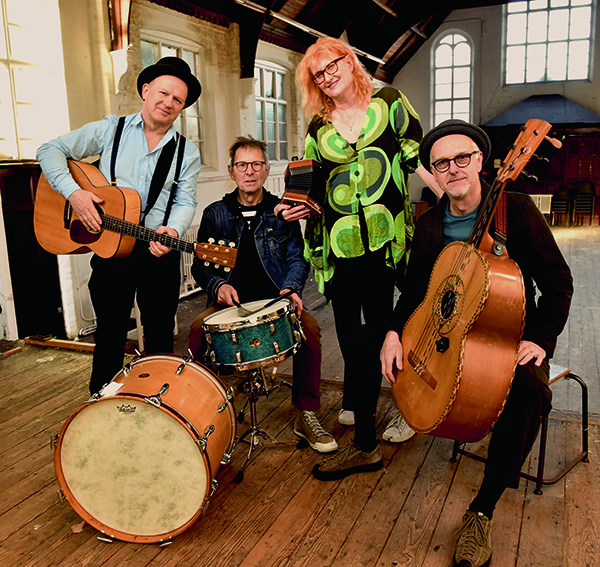
by Steve Orme Thirty-five years after splitting up, the four original members of the group Fairground Attraction are back together – and they reckon they’ve still got their unique sound which propelled them to the top of the charts. The band had a stratospheric rise to fame in the late 1980s. Their first single Perfect became a UK number one and won best single at the 1989 Brit Awards. Their debut studio album, The First of a Million Kisses, got to number two and picked up best album at the same awards ceremony. They don’t agree on why they went their separate ways. There were reportedly arguments before the band’s guitarist and producer Mark Nevin abandoned a recording session for their second LP. But now Mark, singer Eddi Reader, Simon Edwards who plays guitarrón – a Mexican acoustic bass guitar – and drummer Roy Dodds are preparing to release a new album which they will be promoting on a UK tour which will stop off in Nottingham. Eddi and Mark took time out to tell me they had no regrets about splitting up, their hopes for the band’s future and why their music is still popular. Born in Glasgow, Eddi who is 65 and has had a successful solo career since leaving Fairground explained why the group split up around 1990. “It was definitely ‘this isn’t working. We’re not aligning together.’ There was no way either of us had the skills to figure it out. “The music was the most important thing, so honouring that while you’re young is really difficult. It’s great now because we can honour what it was and look at what’s new about it too. “I’m noticing that the old songs, when we play them, they’re just timeless pieces of work .” Mark who appears to be the driving force behind Fairground Attraction and writes most of their material puts their music into perspective. “We were very conscious when we made the (first) record to make sure we didn’t use any sound that would date. So there are no synthesisers, there’s nothing that was of the era. Everything was classic in the sense that it was acoustic. There were natural instruments, Eddi’s amazing voice and songs with proper, traditional values. We really did prove ourselves correct in that decision because it is timeless.” Another reason Fairground Attraction were successful was that they wouldn’t put up with any interference from their record company RCA. “They wanted to provide us with producers,” says Eddi “but we’re actually pig-headed in our artistry. Both of us.” “We said if it’s not pure, forget it,” adds Mark. “Their producer would have made us sound modern. We had to fight them. “We played the music and recorded it as purely as possible. The song Perfect is us playing live. The actual record is just the second take.” Two years ago the four members of Fairground got together in Mark’s kitchen and they soon rekindled the spark that had made the band such an attraction. “We just played together and suddenly it was there,” says Mark. “It’s got a unique sound. It was like when you pour some hot water into a Cup A Soup and it comes to life.” Eddi experienced a difference in that session: “Something unconsciously happened to my physical approach which was nothing to do with my head. It was like someone had turned a key inside me. Everybody in that kitchen changed my physiology.” All the songs on the new album Beautiful Happening have been penned by Mark apart from two which he co-wrote. So where does he get his songs from? “I find them in the garden like mushrooms. There are songs floating around everywhere. For some reason early on I didn’t know how to catch them. “In a way I’m like a radio receiver. I turn it on to the right frequency and music comes. It’s not from me – I’m just the receiver.” The music business has changed considerably since Fairground released their first LP. They’ve been able to record their new album without a record company behind them – but it’s meant so much work for Mark. “You have to become a full-time executive, manager and all these things, so you’re doing about 40 people’s jobs. It’s very hard work day in day out to make this a reality and get the things done in time.” Eddi has had a varied career since leaving Fairground. At one stage she recorded an album of material by Robert Burns with the Royal Scottish National Orchestra. She was awarded an MBE for services to singing in 2006. She has had a strained relationship with record companies and cites an example of a festival she played in Australia. “There were 5,000 people in front of me and every one wanted to buy a record. But the distributor had only sent 20 copies which soon sold out! That’s what we as artists had to deal with for years. They didn’t have any love for what you were doing.” Mark called in a few favours to make new videos of the band because they didn’t have a budget. One of the videos was made by John Sorapure, director of photography on blockbuster films including Paddington and Barbie. “He happens to be an old friend of mine who lives around the corner. So he did that video of us for nothing.” Eddi jumps in with her assessment of the band’s current standing: “We’re doing this off our own back but we’ve also got this heritage. We’ve got a foot in the door. “I’ve been touring for 35 years and a lot of people who come to my (solo) shows will come to see the band. There’ll be extra people that’ll come who remember just the Fairground Attraction album. “There’ll be people coming back with their daughters and sisters and friends. And then there’ll be people who are older than us. My mother’s coming to the Glasgow gig.” The re-formed band
The Lost Houses of Derbyshire – Ockbrook Manor
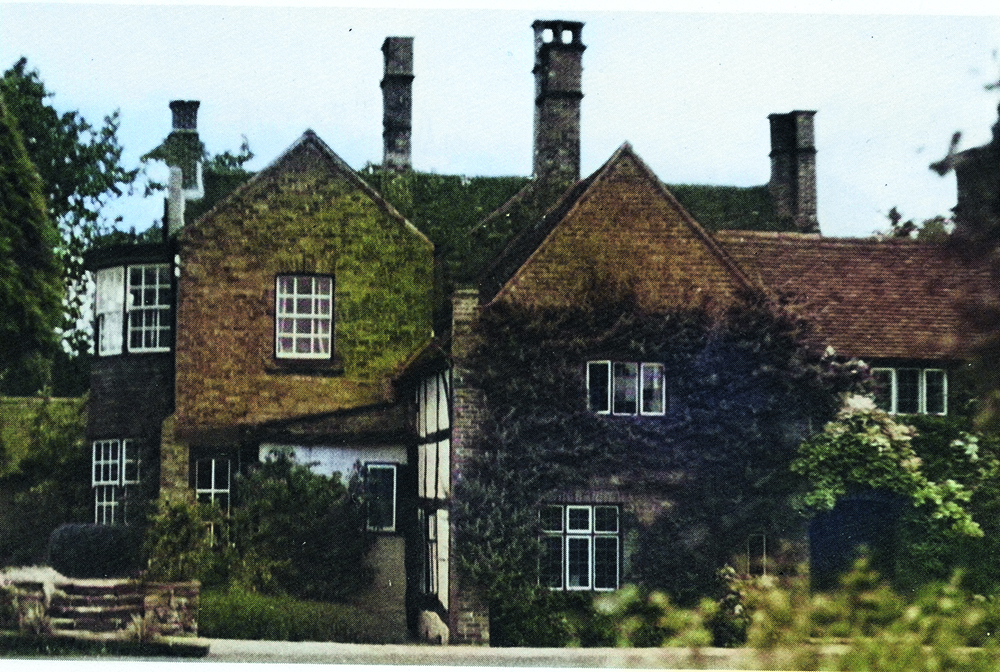
by Maxwell Craven Ockbrook Manor was a wonderful old house which one could only describe as ‘multi-period’ having, seemingly a portion of its fabric from virtually every post-modern era. The other thing is, that by being called ‘Manor’, one might assume that it was the capital mansion of an estate going back well into the Medieval period, yet that is not quite true either. It is well known that Ockbrook was granted by William I to Geoffrey Hanselin, from whom the estate had passed, by 1290, to Hugh, 1st Lord Bardolph, whose son was recorded as having a park there. The Lords Bardolph lived at Wormegay in Norfolk as their principal seat, but the fact that they had a park presumably suggests that they used Ockbrook as a hunting lodge. At some stage, too, much of the land had been granted by the Hanselins to Dale Abbey. In 1358 John, 3rd Lord Bardolph, sold the manorial rights and his Dale tenancy to Sir Godfrey Foljambe of Tideswell, whose seat and prolific lead interests remained in the north of the county. This suggests that any hunting lodge at Ockbrook was either abandoned or let, either to a bailiff or to a sub-tenant, although any such detail remains elusive. The Foljambes’ estates passed eventually to Yorkshire grandee Sir William Plumpton, who died in 1481 from whom Ockbrook came to Sir Thomas Seymour. He sold it to Sir Andrew Windsor, created 1st Lord Windsor (ancestor of the present Earl of Plymouth) and in due time, Frederick, 4th Lord Windsor, succeeding to the family estates in 1559, sold the manorial rights to the resident freeholders of the village. Meanwhile, when Dale Abbey was dissolved in 1536, their land at Ockbrook was acquired by Francis Pole of Langley whose posterity also sold it to the Stanhopes of Elvaston. The freeholders who bought the land and shares of the manor from Lord Windsor included several local families who remained in the village until the early 20th century: Battelle, Columbell, Piggen and Windley. The purchasers of the land on which stood the original manor house (and three shares of the manorial rights) were the Piggens, They almost certainly built the first residential capital mansion on the site – although whether their new house actually stood on the ancient site is impossible to tell – and a timber box-framed wing remained embedded in the fabric until the house was eventually demolished dated from this mid-Tudor period. The site was on the NE angle of the junction between Church Lane, The Riddings and Bare Lane, 150 yards due north of the church, a proximity that might suggest that it was indeed built on the ancient manorial site. We get an indication of the size of the house from the 1664 hearth tax record, which shows Richard Piggen assessed for tax on three hearths, which suggests something pretty modest: possibly there was still the great hall, open to the rafters with a large hearth, a parlour with chamber above providing the other two. Not long after Richard Piggen’s time, the house was rebuilt and enlarged by his successor in brick, two gabled two storey ranges being added to the SE front between which lay the front door. This probably led into the former great hall, which this rebuilding would have floored over to provide two chambers above it. The new gables were straight and coped with stone and included chimney shafts, latterly drafted by the addition of flat tops raided on stone slabs set on end, giving the skyline a distinct profile. In 1713 the Keys family of Hopwell Hall acquired Piggen’s three shares of the manorial estate and his land, and incorporated it into their Hopwell estate, and it then descended as a tenanted farm, first to Henry Thornhill and then to Sir Bibye Lake, Bt. who, in 1786, sold the estate to Thomas Pares, a rich Leicester tradesman. The Pares family were great improvers of their estate, and in the Regency period they rebuilt the old house to improve its viability. They added a short two storey service range and put in sashes where previously there were mullion and transom cross windows with casements, although they left the old timber framed wing alone bar up-grading the original mullioned casements. The reason for this up-grading was not so much to improve it as a farm house, but to make it suitable with a view to letting to Derby businessmen and gentlemen, keen to rent a villa as near as possible to Derby but far enough away from the rapidly increasing smoke and grime of Derby’s foundries. The first tenant, as it happens, was Bryan Thomas Balguy, the second son of John Balguy of Duffield Park (pronounced ‘bawgy’), a descendant of the Bulguys of Derwent Hall. The father had become an Alfreton coal-owner but was professionally a barrister and a very eminent judge. Bryan Thomas (1785-1857) was also a barrister and in 1818 was appointed Town Clerk of Derby and as a result, he built Field House Spondon (see Country Images June 2021) needing a house within striking distance of the Guildhall at Derby. Bryan Balguy married a young wife, Emma Broadhurst Portmore (who was born in Duffield in 1808) in London in 1827 when he was 42 and she was 19. It seems likely either that she disliked Spondon (how could she?) or she fell out with the locals, for he sold Field House in 1829 and moved to Ockbrook Manor, on which he took a long lease from, the Pares family, whose lawyer he (conveniently) was. He obviously missed the double Regency bowed façade of Field House, and promptly made alterations to the Manor, including on the SEW side – a full height Regency bow. He was obviously not satisfied with the three sashes to each bow fitted to his old house in Spondon, so at Ockbrook he crammed in five sashes per floor to the bow, dividing them with hung tiles, a very un-Derbyshire conceit
PREDATORS OFTHE OKAVANGO DELTA…Botswana
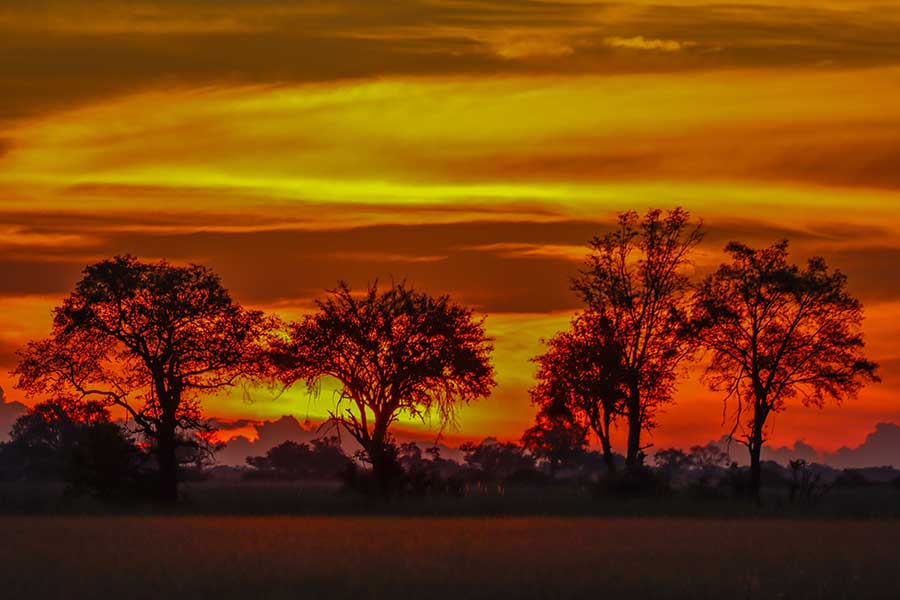
With Martins World Travel My last month’s article concentrated on the rich animal and bird life of this unique area of Africa. Now it’s time to divulge the incredible predators we viewed on the same trip, very close up and personal, with excellent guides to ensure our safety. Guides at our remote lodges and camps are renowned for their professionalism and knowledge. They understand the Okavango like no other and can quickly predict the moods of the rich wildlife which surrounds us… often just a few yards away. When viewing predators like lions, leopards and hyenas often so close you can smell them the best approach is in a purpose built 4×4 vehicle, open sided and open both front and back. A canvas roof acts as a sunshade. By keeping still and quiet when in the close company of lions and leopards these powerful predators appear to ignore the contents (us) ! And view the overall exterior as nothing of interest to them .. thankfully. We slowly approached a mature female leopard resting in a tree after consuming her previous nights kill. A reed buck was almost totally consumed, hung up in the same tree and well out of reach of the next predator down the chain… spotted hyenas. A vulture glided low overhead and she snarled in its direction just yards from us but about 12 feet up the sturdy tree. On another occasion we came across a huge older male lion that was resting next to a dead elephant. Our guide said the elephant would only recently have died of natural causes and the lion would feast on the carcasses for about 3 days. Lions like fresh meat and once it starts to smell as it rots quickly in the heat the lion will move on to find or take down fresher meat. This lion allowed us to approach very close and we filmed and photographed him as he laid on the ground with a bulging belly full of prime elephant meat and hardly able to move. When he chose to move away the hyenas, jackals and vultures would quickly move in and take their fill. Nothing is wasted in nature. On one of our morning “drives” we were covering various trails and bush that ranged from dense to open scrubland. We noticed a few zebra and giraffe feeding and suddenly their demeanour changed to one of apprehension. As they quickly moved out of the area two huge male lions moved purposely towards us coming as close as just a few feet. They appeared to be two fully mature brothers. The fact they hunted as a pair and very successfully too was confirmed by their stunning condition. The lead male had a thick black mane whilst his no less impressive companion had a lighter coloured mane. They walked right by us as if we did not exist and then settled down to rest in the shade of an acacia bush just a few yards from us. Cutting off trail through scrubland and the occasional termite mound and heading towards a thick patch of trees and bushes our guide spotted a young leopard, a 2 year old female, and she was obviously searching for a kill. She moved effortlessly and quietly through the vegetation stopping occasionally and marking her territory on her way. She passed very close to us emerging as if out of nowhere. Her coat was beautifully marked and she was in absolute prime condition. Our guide informed us that leopards would often lie on a tree branch waiting for prey, particularly the Marula Tree whose flowers attracted many an unwary antelope when the flowers dropped to the ground. A favourite food source but sometimes with deadly results. On our bush walks our guide always looked up towards the overhanging branches to ensure a hungry leopard was not lying in wait in search of its next meal. Our expert guide viewed a set of tracks that held his interest and we followed them along a trail to the point where they disappeared in the marsh grasses. He recognised the paw prints as Hyena tracks and slowly drove our vehicle over the scrub and towards an old termite mound that had dense vegetation around it. His sharp eyesight and vast knowledge had led us right up to the den of a Hyena family right on the edge of the marshes. An adult female emerged and wandered off in search of a meal and only a few moments later a young cub came out and looked around.. all the while viewing us with total indifference. Prey species are plentiful in and around the vast Okavango Delta an area covering up to 20,000 square kilometres when water levels reach their annual peak. Year round water is the key to why nature is so bountiful and even when the system slowly shrinks to a third of its size game and the predators that prey upon them are always here to be found. Warthogs can be very tough to tackle due to their speed, aggression and razor sharp tusks. They are often found in small family groups with mothers being highly dedicated to their numerous offspring. Their sociable disposition to each other belies their power and even leopards and lions are cautious about tackling adult warthogs. Warthogs have very sharp and dangerous tusks that can cause serious injury and even death to a careless predator. A cornered Warthog is a creature to be reckoned with. Various species of antelope form the main food for these stunning predators. Southern Reedbuck, Tsessebe, Red Lechwe, Impala, and the biggest being the Greater Kudu. Bigger game such as zebra and blue wildebeest roam from one grassy wetland to another and herds can number up to a hundred animals of all age ranges. Fit adult elephants are rarely taken down even by big male lions but the young are occasionally targeted. It is possible to see a solitary female with her calf but it is more
Walk Derbyshire – An Amble through Ashover
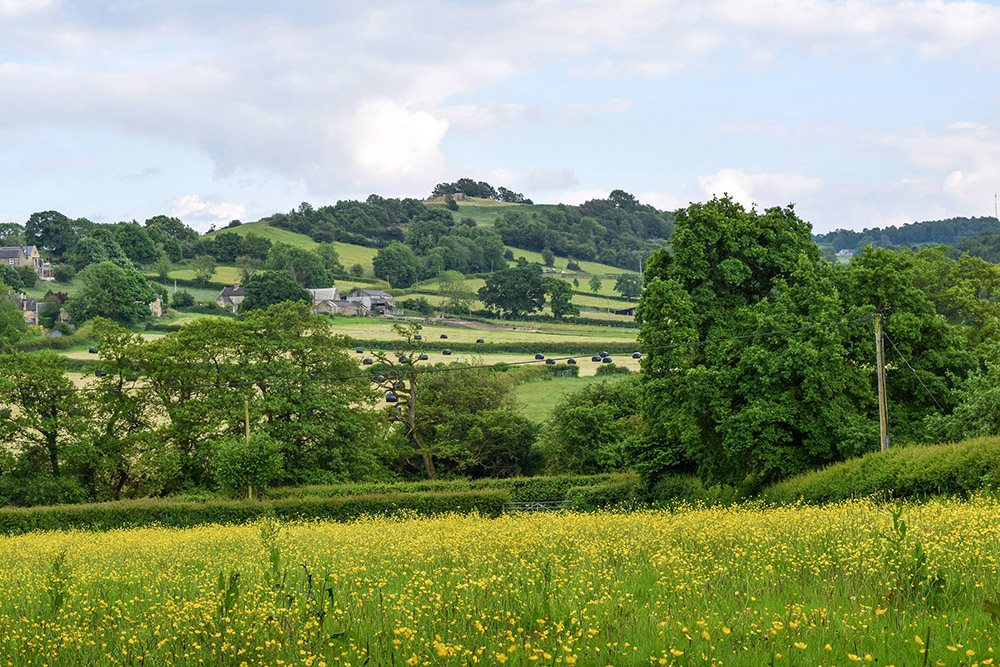
Set alongside the River Amber is the picturesque village of Ashover. Quaint cottages, stone houses and old pubs fill this favourite Derbyshire village of mine. It may take you a while to drive through the village as it is so pretty, with many cute cottages for you to stop and admire. Ashover has a truly rich history with quarries, lime kilns and lead mines. It holds All Saints Church dating from between 1350 and 1419 which was built by Thomas Babington. (One of his family members was executed for plotting against Elizabeth I). Ashover is also the home to the long standing Ashover Agricultural & Horticultural Show – this year’s show takes place on Wednesday August 14th. It is a great day out for all the family. In the village there are three pubs, a cafe, a cute coffee shop and gorgeous little village shop which sells gifts, cakes and ice cream (cash only!). There is a lovely cricket pitch with football goals, a nice children’s park and play area, and tennis courts, so plenty to occupy you. Adjacent to the cricket pitch is Ashover Parish Rooms now the Village Hall, which can be hired for weddings and events. There’s a plethora of walks in and around Ashover featuring stunning views, high vantage points, buttercup filled meadows and babbling brooks. You can see why this is a favourite for myself and many other walkers. USEFUL INFORMATION This walk is pretty easy to do. Takes just over an hour or longer if you are taking time to take in the beautiful scenery. We came through a field of cows with calves so please be careful if you have dogs. It’s a very peaceful walk which goes through fields, meadows, along the river and is easily shortened or extended. Near the end you pass 3 pubs so take your pick! Track with … https://www.outdooractive.com/en/route/hiking-route/central-england-and-the-midlands/drafted-on-2024-06-25/295370954/?share=%7Ezzgg3age%244osstcjj Parking… there is a free car park at the village hall and also plenty of spaces on the road (please park responsibly!) Pubs… three in the centre of the village. The Old Poets Corner, The Crispin Inn and The Black Swan. Distance – 4.35km Time – 1 hour-ish Terrain – Easy to moderate THE ROUTE Starting from facing the cricket pitch we walk to the bottom left hand corner to the small pavillion and follow the footpath to the left as it goes all the way through the fields, through the woods (where you will smell the wild garlic at the moment), till you hit a little junction in the path. Turn right through the gate and you will come to the Fall Hill quarry. Follow the path as this goes head straight onto Hockley Lane so please be careful! Head left on Hockley lane for a few yards where, on your right, you will see a footpath sign which looks like somebodies driveway but this is the footpath – honestly! Carry on down onto the road, don’t go down the bridleway. We are now walking alongside the River Amber and after 20 or so yards on Fallgate you will come to the SLOW sign on the road, here you will see an opening on your right which will take you along the river. Follow along the River Amber and then take the path to the right. This will go down a couple of steps and then up a couple more and through the trees. When you come out onto the lane you have an option of making this shorter by taking the bridle path to your right but this is a little treacherous underfoot, especially if it’s been bad weather. We are carrying on straight up Gin Lane in front of you. When you get to the fork in the road, take a right along the track which slowly makes its way uphill. Climb all the way to the top. You will pass Overton Hall on your right. You will come to a clearing with a path to the right. Take this. You will come to a small gate with the yellow footpath arrow. Take that and go down the stone steps – slippery when wet. Follow the stone steps to the bottom, you will go over a little bridge and following the path up Salter Lane eventually coming out onto Hockley Lane with Old Poets Corner on your left. Once you’ve had a swift pint at one of the pubs, follow straight up past the Black Swan on your left and continue around the corner till you see your car. Enjoy a pint at one of the pubs! 00
Celebrity Interview – Radio Derby’s Ian Skye

Few things in this rapidly changing technological world stay the same, especially in broadcasting where bosses are always trying to attract more and sometimes younger listeners. But there’s one constant for those who listen to BBC Radio Derby: the knowledgeable yet jovial voice of Ian Skye who’s been educating, informing and entertaining listeners for the past 13 years. After a busy mid-morning show Ian sat down with me to chat about his eventful career, how it almost went “spectacularly wrong”, what brought him to tears and the only time he’s been starstruck. Who affected him in that way? The answer may surprise you . . . Ian admits he went into radio entirely by accident. He wanted to act: “I loved acting, I did amateur dramatics which was probably the making of me because I was painfully shy as a kid. It gave me huge confidence.” He went to the University of Kent in Canterbury to study German and during freshers’ week attended a meeting of the drama society with the intention of joining. But the people there were unlike those he’d met in his previous amateur dramatics group. “It was horrible,” Ian remembers. “It was everything you imagine about pretentious dramatic types – it just wasn’t for me.” He wasn’t really interested in radio but went to the student radio station’s introductory meeting. “At the end they said if you’re interested in being an engineer, come out of this door, if you’re interested in being a presenter come out of another door. There was no other way out! “Somehow I ended up getting trained to be a presenter. I did a weekly rock show called The Delicate Sound Of Thunder after the live Pink Floyd album and rapidly fell in love with radio.” When Ian had been looking for advice about a career he was told he should be a stage manager or a civil servant. The truth was he didn’t have any clue what he was going to do and how he could use his degree in German. So he pursued his interest in radio, recorded a demo tape on cassette and sent copies of it to the programme director of every commercial radio station in the country. Radio Wyvern in Worcester which was actually Ian’s home station – he grew up in Lickey End near Bromsgrove – asked him to go in for a chat. “By the end of ‘come in for a chat’ it was ‘we’re going to give you a job, it’s going to be the most we’ve ever paid a presenter, we really like you, you’re going to do the Drivetime show in the afternoons and a Saturday morning shift and you’re on at four o’clock.” Not only was Ian amazed because he had only 40 minutes to prepare for his first programme but also because he was told to change his name. His real name is Wickens but his new bosses said Wickens wouldn’t work in a sung jingle. He liked the Isle of Skye, so Ian Skye was born. He stayed at Wyvern for a couple of years and had a “fantastic time”. Then he was offered some work on the Overnight Express – a sustaining service at night for the GWR group of commercial stations in the south west. It wasn’t a full-time job but he was also asked to present shows in Swindon, so he moved to Bristol. Kent, Newcastle, Teesside and other stations followed. “There’s not many corners of the country I’ve not been on the radio,” says Ian. He was doing the breakfast show on Century FM in Nottingham, which was broadcast across the East Midlands, “when it all went spectacularly wrong”. Ian is careful what he says because he believes a non-disclosure agreement is still in place. “They sacked me and my producer supposedly for a piece of audio that we played but actually it wasn’t. We took them to a tribunal. In the end they settled out of court. That’s the only time in my career when I’ve been out of work.” He returned to the airwaves with The Wolf in Wolverhampton, another station which was prepared to pay him more than they normally would for a breakfast presenter. “I had a fab year or two there. And then Kelvin MacKenzie (the former Sun editor and media executive) bought the company and it went a bit different.” At that time Ian found that presenting jobs in commercial radio were disappearing because stations were merging. And he didn’t like the way presenters were called on to become more like salesmen: “Predominantly you would have to do things like asking people who can’t really afford it to ring a premium rate phone number in the hope that they’ll win a car or something.” He’d always fancied getting into the BBC and was delighted when he was finally accepted. “The BBC was the best thing I ever did because I’ve learned a whole new skillset. They’ve trained me to be an interviewer, trained me to be a journalist. But you also have the freedom to exercise all the skills you learned over the years in commercial radio. It’s been a fabulous place to work.” But it hasn’t been without its problems. Just over a year ago members of the National Union of Journalists at Radio Derby and other parts of the BBC staged a 48-hour strike after the output was slashed and replaced by a number of regional programmes. That led to popular, long-serving presenters including Sally Pepper and Martyn Williams leaving the station. Ian is again cautious with his words about the change to more regional content: “I think it’s silly and it’s short-sighted but it is what it is. I don’t think it’s the best thing we could be offering and I hope it’ll get reversed at some point. “It was a tough time. We all had to reapply for our own jobs but you bite the bullet and you crack on
Derbyshire Villages – Rodsley
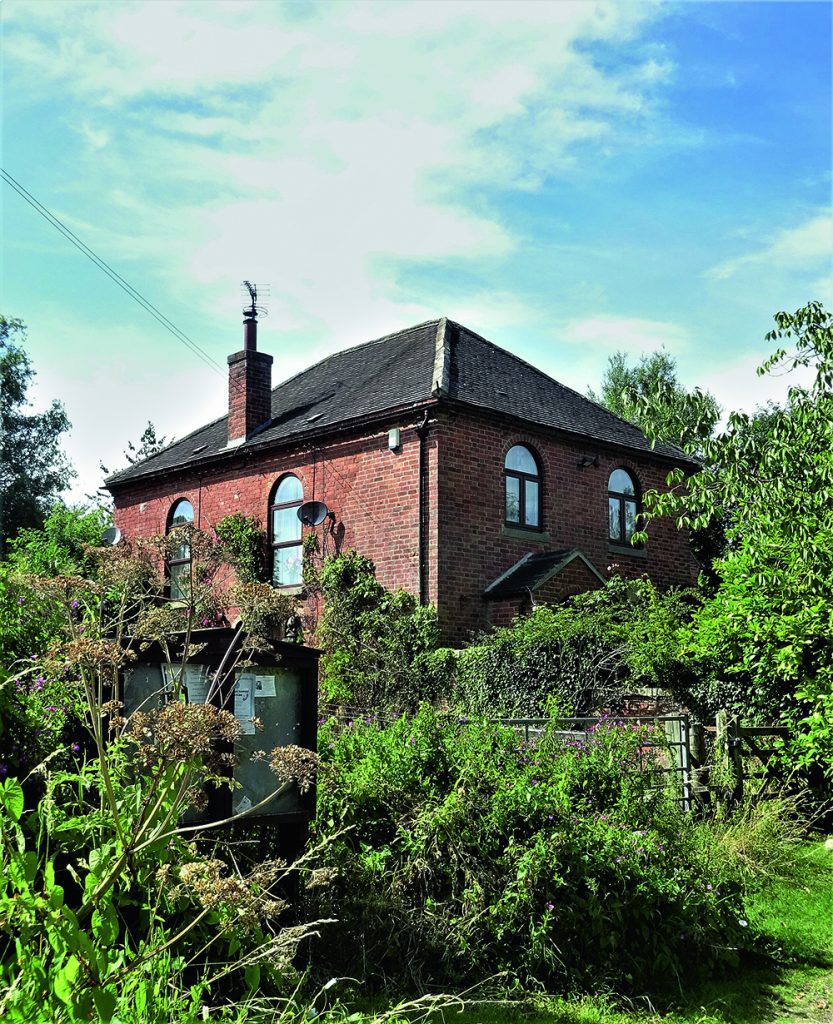
by Maxwell & Carole Craven Having basked in the remoteness and sequestered lanes of Harehill and Muselane, we were much tempted to stay in that wonderfully pastoral and semi-wooded landscape that lies well west of Derby but close to the south western edge of the county. Hence, last August, we ventured between Shirley and Yeaveley in order to re-acquaint ourselves with the delights of Rodsley which Pevsner appears to have forgotten entirely. I suppose that academic 1950s tourist probably got into mental over-load when it came to relatively unremarkable rural brick buildings, but they never cease to delight us and there are gems to be sought. We approached the hamlet from Yeaveley, where we had been doing some research for a privately commissioned history of the Meynells, and travelled east along Rodsley Lane. You should not be misled, however, for almost every road in Rodsley is called Rodsley Lane, for that upon which we were travelling eventually arrives at a cross-roads in the centre of the settlement, from which you can turn left (up Rodsley Lane) to end up in Wyaston, or right, (down Rodsley Lane) which will lead you to Park Lane and eventually to Long Lane, just east of Alkmonton. If you were to go straight across, however, you will actually be entering Shirely Lane which, needless to say, gets you, fairly rapidly, to Shirley. At this juncture a little background might be in order. In 1066, a Saxon freeholder called Brun (Brown in modern parlance) held what subsequently became the manorial estate at Rodsley, although a small portion of the land had earlier been bestowed on the Abbey of Burton as a parcel of the vast manor of Mickleover. Brun clearly failed to survive the Conquest as, in 1086, when Domesday Book was compiled, a Norman called John was holding it, lording it over no less than six villagers and a couple of smallholders. He also had land in Osleston further east. This John appears to be identifiable with (or possibly father of) the John de Turbeville of Rodsley who endowed both the Abbey of Burton and Tutbury Priory with parcels of his land during Henry I’s reign and held a knight’s fee there – that is, enough land to be able to equip and feed a mounted knight (probably himself) for service with the crown. His probable son, another John de Turbeville, died without any surviving children before 1166, when the estate passed to Robert son of William de Alfreton of Alfreton, from whose family it later passed to the Montgomerys of Cubley and thence to the Vernons of Sudbury, who held on to much of the estate until 5th Lord Vernon sold Rodsley to the Cokes of Longford, in which parish the village actually lay. Hence the lords of the manor always had a principal manor house elsewhere, so there was never such a thing in Rodsley, nor consequently, did these lords ever appear to have founded a church. We do not get much of a picture of Rodsley again until the 1664 hearth tax assessment, when we find that every householder – fourteen – in the village had only one (taxable) hearth except Christopher Pegge, who had three but was taxed on only two of them. Christopher Pegge is referred to as ‘Mister’ in the return, and was thus minor local gentry and indeed, was a member of the Pegge family of Yeldersley. Therefore, going towards the village, the first building we encountered was the charmingly named Three Pots Cottage, end-on to the road on the north side. It had been one of Rodsley’s two pubs in the 19th century (and before) – called the Three Pots – although the origin of name seemed to us impenetrable; it certainly was not heraldic, which was my first thought. It was run by a William Mansfield in 1827, but soon passed to the Ratcliff family, who obviously also had worries about the name for, between 1835 and 1846, they re-named it the New Inn, although it had reverted to the Three Pots by 1857, only to become the New Inn again by 1864 but, by the end of the century, it was calling itself the Old Three Pots. It seems not to have survived the first decade of the 20th century, however and was gone by 1908. As the delightful twin range 18th century brick cottage lies a good way outside the village centre and near nowhere in particular, I cannot say we were surprised! Three quarters of a mile further on and one once again encounters some buildings, part of the appropriately named Corner Farm, the entrance of which is set on the NW angle of the cross roads, which here manifests itself. As we approached the crossroads, we saw a long low brick barn on our left, to which is affixed, near its east end, a cast iron plaque erected by the Sherwin Society in 1976 to mark the canonisation of locally-born Catholic martyr, St. Ralph Sherwin in 1970. Ralph Sherwin was born in 1550, younger son of John Sherwin of Rodsley, farmer, and was educated at Eton as a scholar from 1563, which establishes that John Sherwin was no mere peasant farmer. His wife’s brother was John Woodward, rector of Ingatestone, Essex, who was the appointee of local grandee Sir William Petre and the latter clearly helped Ralph to obtain a fellowship at Exeter College, Oxford, after which he converted, went to Douai, was ordained and then on to Rome, after which he was one of a group of young missionary priests sent to re-evangelise England, but was arrested tried and executed in December 1580. His ministry had lasted hardly six months. We were by no means clear which of the farms clustered round the crossroads had been that worked by John Sherwin, but certainly the family was still in the village in 1666, when the saint’s great-nephew, another John died, leaving the poor of the parish £1 yearly out of