The Historic Core of Derby

by Maxwell Craven People often quite reasonably assume that Derby’s Market Place was the original historic core of the borough, but appearances can be deceptive. When King Edward the Elder founded the city as a defended settlement c. 928, the actual core was the area between the Cathedral and old St. Alkmund’s (now part of the inner ring road) with a grid of streets off Queen Street. Derby’s Market Place did not come on stream until about 1100, a fact established by archaeology in advance of the Assembly Rooms being built. It was host to stall holders and ringed by houses with selling spaces in front. The other fact that is not at first apparent, is that there was a road running from a crossing of the Trent at Swarkestone north, through the future site of Derby, to the Derwent by Darley which was in use at least from the Iron Age. The use of the Trent crossing is confirmed by finds of Roman coins along the course of the present Swarkestone Bridge. It was along this road that St. Alkmund’s was founded some two centuries before the city and along it were established most of the medieval churches, except St. Werburgh’s. Iron Gate is part of this ancient former trackway, and if you were to assume that it got its name from hosting the shops of iron mongers, you would be right. In the mid-13th century a Darley Abbey charter calls it (in Latin) ‘the street that leads from St. Mary’s Gate to the Market Place’ but in 1318 it was (again in Latin) ‘the street of the (iron)smiths’ and indeed there are records of iron smiths with premises there in the borough’s charters. All the streets were then exceedingly narrow but, in 1866, the council began a very long-running campaign to widen them and Iron Gate (the suffix ‘gate’ is from the Norse gaeta, meaning ‘street’) was the first, when all the properties on the east side (some very ancient) were bought up, demolished and the much-reduced plots sold off to finance the whole thing. This is why the oldest buildings of Iron Gate line the west side and those opposite are mid-Victorian or later. Meanwhile, the Market Place, by the early 14th century, was home to the first Guildhall, which stood in the middle, of two storeys: a lock-up for miscreants on the ground floor and a meeting room above reached by an outside staircase, much like that which survives at Aldburgh, Suffolk. Around it, the old shops gave way to grander houses, like that built by Bess of Hardwick’s fourth husband, Lord Shrewsbury, later rebuilt in the 1660s as Newcastle House by her grandson, but disastrously demolished, unrecognised, in 1970 to make room for the current Assembly Rooms. Needless to say, Market Place was the focus of a market from the time of the 1154 Royal Charter until some tidy-minded councillors in 1933 erected a new market area on The Morledge, leaving the entire space bereft of purpose. Prior to that though, there had been numerous improvements. In Charles II’s reign a block of buildings was erected facing the west side (traditionally called Market Head) which housed the meat market, known as The Shambles. To this, Samuel Crompton, the banker, in 1708 added a handsome arcaded block backing on to The Shambles facing east called The Piazzas, with warehousing above and shops at ground level. Here people could browse display windows under cover but – strangely enough – it never took on, and from lack of use was eventually demolished, along with The Shambles in 1871-77, to make more room for stalls. In 1731 the old Guildhall was replaced by a fine Georgian building by Richard Jackson, a Staffordshire architect who was then building Mr. Crompton’s House at The Friary. The council wanted to build it on the south side, where the present Guildhall stands, but the property owners were asking too much. It was only in 1828 that this could happen, which meant the demise of the eighteenth century guildhall and the building of a new one which, as luck would have it, burnt down rather spectacularly on the night of Trafalgar Day 1841, to be rapidly replaced (using the original ground floor and south elevation) by the present building, by Henry Duesbury. The Market Place was also, from 1763, home to the combined county and borough Assembly Rooms, removed respectively from Full Street and the Moot Hall in Iron Gate. Lord Ferrers, assisted by Joseph Pickford, built a sumptuous building fitted out by Robert Adam in 1774. That survived as the hub of local social life until damaged by a fire in 1963. It could have easily been repaired – today Historic England would have insisted on it – but the councillors, with grandiose ideas, destroyed it to make way for the present (and terminally empty after yet more fire damage of nine years ago) Assembly Rooms designed by Sir Hugh Casson. At any time from the laying out of the Market Place, you would have set out for Ashbourne by descending Sadler Gate, thence along Bold Lane and Willow Row to Ford Street where one could have crossed Markeaton Brook to reach Nuns’ Green (now Friar Gate) to Ashbourne. In the 13th century it really was a haven for leatherworks; Lawrence the Saddler was recorded there then and Potts the saddlers still had a shop there until the 1980s. Iron Gate was originally the width of Sadler Gate, but the latter was never widened. Indeed, it was 1971 before pressure from then newly-formed Derby Civic Society persuaded the Council to ban motor cars and pedestrianise it. Interestingly, although most of the frontages are 18th or early 19th century – essentially Georgian in style – the buildings behind are mainly much older; Derby thrift preserves many a 16th or 17th century building in Sadler Gate. Only the little shop opposite the end of the 1871-built Strand Arcade, with No. 46 (dated 1675) and
Walk Derbyshire – A Walk Between Monyash & Flagg

If you were living in the Peak District countryside around a hundred years ago, the chances are that you would be following a dual working schedule. Part of your working day would be tending the needs of a dairy herd and maybe carrying out a little ploughing and growing feed crops for those valuable cattle. The other and entirely unrelated occupation could be spent underground, frequently working alone with nothing to help see what was in nearby rocks, other than by candle power. Tools would be a simple pick and shovel. The last independent Peak District lead miner was the late C.H. Millington who lived in Monyash. The name Monyash frequently leads to much argument with pros and cons on two sides. There are those who say the name means ‘Many ash trees’, but the more widely read side disagree, saying the name should be based on Maneas, a title that seems to have been popular as far back as early records indicate. Apparently Maneas means ‘wet lands’ in Saxon, a fitting title for a village built on an ancient clay bed 5million years old. This clay deposit has allowed five ponds to provide drinking water for cattle, (plus one now in-filled as a car park). All those currently in use, are to the south of the village green, with Jack Mere to the north used for parking cars. Monyash is built around a small clusters of cottages and a network of popular footpaths leading into Lathkill Dale form a linked network of field paths where lead miners would plod their weary way home after working underground after a day, still having to tend their cattle, or mow hay for their winter feed. Monyash was an important centre covering a section of the underground riches. The village even had its own Barmote court, an ancient system governing lead mining disputes and transfers of mine ownership. The village church is dedicated to St Leonard and was probably founded on the site of outdoor meetings around a simple wooden cross in the twelfth century. Adjacent to it is the village school and a stone preaching cross stands in the centre of the village green. The village has a small, but well-designed public hall that stands beside the Bakewell road on the east side of the village. The Golden Lion Inn closed in the early part of the 20th century, leaving the Bull’s Head to offer food and drink, together with a café in the converted blacksmith’s smithy next door making a popular venue for walkers, motorcyclists and non-powered cyclists. The pub has always been known as the Bull’s Head, apart from a brief interlude when the landlord decided to change its name to The Hobbit. The change caused such an outrage that it had to revert to its old and trusted Bull’s Head title. The plinth for the village cross is marked by many small holes left by the blacksmith when he tested newly sharpened stone drills. The walk turns for home at Flagg a couple of miles to the North West, unfortunately it no longer has a pub, it closed a few years ago due to lack of custom in this comparatively sparsely populated district. Not enjoying the same size of water deposit, it does have sufficient issuing from underground which provides a supply for each house in the linear village, but little or none beyond. This is a linear village with its own manorial hall, but no longer can it manage to run a pub. While there are abandoned lead mines scattered around nearby fields, the village only supports two or three dairy farms. Many of the remaining dwellings have been modernised, giving the village a look of prosperity. As mentioned earlier, many of the surrounding fields were criss-crossed by farmers-come lead miners on their way to delve far below the surface. These paths are used on this walk, together with a couple of quiet back roads in order to follow this little used circular walk out to Flagg and back to Monyash. It should be easy to follow and makes an ideal walk when the spring flowers are coming into full bloom. Only a little over five miles of gentle meadow walking, it has the choice of two places of refreshment at the end of the walk. USEFULINFORMATION: A five mile (8km) easy walk, using well-made stiles to cross stone walls. RECOMMENDED MAP:Ordnance Survey Outdoor Leisure Sheet 24; 1:25000 Scale. The White Peak Area PUBLIC TRANSPORT:Bakewell to Monyash bus services PARKING:Jack Mere off road parking beside the Flagg road, REFRESHMENTS:Bull’s Head The Old Smithy Café THE WALK THE WALK THE WALK 1. The walk starts at Jack Mere Car Park (free parking) at the Monyash end of the Taddington and Flagg road. Walk northwards, away from Monyash village, to a road junction and then turn right at a signpost for about 30yds (46m). Cross over the stile on the left near the road junction (signposted to Taddington). Cross a series of meadows, using gates or stiles where necessary, closing all gates unless asked to do otherwise. Viewpoint. Look back towards the village. The church steeple is the focal point, but narrow strip fields, fossilised in their medieval plan, are all around. 2. Go to the right of a short belt of trees. Continue to cross boundary walls by their stiles. Reaching stiles to the left, cross a boundary wall as indicated by yellow arrows. Walk on as far as a track junction with the road. Start to walk gently uphill. Strips of mature woodland in the Peak District have a dual purpose. Not only do they provide windbreaks on the exposed upland, but their main purpose was to keep cattle away from poisonous lead waste left by mining activity 3. Cross the road and walk down the cart track. Ignore a waymarked path marked by numbers eight, diverging to the right, and continue uphill along the lane. Notice the heather growing on either side of the lane.
Celebrity Interview – Billy Ivory
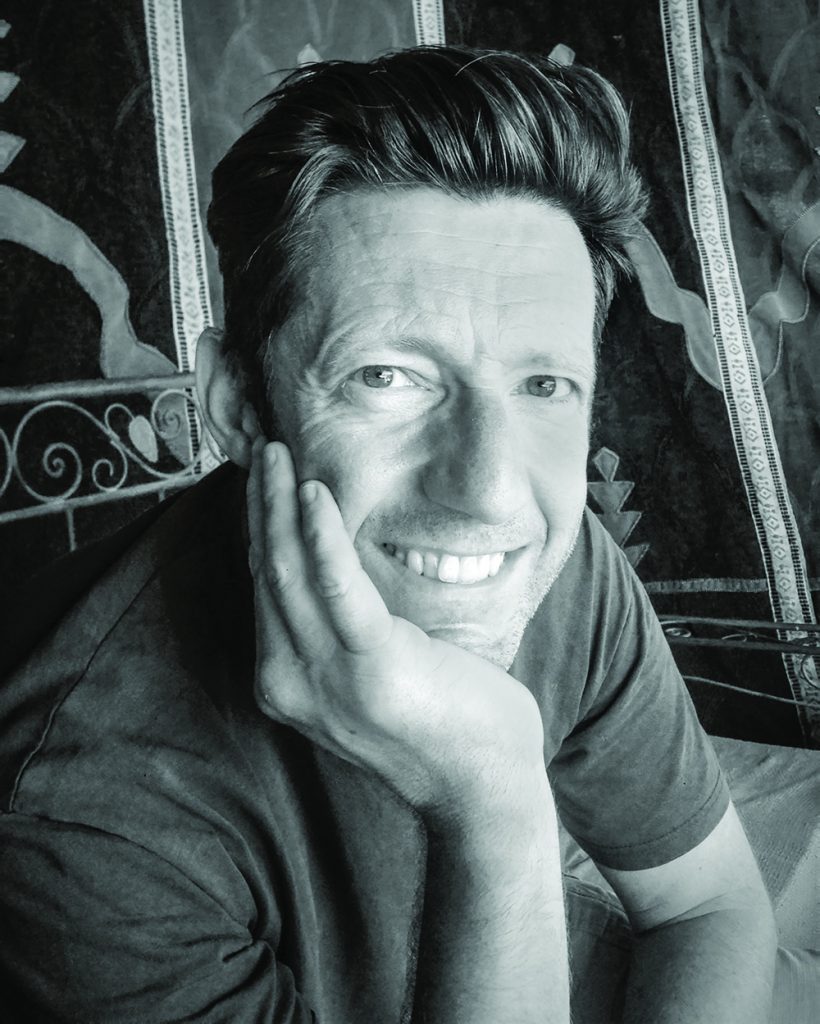
Imagine you’re writing a film and you’re asked who you would ideally like to play the two lead roles. That happened to Nottinghamshire-born screenwriter William Ivory on his last project and he had no hesitation: Michael Caine and Glenda Jackson. When approached both actors astonishingly said they wanted parts in The Great Escaper which was released last year. The film is based on the true story of 89-year-old British World War II Royal Navy veteran Bernard Jordan who “broke out” of his nursing home to attend the 70th anniversary D-Day commemorations in France in June 2014. William, also known as Billy, admits he was nervous about working with the two superstars: “It was a huge physical commitment to expect them to do it. We were all set to go and the producer rang me to say Michael’s back was bad and he couldn’t walk. Everything was off. “I was heartbroken. But then incredibly nearly a year later Michael rang up and said he’d had a back operation and was ready to go. He said ‘I want to make this film and I want to tell this story’. “By then Glenda had got other work but she said she could give us an eight-week window to film it. So we were back on, which was great.” It turned out to be the last time she would act on screen. She died last June. “Glenda saw the film and loved it,” says Billy. “It’s a heck of a thing to leave behind. She was the centre of the film which was terrific.” Working with such well-known names is nothing new for Billy. The first show he wrote for television, Common As Muck, a 1990s series about the lives of a crew of binmen, featured Edward Woodward, Tim Healey, Roy Hudd, June Whitfield and Paul Shane. His 2010 comedy drama film Made in Dagenham which dramatised a strike at the Ford car factory that called for equal pay for women starred Bob Hoskins, Miranda Richardson, Geraldine James and Rosamund Pike. And his 2013 TV film Burton And Taylor, based on acting duo Richard Burton and Elizabeth Taylor, boasted Helena Bonham Carter and Dominic West in the title roles. Billy reckons he found working with Michael Caine, “arguably our greatest film actor ever”, and Glenda Jackson an interesting process. “Michael was very funny because right from the start he said ‘it’s quite simple, Bill, I like to make them laugh or make them cry’. He’s extraordinary because he had some big speeches and he was going ‘nah, I don’t need all them words, I can do it with a look’. “You get a lot of younger actors saying ‘I’m a method actor, I’m doing this, I’m doing that.’ None of that with him – he just turned up, asked what lens was on the camera – he knew all the technical stuff – and then he’d just do it. He would inhabit the role so much that it became impossible to say to him ‘they wouldn’t do it like that, they wouldn’t say it like that’ because his reply would be ‘well, I just did’. Michael Caine described The Great Escaper as “the happiest picture I ever worked on”. He’s since announced he’s retired from films. Billy points out that Glenda Jackson was “incredible” but much more analytical. “On the first day she said to me the script says (her character) Rene is slumped on the sofa. I said she was nearly 90 and she wasn’t very well. Glenda said Rene was an ex-ballroom dancing champion and she wouldn’t slump. “She worked it out, she had her motivation and she delivered it beautifully. It was extraordinary. There are times when people do stuff and it’s just magical because you think you’ve rendered it in the most beautiful way or the most effective way and then they make it do a bit more.” William Ivory was born in 1964 in Southwell, Nottinghamshire to Bill, a journalist with the Nottingham Evening Post, and Edna. He always wanted to write and his plan was to get a university degree and become a lecturer so that he could write in his spare time. But he hated university, dropped out and became a dustman “which broke my mum’s heart”. But working on the bins around Nottinghamshire pit villages including Rainworth, Blidworth and Ollerton kept him fit. He told himself if he wanted to be taken seriously as a writer he had to send off examples of his work. Kenneth Alan Taylor had just taken over as artistic director at Nottingham Playhouse “and he was the first person to show me any encouragement. He said come in and we’ll talk about your work. “He said there was stuff he liked but it was nowhere near ready. I didn’t want to go back on the bins – winter was coming! I said ‘have you got any work here?’ He said not unless you can act. I said of course I can act, how hard can it be?” Billy got a part in a play called Me Mam Sez by Mansfield writer Barry Heath which was about kids growing up in the Nottinghamshire town during the war. “I got little bits of work,” says Billy. “I wasn’t the best actor but I wasn’t the worst. Then I got a job on Coronation Street and played a character called Eddie Ramsden for about a year. It was fantastic because I started earning proper money. “For the first time I saw a television script. They just looked to me as though they’d be really easy to write. I thought it would be quick as well.” Billy’s mother had recently died from motor neurone disease and he wanted to write a piece to celebrate her life. “I thought I’d write a telly play rather than a theatre play. I wrote Journey To Knock and one of the producers on Coronation Street said it was really good and I should send it to the BBC.”
The Lost Houses of Derbyshire – West Hallam Hall

No native West Hallam resident, of course, would acknowledge being resident of Ilkeston – they are fiercely independent folk – but the loss of the hall caused this unexpected expansion, and the man responsible was bullish Nottingham developer and bigwig, Alderman Sir Albert Ball (1863-1946), as with one of two other lost Derbyshire houses (not to mention Nottinghamshire ones!) The manorial estate at West Hallam came very early into the hands of the Cromwell family, later famous for giving us Lord Treasurer of England, Ralph, Lord Cromwell KG, who built Wingfield Manor in the 1440s. When he died in 1455 his daughter and heiress was long married to Sir Richard Stanhope KB of Rampton, Nottinghamshire, but her daughter Maude, who inherited the West Hallam element of Lord Cromwell’s estates from her mother, sold it in 1467 to Thomas Smith, otherwise known as Powtrell. The Powtrells were an ancient Nottinghamshire family, seated since the late 12th century at Thrumpton; a junior branch was at Atlow in Derbyshire in the 13th and 14th centuries, another at Prestwold, Leicestershire a little later. Richard Powtrell had been Receiver General of Edward III, but died without issue in 1399; his heiress Isabella, his brother’s daughter, had by 1420 been long married to Thomas Smith of Breaston, and their son, Thomas, is the man who inherited West Hallam in the right of his wife, and assumed the surname and arms of Powtrell in lieu of Smith. The Cromwells may have had a house there in the very early period – there is a moated site called The Mot, fed by the Stanley Brook, in nearby Fox Holes plantation where Ralph de Cromwell II is said to have established a residence – but seem not to have lived there after their rise to fame and power in the 14th century hence, when Thomas Smith (or Powtrell) decided to build a new house, it would have been an entirely new affair, arranged around a courtyard. In 1670 it was taxed on 20 hearths, which is quite a healthy number for a medieval house, so the house was probably a fairly grand affair of coal measures sandstone. Like a number of the grander houses in the county, West Hallam Hall also had a domestic chapel, served by a priest, probably the incumbent of the parish church, which stood immediately to the east of the house. This arrangement was only thrown into sharp contrast after 1536 when Henry VIII broke with Rome and declared himself Supreme Governor of the church in England. John Powtrell (died 1544) could not stomach this upheaval and remained staunchly Roman Catholic, becoming classified as a recusant and being fined for non-attendance at church on a regular basis, thus diminishing (as the Crown intended) the family’s financial resources – in the hope that to save their patrimony – Catholic gentlemen would conform. His son Sir Thomas continued this stance after Queen Mary’s death, although the younger son Nicholas, a lawyer, was content to conform and became ancestor of the Powtrells of Egmanton, Nottinghamshire and Chilwell. This persecution intensified after the arrest of Mary, Queen of Scots, Lord Shrewsbury being the chief instigator of various campaigns of suppression in Derbyshire, culminating in the execution of the Padley Martyrs and Richard Simpson at Derby in 1588. Despite this, the Powtrells seem to have managed to keep their heads down until 1680 when the Catholic priest George Busby was arrested at West Hallam Hall, where his predecessor had had a loyal following of 40 local people. He was tried before a grand jury empanelled with the cream of the local (Protestant) landed gentry, and executed in 1681 – this in the wake of the hysteria surrounding the conspiracy called the Popish Plot which came to a head at that very time. By this time, too, the Powtrells had lost the estate, for in 1666 when Henry Powtrell died, the house and lands passed to Sir Henry Hunloke of Wingerworth, brother of Mrs Powtrell (and of the wife of Henry’s brother, John), by deed of gift which allowed the Powtrell family to continue to live in the house, which they did until the death of John’s younger nephew, William, in 1687. This arrangement was almost certainly because the recusancy penalties had finally taken their toll on the family fortunes. The Hunlokes, also recusants, but, with much coal under their estate just south of Chesterfield, were bullet-proofed against the depredations of recusancy fines, used West Hallam Hall as a place for younger sons and widows to live, but by the mid-18th century it was lying empty, and they demolished it a few years after 1770 – except for the chapel which served a flourishing if select Catholic community in the area. Once the hall had been demolished, a two and a half storey brick farmhouse was built to replace it, yet with the chapel still attached. What did for it, the last surviving fragment of the old hall, was the Duke of Wellington’s Catholic Emancipation Act, passed in 1829. From thence the local Catholics could worship openly again for the first time in 300 years, and could travel to Chapels in Derby, Ilkeston and Nottingham to worship on Sundays and feast days. Hence, in around 1833, the old building was finally taken down. Its stained glass, some of which is claimed to have been rescued by the Powrtrells from the dismantling of the Abbey of Dale nearby, was installed in the parish church next door. The very ancient cruciform sandstone font had, much earlier, found its way to Holy Trinity, Mapperley, but in 1815 it was identified and recovered by Revd. Thomas Bloodworth, who gave it to Sir Robert Wilmot, Bt., of Chaddesden Hall who, in turn, presented it to Revd. William Hope, a Derby bigwig, who bequeathed it to the Museum at Derby. It was subsequently presented to St. Barnabas, Radbourne Street, Derby on its consecration in 1885 where it remains. Meanwhile,
Dining In Derbyshire – MEZZO, Derby

To the south east of Derby, sandwiched between the River Derwent and the old A6 London Road is a vast area of former industrial land that had been part of the larger railway yards. An ambitious project by Derby City Council has transformed the once derelict area in to a thriving business park. The site now hosts offices, from family run to multi-national retail outlets, glitzy car showrooms, Pride Park Stadium – the home of Derby County FC, a nature reserve and the eye catching Derby Arena. Plus many eateries. One of these restaurants, tucked away on a quiet road in the shadow of the Arena, is Mezzo; our destination for a midweek lunch. Susan and myself were looking forward to lunch with the promise of something a little bit different. It was our first visit to Mezzo and although I’d read and seen online how the food was presented we were still a little unsure. We needn’t have worried. First timers, like ourselves, are nothing new and the helpful staff explained the simple lunchtime procedure. Mezzo’s lunchtime service is a pick ’n’ mix buffet. In place of plates the restaurant uses bowls that can be disposed of in the recycling bin. There are four sizes: from extra small to large. The emphasis is on healthy eating. Everything on the menu is cooked fresh daily and from scratch, using quality natural ingredients. Nothing is bought in pre-made or processed. I picked up a medium bowl and selected the chicken breast. I passed the hot selections and went to the 20 dishes on offer at the cold buffet. With every intention of keeping my bowl looking beautiful I added a large scoop of potato salad and then two scoops of the vibrant green mixed salad; a mixture of peas, broad beans, rocket, mange tout and broccoli. A scoop of red cabbage winter coleslaw filled any gaps I had left. I had avoided the delicious looking dishes of chickpeas and the one of couscous but I found room for a few little extras: pickled gherkins, sliced tomato and sliced red onion. All the dishes are labeled on the glazed guard above the buffet bar. From a selection of dressings including mayo, yoghurt and mint, balsamic plus a honey and mustard, I chose the classic French. Every flavour and texture element of the green salad wasn’t lost; from the crunch of the mange tout to the peppery hit from the rocket. Susan picked up a small bowl and selected the salmon, a generous, plump fillet, and made her selection from the hot trays. She chose the baby new potatoes; unpeeled they were full of flavour. Teriyaki noodles, couscous and wild rice were also available. The latter would have been perfect with the curry that is one of the lunch dishes. Susan topped her dish up with a scoop of mixed vegetables: cauliflower, leeks, peas, carrots, fine beans and cavolo nero. And topped it off with dressing of yoghurt and mint. The combination was traditional, generous and packed with flavour. All of the proteins are cooked naturally; nothing added. My generous portion of chicken breast was steamed. It was moist and full of flavour. Susan’s salmon had been oven baked on a pan fried setting. The fish was flavourful and everything you’d expect: the flesh fell apart in pale pink flakes and a perfect crispy, crunchy skin. Also available are roasted falafel, and griddled halloumi. At a table close to us sat a group of five women wearing fleeces emblazoned with Great Britain Cycling Team. I asked how they were enjoying the Arena and lunch at Mezzo. They all agreed that the food was tasty and, very important to them, healthy. Although there are no desserts, for those of us with a sweet tooth there’s a selection of homemade sweet treats. The generous lunch portions had filled us but we couldn’t leave without any of the tempting chocolate goodies. A large piece of rocky road with shortbread (or is it tiffin?) scattered over with tiny marshmallows and an equally large piece of millionaire’s shortbread where acquired for later. In the evening the buffet style service is replaced with bowls assembled to order. The same tasty, fresh ingredients are put together in the restaurant’s kitchen and look far more elegant than my chicken salad stack! Mezzo was started in 2012 by Skevy and her partner, David. Skevy trained at Richard Corrigan’s Michelin starred restaurant in London and has spent her working career in the hospitality industry. Their philosophy at Mezzo is ‘eat well, love life’ and this is reflected in great tasting food. The restaurant is licensed and offers a range of drinks from flavoured water to beers and wine. Mezzo’s location on Victoria Way is ideal; easy to get to, yet away from the busy through roads and a stones throw from the Derby Arena. There’s allocated parking outside the restaurant. Alternatively, at the rear of the restaurant is the Arena with it’s huge car park. By arrangement you can park there free for 3 hours. Just enter your vehicle registration details on Mezzo’s tablet in the restaurant. The restaurant’s contemporary decor leans towards the industrial with exposed brickwork, large exaggerated filament light bulbs and comfortable seating reminiscent of a vintage American diner. And large windows flood the interior with natural day light. The restaurant is one of a number of small businesses in a row of new retail units. The ‘new build’ allows for easy wheelchair access. At the front of the premises there’s an extensive area dedicated to outdoor seating. The winter months may not be ideal for al fresco dining but the sturdy, clean benches are under a transparent canopy and catch the sun; taking advantage of their south westerly aspect. While we sat and enjoyed our lunch I noticed that there was a brisk takeaway service. For the carry-out the bowls are supplied with a lid and wooden cutlery. Also, you can order online for a local home or
Product Test – Odile Lecoin

This exclusive skincare line is carefully curated to provide maximum results, with minimum effort. The luxurious products contain unique natural ingredients, all of the highest quality, to rejuvenate, nourish and smooth even the most delicate skin. OR, j’illumine The Divine Cleansing Milk 200ml £35 For clean, soft, supple skin look no further than the OR, j’illumine. This creamy cleansing milk gently eliminates impurities and make-up from deep inside the pores, whilst respecting the skin’s hydrolipidic film. Rich in fatty acids, it leaves the skin exceptionally soft and soothes the most delicate skin, as well as encouraging cell renewal to stimulate skin repair leaving the complexion luminous and radiant. OR, éclatant Purify and Glow Cleansing Balm £45 Deeply cleanse your skin whilst maintaining its vital barrier with the luxurious OR, éclatant, Purify and Glow Cleansing Balm. The powerfully effective 2-in-1 cleansing balm transforms into a beautiful milky texture as you wash away impurities and all traces of the day to reveal a silky soft and glowing complexion. The luxurious balm cleanser is suitable for any skin type and is especially soothing for those with dry skin thanks to the naturally hydrating ingredients sweet almond oil and shea butter. OR, je veux The Age Defying Cream £140 The age defying cream, OR, je veux is a global anti-ageing cream formulated to treat all signs of ageing. A unique combination of ingredients work together to provide antioxidant and antipollution protection and rejuvenate skin for a radiant and more youthful looking complexion. The super-ingredient, Abyssine 657, discovered in the harsh environment 8,000 feet down on the ocean floor effectively protects and stimulates the skin’s natural defences whilst soothing and nourishing even the most delicate of skins. Apply OR, je veux in upward strokes twice a day to a clean face, neck and décolleté. After 28 days of application wrinkles appear less visible, and the skin looks younger, firmer, softer and rejuvenated. For more information and to buy online visit www.odile.co.uk TRIED & TESTED :: TRIED & TESTED :: TRIED & TESTED Age Defying Cream I’ve used this facial moisture cream twice a day for nearly a month with excellent results. My skin feels smooth and well nourished, testament to all the natural ingredients. Excellent JP. Divine Cleansing Milk This is a really gentle cleanser and great at removing makeup, a little goes a long way! It leaves your skin feeling fresh without drying out. Ideal for delicate skin. CB Cleansing Balm I love the packaging on this product. It applies well and when you add a little water you can make this into a milky texture which glides on really easily. Leaves skin feeling very clean and smooth. VP 00
Walk Derbyshire – Where Izaak Walton Fished – Hartington

Izaak Walton, seventeenth century author of ‘The Campleat (sic) Angler – The Contemplative Man’s Recreation’ would have been familiar with at least half of this walk. The Dove was one of his favourite places to cast a fly, along with his younger friend, the impecunious Hartington landowner, Charles Cotton. They regularly fished the river’s clear waters, mostly below Hartington, especially favouring the quiet pool opposite Cotton’s home at Beresford Hall. This quiet spot they named Pike Pool in acknowledgement of a monster pike that traditionally lay in wait beneath the shadow of the tall pillar, or spike of rock rising from the deepest and shadiest part of the pool. In the treatise, Walton calls himself VENATOR (traveller) and Cotton is known as PISCATOR (angler). Charles Cotton had a fishing temple built as a resting place for them, it still stands behind a high stone wall in the grounds of now demolished Beresford Hall, but being on private land the only time to catch a glimpse of it is in winter when the surrounding trees are bare. The Dove flows through two accessible dales below Hartington which are followed on this walk. Named in some far off time, these are Beresford and Wolfscote Dales, just waiting to be explored after the walker climbs down through comparatively dry Biggin Dale on the way back to Hartington. Leaving the riverside path and following a short walk across fields beyond the head of Beresford Dale that would have been familiar to the two angling friends, the village is reached after a mere fifty yards of road walking. Hartington has long been a busy village. A market place for locals until a few decades ago, but now the only agricultural industry is the delicious Stilton cheese, made in one of only a handful of places allowed to call the product of its dairy, Stilton cheese. A small converted cottage beside the lane down to the dairy now serves as a shop selling this and other locally made cheeses. The closest the village comes to running a market is on one of the annual events organised locally. Ancient Britons would have known the rich valley land on either side of Hartington and it is believed they fought Roman legionaries on nearby Hartington Moor, perhaps in a dispute over the Roman plan to build their road from Derventio, Derby to Aquae Arnemetiae, their spa which still produces warm water in present day Buxton. Many great and famous personalities have either lived or stayed briefly in and around the village. Literary giants and philosophers, such as Doctor Johnson, fully enjoyed the delights of the shady dale, still unchanged thanks mainly to the care given by the Peak District National Park Authority, or the National Trust, an organisation that owns many sections of the dale, mainly acquired through the generosity of donors. While the walk passes through these three secluded dales and over lush meadows, it runs close to Biggin, one of the least known villages in the Peak District. It is hard to believe that during World War 2, there was a large POW camp close to the village on land now used for sheep auctions. A degree of freedom was offered to trustworthy prisoners who worked on surrounding farms, many of them later recalling their affection towards the Peak District countryside. Hartington Hall, a Jacobean manor house at least 300 years old is now a high standard youth hostel, very much in keeping with a resting place where Bonnie Prince Charlie is said to have stayed on his abortive march on London, a march strangely abandoned for little or no reason at Derby. Useful Information A moderate 5 miles (8km) walk across fields, followed by two dales alongside a famous trout stream, beyond a short walk through a dry dale famous for its semi-alpine flowers every summer. Recommended Map: Ordnance Survey Explorer map, Sheet OL24, 1:25000 scale; White Peak Area. Public Transport: buses from Ashbourne and Buxton. Car Parking: Market Square (free), or pay and display in the car park next to the road towards the Manifold Valley. Refreshments: Two pubs in centre of village and a scattering of small cafés and shops around the market place. Refreshments can also be bought at the youth hostel. Directions From the market place follow the road eastwards, past shops and a café until it reaches a side road marked by a small war memorial commemorating the village dead in two World Wars. Turn right here and walk up the steep hill. Follow the road, uphill to the youth hostel, then turn right opposite its garden gates, into a walled un-surfaced track heading towards fields stocked with grazing cattle. At the end of the lane, go over a stone stile, then turn half right to cross two fields by an indistinct path – aim towards a clump of trees ahead next to a minor road. There are many interesting views both near and distant to be enjoyed as you walk across the elevated open fields. The prominent rise to the south west beyond the cleft marking Dovedale is Ecton Hill above the Manifold Valley, a one-time valuable source of copper, zinc and lead ore deposits. It is said that a Duke of Devonshire in the eighteenth century was able to use the profits from the mine to build the Devonshire Royal Hospital and its dome. Cross the stile beside the trees and turn left along the narrow metalled lane as far as a cross roads. Continue ahead on a rough cart track. Pass a well-made stone barn, then leave the walled track at a gate to walk downhill on an open path into Biggin Dale. Turn right and walk along the rocky dale bottom. Join the main dale as you pass a high limestone crag where harebells and other semi-alpine plants bloom in early summer. Turn right on to a rocky path and walk upstream beside the River Dove. The path fills a narrow ledge between the riverbank and
Celebrity Interview – Michelle Collins
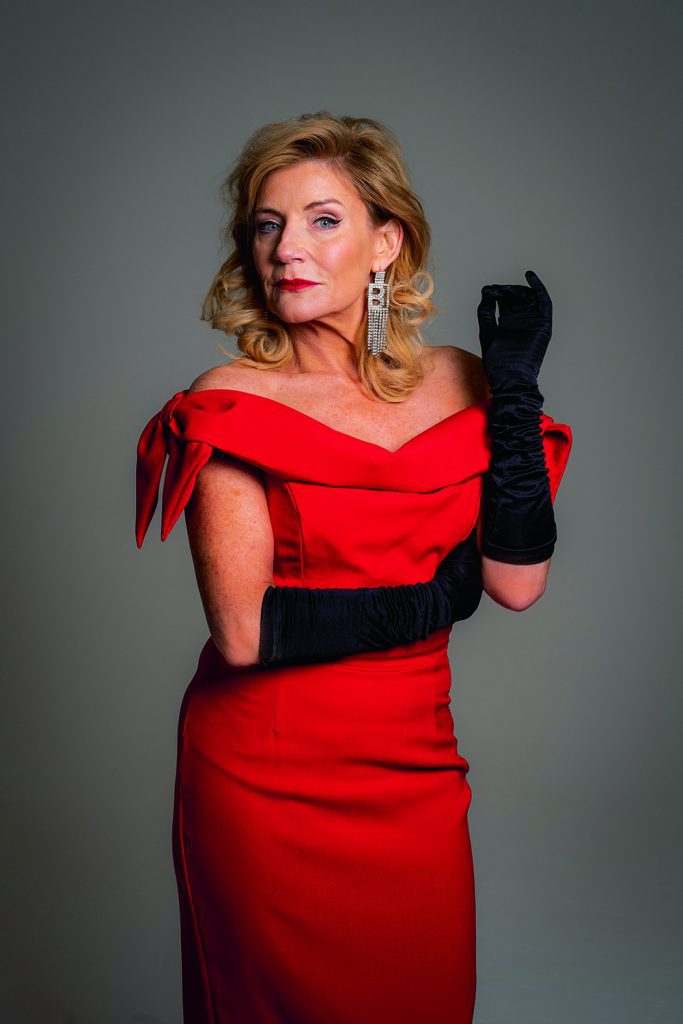
She played Ian Beale’s wife in EastEnders for eight years and the landlady of the Rovers Return in Coronation Street. Now Michelle Collins is taking on what she describes as the role of a lifetime. Michelle will be getting dolled up for the role of Miss Scarlett in Cluedo, a new play based on the addictive board game that she was obsessed with as a child. “We all need a bit of glamour in our lives, don’t we, darling?” says Michelle. She reveals that whenever she played Cluedo with her family, everyone wanted to be Miss Scarlett, the femme fatale who is regarded as young, cunning and highly attractive. “Miss Scarlett is one of the most iconic characters, along with Colonel Mustard and maybe Professor Plum, which makes it more difficult to play. “Me and my sister would go and stay with my five cousins and we would all fight for that part. But because I’m the bossy one I would always get it,” she laughs. “I think because of lockdown people have gone back to board games. It’s funny that they’ve brought us back together when you find out that Cluedo was actually invented almost out of boredom during the Second World War when people were stuck at home during air raids. “It adds a lovely dollop of nostalgia to the fun – and the murder! – of Cluedo.” If you’ve never played Cluedo, you may not know that the object of the game is to determine who murdered a victim, where the crime took place and which weapon was used. Each player assumes the role of one of the six suspects and attempts to deduce the correct answer by strategically moving around a board representing the rooms of a mansion. Hollywood turned the game into a film called Clue in 1985. Now the play is on tour and is slightly different from the board game. Miss Scarlett, Professor Plum, Mrs Peacock, Reverend Green, Mrs White and Colonel Mustard arrive at a country house one dark and stormy evening. They are surprised to find they have all received the same intriguing invitation from Lord Boddy. There are shades of Agatha Christie’s mystery And Then There Were None as the inhabitants and guests of Boddy Manor are killed off one by one with a variety of weapons. The play, described as a “hilarious spoof of a thriller” will “keep you guessing right up to the finale as both the guests and audience try to work out whodunnit with what and where”. “It’s a comedy whodunnit,” says Michelle. “I’ve done a Miss Marple and everyone loves those. It’s great to dress up in period clothes, 1940s clothes which are so glamorous. “We’re in the hands of the perfect director in Mark Bell. He did the smash hits The Play That Goes Wrong and A Comedy About A Bank Robbery. “It takes a very particular director to get the best out of something as fun and escapist as this.” She says she will put her own stamp on the role of Miss Scarlett. “It’s really exciting to play someone who, like most women, has more going on than you see on the surface. She has a history. She looks glam and dressed up but she’s a smart cookie. “I’ve never seen the film but this will be very different: very funny, very dry, a little dark at times but ultimately great entertainment. “I think it’s the perfect climate for something feelgood like this. People are desperate to get back to the theatre. They miss that creativity in their lives. It’s great that the play is something for all the family, something everyone can enjoy after the couple of years we’ve had.” Michelle Danielle Collins was born on 28 May 1962 in Hackney, east London to a Welsh mother and a father who had English and Flemish heritage. After getting her first theatre job her career changed direction when she performed in the video for the Squeeze hit Cool For Cats in 1978. She went on an 18-month tour with the band who worked with artists including Marc Almond, Level 42, Altered Images and Kid Creole and the Coconuts. When the band broke up Michelle went back to acting. While she was filming a BBC play in 1988 she was spotted by EastEnders’ producer Julia Smith who asked her to audition for the role of Cindy Beale, a character featuring in 11 episodes of the soap. She excelled in the role of renowned villain, so much so that she became a regular in the series. When she left EastEnders she had a string of drama roles for the BBC. She acted in two series of Real Women, two series of Sunburn for which she also sang the theme tune and three series of Two Thousand Acres of Sky. Michelle then moved to Weatherfield, playing Stella Price, the landlady of the Rovers Return, for three years. She left after claiming she was “unhappy” about the lack of screen time for her character. But she has continued to appear on the small screen, guesting in Casualty several times as well as Death In Paradise and Midsomer Murders. A former Midsomer detective, Daniel Casey who played Gavin Troy, joins Michelle in Cluedo as Professor Plum. Michelle is excited to be doing Cluedo which is on tour for six months. She lost a lot of her work because of lockdown. “I was in the middle of doing a tour of Pinter’s The Birthday Party – Meg, a dream role. Then I was doing a one-woman show in Edinburgh and that had to close.” Michelle thinks the Cluedo tour will fly by and will be a real antidote to what she describes as “a real rubbish year”. She explains: “My mum died. A really good friend of mine died of Covid and I was quite ill for a while. It’s been horrible. “My mum was fine during Covid but she had cancer and couldn’t have her immunotherapy
Places Pevsner Forgot – Makeney, Derbyshire
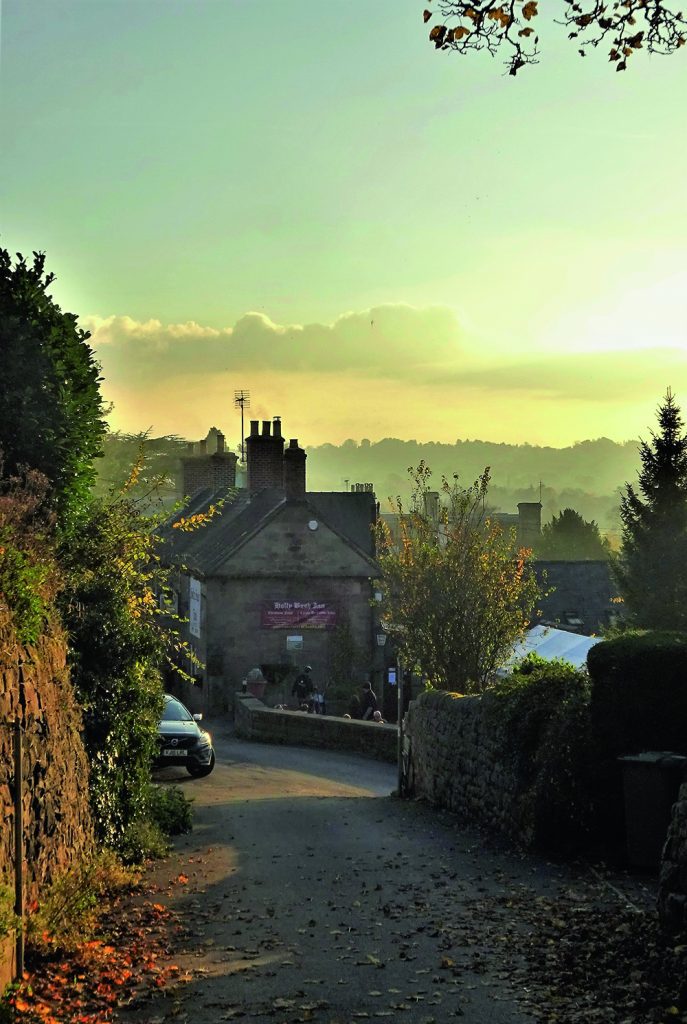
As we wandered round sunny Makeney, we wondered how Pevsner could ever have forgotten to include the place, for although historically a miniscule hamlet within the huge parish of Duffield, it gained in importance in the 19th century through its proximity to the various expanding Strutt family enterprises at Milford and gained two important houses as a result, although there never was either church or chapel. Furthermore, there is an historic inn, the Holly Bush, probably of 17th century origin with an historic turnpike trust way-marker set against its wall. How could he possibly have missed it, we wondered, especially as the hamlet is clearly visible from the A6 going north. No matter, however, we were on hand to make our own assessment. The village is situated on the east side of the Derwent on the unclassified (but remarkably busy) former turnpike road from Duffield church, along Duffield Bank to Milford, which originally ran past the pub and down the other side, but which acquired a new section cutting off this loop, now Holly Bush Lane, pitched around 1870. Holly Bush Lane also has a steep lane leading off from its apex called Dark Lane. We decided to park well clear of the Holly Bush, the narrow road outside which tends to clog up with parked Chelsea tractors, instead leaving the state chariot parked on the road near Red Lane, which winds up from a point just south of the village to Holbrook. This enabled us to see a very smart Regency cottage orné by the junction called Makeney Lodge, still with its original cast iron sliding jalousies at the windows, an adjunct to refined living famously made in Derby at Weatherhead, Glover & Co.’s Britannia foundry, Duke Street. The interior is very fine, and is illustrated in Bobby Innes-Smith’s 1972 Derbyshire Life book on local houses, from which we may infer that the cranked-out stair balustrade was also sourced from the Duke Street foundry. This should occasion no surprise, as the house in its current form was built around 1825 for Anthony Strutt (1791-1875), and probably designed by his uncle, William Strutt FRS, a keen amateur architect. It also incorporates a datestone bearing the legend HP/1784 which are apparently the initials of Henry Peat, who is believed to have rebuilt an earlier farm house there, dating from c. 1730. This may be true, for a Henry Peat married Elizabeth Beardall at Duffield in 1730, and a son may have effected a rebuild. Either way, there is no visual evidence in the existing fabric that the house you see today is anything but a new build. Why it escaped being added to the statutory list defied us; perhaps in 1981 when the County was re-listed they failed to drive along on that side of the Derwent! By 1846, Strutt had moved up Dark Lane to another new house, confusingly named the Old Hall, and sold the Lodge to Maj. Alfred Holmes (1816-1895) son of Charles, of the famous Derby coach building company. His heirs sold it to Judge Henry Raikes, chairman of Derbyshire quarter Sessions, and his family sold it to the Heyworths in 1954, connections by marriage of our own family. It has changed hands again since, most recently in 2015. Strutt was a restless fellow, however and he acquired yet a third large house in the hamlet. This we never saw as we wandered along past Hollybush Lane, because it failed to survive, its site being taken over by the stable block (now converted as residences and a business) built by George Herbert Strutt, Anthony’s great-nephew, when Makeney House was built. We reached this point by walking along the main road, past an elevated row of eight artisans’ cottages under a continuous roof built by Anthony Strutt for the Milford Mill workers in the 1820s and called Makeney Terrace. These, although a little altered, are listed grade II. Beyond them is a real gem: the original Makeney Hall, later Old Hall farm. Built by Richard Fletcher around 1814, and later sold to a branch of the Bradshaws of Duffield. The old guides claim that Judge John Bradshaw, a regicide in 1649 was born there, but in fact he was a Cheshire Bradshaw with no connection here. It was later acquired by the Heath family, which in the 18th century produced three brothers who founded a bank in Derby (which went bust in 1779). They turned it into a farm, sold it back to the Bradshaws, from whom it passed to Charles Mould who built the house Anthony Strutt acquired, and remained a farm until the mid-twentieth century, when it was divided into four tenements under the name Makeney Yard (deservedly listed grade II). It is a stone gabled building of considerable charm, but the frontage of which is rather marred by the parked cars of the four occupying families. It was immediately north of that where the converted stables are positioned. The house (called the Hall) was built in 1813 on his marriage, possibly by adapting a wing of the old hall, by local iron founder Charles Mould on land bought from the Bradshaws. However, in 1856, a sale was agreed between Mould and Anthony Strutt of both house and estate, most of which lay on the water meadows to the west of the road. In a letter of 10th March 1869, Strutt wrote to a friend, “I found it [Mould’s house] a strange mixture of some modern additions and ornaments made when the young Charles Mould got married, very absurd indeed, [but the] main stone work of old building very good.” He goes on to say that he had begun work to ‘make the house habitable’ but by 1869, had lost heart and offered the place to let. The rebuilding works, which were begun in 1858, were probably overseen by the Derby-born architect of Buckingham Palace, Edward Blore (1787-1879), who had recently built Kingston Hall (Notts.) for Strutt’s nephew, Edward, recently elevated to the peerage
The Lost Houses of Derbyshire – Old Thornbridge Hall – Ashford in the Water

Thornbridge was once part of the estate of the Longsdon family of Little Longstone, who claim a descent (never securely sorted out, but nevertheless highly likely) from Serlo de Longstone living around 1100 and, although the estate was held by that family (latterly spelling their name Longsdon) from the twelfth century until 1790, there seems no evidence that there was ever a house there, although there certainly may have been. Nevertheless, the family were numerous and still flourish today, although the claim made by G. T. Wright, JP in his very substantial book, Longstone Records (Bakewell 1900) that he himself and the Wrights of Eyam were descended from them in the male line does not really stand up to scrutiny. Thomas Longsdon of Little Longstone (1706-1780) was twice married and produced no less than eight sons, who began rebuilding the family’s fortunes after some decades of decline, for the eldest son, James Longsdon (1745-1821) was a partner until 1786 of Andrew Morewood, a Manchester cotton merchant, as were his younger half-brothers Anthony, Matthew and Peter, all of whom actually lived in Manchester, not to mention David, a grandson. This effective family migration towards Manchester in pursuit of cotton riches, led to the sale of Thornbridge by James, in 1786 when he inherited Little Longstone. The purchaser, after over three years without a taker, was his former business partner, Andrew Morewood (1714-1794), of a younger branch of the Morewoods (later Palmer-Morewoods) of Alfreton. The sale was probably to raise capital to invest in the remaining Longsdon estates. The price for the estate was apparently £10,000, and did include a house about which little is known. It was most likely a modest farmhouse, conceivably that upon which hearth tax was assessed in 1670 for one hearth when it was inhabited by a member of the family. Andrew Morewood, had made a considerable fortune in the cotton trade, although it should be remembered that, contrary to what one might read on various websites, Manchester at this period traded cotton, not from the southern states of the USA (as later in the 19th century), where it was picked by slaves, but from India and Egypt, where cotton was picked by paid labour (although I would not vouch for the free status of those who picked for the Mamluks, Ottoman Egypt’s de facto rulers). He therefore decided to build himself a modest country villa, the first Thornbridge Hall, completed in about 1792, and died there two years later. His new seat was a typical later Georgian country house, built of Carboniferous Limestone with Millstone Grit sandstone dressings, probably from Bakewell Edge, and of two storeys. The entrance front was five bays wide with a three-bay pedimented central section which broke slightly forward. The right return was of one wide bay under each pile of the building, expressed as Venetian windows, superimposed, one above the other, with flat mouldings, and there were quoins at the angles. Who designed it is difficult to say; probably an architect who was also a builder, as was then usual, although from the relative sophistication of the design it was unlikely to have been a local man armed only with a pattern book; perhaps he chose someone from Manchester. John Morewood (1754-1811), who soon succeeded, extended the house by adding a matching range at right angles to that already existing, but with an oeuil-de-boeuf or oculus in the pediment. A modest park of 20 acres was also laid out around the house, to which he added a further 20 acres leased from the Duke of Devonshire. The situation of the house cannot have lacked grandeur in the first place, and it is doubtful whether a professional landscaper was involved. John Morewood was succeeded by his brother, George and, after his death in 1854, by his third daughter’s husband, James McConnell, a Prestwich cotton spinner who in 1835 had bought nearby Cressbrook Mill and built the hall there to the designs of Thomas Johnson of Lichfield. He soon decided that Thornbridge was not quite to his taste after all and decided that he preferred the more overtly Gothic Cressbrook which was set in an even more spectacular setting. Therefore, in 1856 McConnell decided to move on, placing an advertisement in The Times for 17th December 1856 offering it to let, but, receiving no takers, eventually sold it in 1859. The buyer, rather surprisingly, was the Revd. Henry Longsdon (1826-1899) of Little Longstone Hall, whose ancestor had sold it in the first place. He had inherited the family estate at Little Longstone aged 18 months in 1827, but his senior line of the family had not benefited quite so royally from the family’s excursion into cotton trading, and he was then the newly appointed vicar of Eyam. However, he still needed somewhere nearby to live, as the Joseph Pickford designed vicarage at Eyam had not then become available, and the family manor house was occupied by his mother. However, after a year or two this situation resolved itself, and Thornbridge was again put on the market, shorn of much of its estate, which was retained as part of that of Little Longstone. The next new owner was John Sleigh of Leek, whose exhaustive History of Leek came out in 1862, with a second edition (less desirable to the collector, but slightly more helpful to the researcher) followed in 1883. He also wrote frequent antiquarian articles for The Reliquary, an historical periodical edited by his friend Llewellyn Jewitt of Winster Hall. The Sleigh family ultimately descended out of Hartington and had at one time acquired the Etwall estate too, but quite why Sleigh wanted to move from Leek, which he clearly loved, is not clear. Nevertheless, he was prepared to spend £10,000 on it (the same price as Andrew Morewood had splashed out in 1790, but, of course, with much less land) remained there until 1871, when it again came onto the market. One attractive feature which enhanced the value of Thornbridge