Lumsdale – Matlock’s First Industrial Estate

Hidden away in a deeply wooded ravine, Lumsdale is unknown to many who live nearby, but as Brian Spencer discovered, it is a unique link with the early days of industry in Matlock. Bentley Brook rises in the rough moorland above Cuckoostone Dale and flows gently past Matlock Golf Club, then dives beneath the A632 Chesterfield road to pass Highfields School, before dropping into the valley bottom where it joins the Derwent at Matlock Green. Once away from the school and a scattering of houses, the brook crashes over a series of small but spectacular waterfalls trapped within a deeply wooded gorge. By harnessing the stream’s power and in particular its cascades, a series of small mills driven by waterwheels carried out a whole range of industries that began in the 16th century, and with adaptations continued until 1920. Abandoned by their owners, the mills fell into disuse, their stone often removed for building elsewhere and it was only by the efforts of a far-sighted lady, that the now romantically tranquil ruins have been preserved as memorials of past industry. Frequently vandalised for their building stone, the ancient mills were fast disappearing until a local lady called Marjorie Mills bought Lumsdale to prevent further demolition. Throughout the rest of her life until her death in 1996 she maintained a passionate interest in the valley, but by 1976 when she realised that her failing health no longer allowed her to take an active interest in its preservation, she transferred ownership of Lumsdale to the Arkwright Society, who together with a group of local residents, continue her work. The three upper ponds nearest to Highfields School are silted-up and have as a result become wild-life havens for bog plants and amphibians such as crested newts and frogs. Of the others the one at the head of the ravine is arguably the most beautiful, but the others still have their attractions, especially for anglers. By parking in the lay-by opposite the entrance to Highfields School on Lumsdale Road, the valley and its ruins can be explored by a rocky footpath winding its way steeply into the valley bottom. Walk gently downhill past the boggy remnants of the first two ponds and with a little care you can see the overgrown ruins of the 16th century Bone Mill. The still recognisable wheel pit and its tail race back into Bentley Brook drove massive grindstones and pulverising hammers to break down calcined bones for use in the pottery industry or as fertiliser. Following the path past the third dam and a group of cottages, the next mill was until the twentieth century used as a saw mill, but initially it was a corn mill, and the huge grindstone imported from the Massif Central in France lies close to the tail-race. The next group of cottages that stand above the waters of the fourth pond, Farm Dam, were once part of a lead smelter and with a little care, it is possible to trace the remains of many of the earlier industrial buildings. For example the smelting cupola is incorporated within part of the cottages. The modern house across the way is known as ‘Pine Trees’ and stands on the site of the smelter’s counting house and smithy. A horizontal condensing flue to remove poisonous fumes and collect by-products ran away from the smelter; with a little bit of investigation, an access trap can still be seen, but certainly not entered. It was into this that small boys were sent to scrape noxious substances like arsenic from the walls – no wonder they led short lives. Below Farm Dam and its bulrushes, is the hiding place of mallards. Hard by adjacent picnic seats, water pours through a still viable sluice, then down a spectacular waterfall part hidden by beech shaded rocks. A now dry side leat carried water into a deep wheel pit where a mill was later adapted for sawing timber, or ground lead oxides for the paint industry. The square sided Derbyshire chimney half hidden in trees above the mill was part of a system designed to dry ore minerals before crushing. This mill was built for the Bonsall School Trustees in 1770 and is well worth a closer look, for it is built, quite spectacularly into the rocky hillside where the nearby waterfall creates an open space. The footpath leads down to a fifth mill known as the Upper Bleaching Mill where you can see the remains of the bleaching vats. This mill was connected to Garton Mill in the lower valley by an ingenious tram system whereby loads of heavy cotton fabrics were carried between the two mills. Turning left as the path reaches the nearby road, it is still possible to see the remains of the tracks which were cleared by the pupils of Highfields School a few years back. It will be necessary to follow the road at this point, past an overgrown mill pond that was used to guide water to the wheels and processing plant at the Lower Bleach Works, or Garton Mill as it was once called. Very much expanded in the 20th century and used by a variety of industries, including Messrs Paton and Baldwin for woollen manufacture, the first mill on the site was built around 1785 by Watts and Co as a cotton spinning mill but went bankrupt in 1813. This was when it became a bleach works in the ownership of John Garton, retaining its function, along with cotton fabric finishing, continuing well into the 20th century. Two groups of solid stone-built terraced cottages were made to serve the mill and are now private homes, then next come two further ponds that served Tansley Wood Cotton Mill, the largest mill in the Lumsdale complex. The first structure was leased from its builder Banks-Hodgkinson of Ashover in 1783 by Messrs Osgathorpe & Prestwidge. If anything they were the most unusual names in the Matlock area, but nevertheless the two
Product Test – Bee Bald

BEE BALD® is a complete line of men’s premium quality grooming, shave, and skincare products and are the exact same kinds of products you are probably using already… just way better! BEE BALD® SMOOTH DAILY MOISTURISER £9.99 Tones and hydrates while working to reduce and prevent the buildup of oil and shine. Fine lines, wrinkles and dry patches are moisturised and smoothed so skin feels cool, fresh and comfortable all day. Shea Butter for superior moisturising and Ginger Root for free radical control. Antioxidant, healing and antiseptic ingredients include Licorice Root, Honey, Bee Pollen Extract, Goji Berry and Vitamin E. Titanium Dioxide provides added protection against the sun. BEE BALD® SCRUB EXFOLIATINGPRE-SHAVE £9.99 Deep cleans and removes pore clogging dirt, oils and dead skin cells. Daily use helps minimize likelihood of ingrown hairs. Kaolin and Bentonite clays condition and cleanse in combination with the gentle but heavy duty “scrubbing” benefits of Jojoba Esters, Juglans Regia (Walnut) Shell Powder and Glycine Soja (Soybean) Oil. Allantoin soothes; Citric Acid, an Alpha Hydroxy Acid (AHA) contains antioxidant and toning properties. Licorice and fruit extracts calm and condition; Pollen Extract softens the skin and provides nutritive enzymes, amino acids and multiple vitamin compositions; Honey Extract contains healing, anti-septic and anti-inflammatory benefits. For more information and to buy online visit www.beebald.com TRIED & TESTED :: TRIED & TESTED :: TRIED & TESTED Premium Shave Cream What can I say, personally I like a good foam when I shave, this product does not. But saying that the end result was better, after my shave my skin was super soft. So if you like your skin feeling moisturised after your shave, then this is the product for you. SBDaily Moisturiser Great product, does exactly as they advertise. Lightly scented, it is easily applied and leaves your skin feeling smooth and soft, without feeling greasy. Probably at the higher price point for what you get. AP ExfoliatingPre-Shave Scrub Nice fragrance and over time it did make my skin feel smoother. A good product which I will continue to use. GP 00
Walk Derbyshire – Following The Norman Conquerors In Hartington

Once Duke William was crowned as King of England following the Battle of Hastings, it took several years before the Normans could claim true domination of the country beyond the readily subservient south of England. Throughout the north and marshes of East Anglia, rebellious Saxons made it clear that they wanted nothing to do with these upstart French speaking incomers. As attempts to pacify those who objected to this change of status failed miserably, King William, the Norman, had to resort to violence, instigating what became known as ‘the Harrying of the North’, when vast areas of Northern England were laid to waste, with the people either murdered or driven off the land they and their forebears had farmed for generations. What became known as the Peak District although being comparatively uninhabited, didn’t escape the takeover, and to put his stamp on the region, King William divided the land amongst those knights who had served him well in battle. With William Peverel taking most of the land to the north and east of the Peak as his hunting preserve, the rest, mainly those lands to the east of what became Staffordshire and north Derbyshire were handed over to de Ferrier in order to expand his hunting estates further south in Leicestershire. While we may be used to imagining castles as impregnable fortresses built of stone, many began life as manmade hillocks protected not by stone but with rapidly thrown up timber palisades, a kind of quick-build system. Generally they fitted a standard design with the strongest part being incorporated within, or on top of the high mound, or motte where the lord and his knights sheltered, and a lower much larger area or bailey protecting everything necessary for everyday living. Here would be a noisy collection of everything from a blacksmith’s workshop to dairies and cloth weaver’s looms. It is uncertain who built the motte & bailey castle at Pilsbury a mile and a half up the valley of the Dove from Hartington, but although no record was made during its construction, or why it was never converted to a stone-built castle, it is quite possible that William de Ferrers built it more as a hunting lodge, rather than as a fortified base for his military excursions throughout the White Peak. Whatever its ultimate need could possibly have been, it now stands as an enigmatic link with the turbulent time following the Norman invasion. The walk passes Pilsbury castle in the early stages, a walk that is never far away from the River Dove. It wanders along a fairly straight course, almost to Crowdicote where the river is crossed by the Longnor road. Hereabouts at Bridge End Farm, the route turns left to cross the river and climb up to the Sheen/Longnor road. Another left turn follows a usually quiet arrow-straight ridge-top road with breath-taking views up and down the Dove. When the road comes to a sharp right hand bend, the walk continues forward, past Harding Close Farm and the highest part of the walk at 1060 feet. Beyond that point the way is mostly downhill to the Dove and once over it a field path leads on, past the famous cheese factory, one of the few places allowed to make Stilton cheese. Beyond the factory, the last few yards of the walk passes the village duck pond and then moves onwards into Hartington’s old market place where the pub named after Izaak Walton’s friend Charles Cotton waits to slake the thirst of those in need. Non- drinkers are catered for in the scattering of small tea rooms and cafes set around the market place. USEFUL INFORMATION A 7½ mile (12km) moderate walk with mainly gentle gradients along field paths and usually quiet roads. The steepest climb comes after crossing the Dove for the first time beyond Bridge End Farm near Crowdecote. RECOMMENDED MAP Ordnance Survey 1:25000 scale Explorer Map, Sheet 24: the Peak District, White Peak Area. PUBLIC TRANSPORT Buses run from Ashbourne via Ashbourne & Buxton. REFRESHMENTS Charles Cotton in Hartington and the Packhorse Inn at Crowdecote are highly recommended. There are also cafes around Hartington old market place. CAR PARKING Pay and display in the public car park beside the Leek/Cheadle road on the south western outskirts of Hartington. Limited free parking near the village duck pond. DIRECTIONS From the Leek road car park, walk back up to the old market place and continue forwards as far as the cross roads. Turn left opposite the road for Hartington Hall youth hostel Walk up the hill towards and then past the village church. Continue over the track crossing junction near Bank Top Farm and go forwards for a little over a quarter of a mile. Still going forwards, cross a secondary path then climb over the western slopes of Carder Low which is on your right. Walk on for another quarter mile, using gates to cross field boundary walls (please close all gates after passing through them). Take the left turn at a signposted footpath crossing and walk down to a minor road which is crossed by stiles on either side. Continue along a grassy high level path until it joins the valley bottom track close by Pilsbury Castle. (If you miss this crossing, do not worry, but turn left to go down the rough road as far as the track turning right into Pilsbury village. Follow the grassy valley bottom track beyond the farm and houses). Spend time exploring the mounds remaining from when Pilsbury Castle was a formidable defensive place, then go forwards for about half a mile as far as Bridge End Farm. Go past the farm buildings for a few yards, in order to turn left and go down the field to a narrow footbridge crossing the river Dove. Climb the steep field path, fortunately for a little under a quarter of a mile, through scrubby undergrowth and gorse covered ground until it reaches a stile giving access on to
Celebrity Interview – Danny John-Jules

Danny John-Jules breaks off from trying to learn “a load of very educated and complicated lines” for his part in the stage version of Dan Brown’s The Da Vinci Code to express his delight at securing the role of Sir Leigh Teabing. Some actors might baulk at taking on a role portrayed by one of our finest actors, Sir Ian McKellen, in the film version. But not Danny. “I’m following in the footsteps of a lord of the theatre. I don’t need anything else in my life. If I never work again I’ll be more than content,” he says with great pride in his voice. This is the man known to millions of television viewers as Cat in the sci-fi comedy series Red Dwarf; as Dwayne Myers, the motorcycling, liberty-taking policeman in the drama Death in Paradise; or from his eight-week stint in the 2018 series of Strictly Come Dancing. So how did he get the part in The Da Vinci Code? “I have no idea and I can’t be any more honest than that. In this climate everyone’s out there hustling for work. I just got a call to do it which flabbergasted me no end. “I would understand it if it was a comedy show or a TV drama. Although I’ve had a vast theatrical career, not many people know me for doing live theatre. People know what they see on telly on a regular basis.” He talks candidly about why he left Death in Paradise, whether there will be another series of Red Dwarf and his future work. But he has no time for so-called showbiz journalists who know nothing about show business. He returns to the subject often before giving me an exclusive which he would have revealed to other journalists if only they’d been bothered to ask. What really annoyed him was when he went on Strictly and the first article he read described him as a Z-list celebrity. When I exclaim how unfair that was, he replies: “Showbusiness isn’t fair. “An overweight journalist can call you anything they want. That’s what they choose to write. You can talk about showbusiness or you can just slag people off. Most of those people who write about showbusiness have no idea about showbusiness. They just talk about individuals and personalities.” One thing that Strictly did was kick-started his love for theatre again. Within a year of being on Strictly, Danny had written a one-man show, rehearsed it and got it on stage. The two-hour spectacular contained 21 numbers from Danny who still regards himself as a song and dance man. But none of the journalists who had criticised Danny when he was on Strictly turned up to review his show. Daniel John-Jules was born on 16th September 1960 in Paddington, London. His parents had travelled to the UK from Dominica on board the Empire Windrush. Danny was brought up on an estate in Notting Hill. He went to a drama group in a church hall and was trained at the Omnibus Theatre Company and Anna Scher Children’s Theatre. He was a dancer in variety shows behind star names including Jimmy Tarbuck, Dickie Henderson and Norman Wisdom. He then featured in many West End productions, being an original cast member of Andrew Lloyd Webber’s Starlight Express, and danced in the group Wham’s video for their song The Edge of Heaven. He turned up half an hour late for his audition for Red Dwarf, unaware of his tardiness and did not appear concerned. Wearing his father’s old zoot suit, he won over the producers who decided he was cool enough for the part of Cat. Danny and Craig Charles are the only actors to have appeared in every episode of Red Dwarf. There have been rumours recently about the cult sci-fi programme returning. Danny says it shouldn’t be ruled out. “For 33 years we’ve had the same question: are we getting any more Red Dwarf? I’m just glad and over the moon that I was in a show that was like nothing else.” Here’s the exclusive that Danny has for Country Images: he had appeared on the ITV show called The Real Full Monty, a programme that raises awareness of men’s cancers. “When I did that show I was invited to the head of ITV’s yearly party at Kensington Palace. Why? The show just happened to be their top factual show of the year and the producers told me ‘you were by far the most popular character on the show’. “If any journalist had the common decency to do a showbiz interview, they would have got that story.” Now Danny is preparing for The Da Vinci Code which is being billed as “one of the most anticipated theatre shows of 2022”. Danny has no worries about following Sir Ian McKellen. “It’s nothing like the film, so obviously I’ll be nothing like Sir Ian. With actors it’s interpretation, along with the director’s final say.” Dan Brown’s book The Da Vinci Code has been denounced by many Christian denominations as an attack on the Catholic Church. It has also been criticised for its historical and scientific inaccuracies. Danny, who was brought up as a Catholic, doesn’t enter the argument: “The good thing about The Da Vinci Code is that whether your character is for or against the popular beliefs, it doesn’t matter because we’re just playing characters. “When you go into any job you’ve got to leave that at the door, whatever you believe, because otherwise there’d be something in every script that you wouldn’t agree with. “We are smoke and mirrors – we’re just playing parts. Whether I believe what I’m saying or not, there’s only one thing that I’m going to believe 100% and that’s the character because if I didn’t believe in that character I can’t portray him. “If I don’t have that problem I just act and make sense of the words on the paper. That’s my job – it’s not to start asking people if
The Lost Houses of Derbyshire – Pilsley Old Hall

The last lost house about which I wrote was Coney Green Hall, bought in 1774 for £4,000 by Thomas Wilson, who also acquired Pilsley Old Hall, just over two miles away and still in North Wingfield parish, so it seemed logical to move right on to chronicle what we know about the latter. The Old Hall at Pilsley was a superb example of a minor Derbyshire manor house: seventeenth century in date, compact, gabled and sturdily built. It was deservedly listed II*, and was by no means too large to make a viable home for a modern family and by the time of its demise in 1965, it was in tatty shape but in reasonable overall repair. Its loss, therefore, prior to the 1968 Act came into force on 1st January 1969, which would have afforded it better protection, seems from today’s viewpoint well-nigh indefensible. The house was built of roughly coursed coal-measures sandstone and with a stone slate roof, topped by four stone chimneys, latterly with brick tops, neatly emphasising the hearth tax assessment of four hearths chargeable in 1670, although no doubt hearths were added to the bedrooms later. It consisted of two parallel ranges, running north to south, giving a twin gabled façade, each gable surmounting two bays on the principal floors and a central attic light, all originally being mullioned, probably the larger ones with single transoms. The windows had moulded surrounds and there was an unpretentious central entrance. The west side sported a ladder staircase window, lighting a fine quality Regency timber staircase (a replacement no doubt, for a more substantial original oak one) with a stick balustrade, triglyph carved tread ends over a Vitruvian scroll and a curled mahogany rail. Indeed, the tread ends are sufficiently old fashioned for one to suspect the staircase was perhaps at least a couple of generations earlier and was perhaps merely fitted up with a new balustrade by the Wilsons, possibly because the original one had become damaged. The east front was blind for two thirds of its length, ending with another staircase light, presumably for the secondary stair, and surviving superimposed two light mullioned windows beyond. Inside, the house was spacious and clearly intended for a gentleman rather than to act as a farmhouse, with a number of distinctive chimneypieces, most of which managed to survive into the twentieth century, that in the parlour even being flanked by a pair of arched niches complete with fielded panelled doors. Others boasted bolection mouldings, and some were of Hoptonwood polished limestone as, inevitably, were the cantilevered staircase and the floors in the hall and kitchen. Apart from modest cornices and dados, little superfluous ornament was applied and if there was panelling (highly likely), it had all gone by the time the Royal Commission of Historic Monuments for England photographed the house. At the time of Domesday, Pilsley was held in chief by Walter d’Eyncourt whose seat, Ayncourt, lay nearby (latterly a moated site, lost to coal mining in the later 19th century) and remained in the senior line of that family until 1442 when Robert, 7th Lord d’Eyncourt of Pilsley died without leaving any children. His barony fell into abeyance between the descendants of two aunts, and the estates passed to the then all-powerful Lord Treasurer, Ralph, Lord Cromwell, whose seat was Wingfield Manor. In 1456, he too, died without leaving issue when Pilsley passed to William 7th Lord Lovell of Tichmarsh. The son, Lord Lovell, Holland & Grey (of Rotherfield), was later attainted for high treason in 1484, when the estate reverted to the Crown. The estate at Pilsley then came to the Leakes of Sutton Scarsdale, although for whom it was built, probably c. 1630, is unclear: either a younger son, or for the estate’s bailiff or agent. Certainly, one junior branch lived at nearby Williamthorpe Hall and another might easily have been ensconced at Pilsley. Nicholas, 4th Earl of Scarsdale, spent a colossal sum rebuilding his main house at Sutton Scarsdale with one of England’s Baroque masterpieces (see May’s County Images), gambled heavily, dying without issue and essentially bankrupt in 1736, when it was sold to Richard Calton of Chesterfield a lawyer, who completed in 1743. He it was who probably converted the main fenestration to sashes in plain surrounds; the glazing bars were fairly thick, which invariably betokens an earlier eighteenth century date. His descendants lived there until the late 18th century when it was sold, along with Coney Green Hall, to Thomas Wilson, from a Nottinghamshire family snobbishly described in Throsby’s edition of Thoroton’s History of Nottinghamshire as ‘rich graziers.’ The fine regency staircase and other improvements were probably the work of the Wilsons, who, readers may recall, also set about making alterations to Coney Green as well. In 1850, William Henry Wilson, a land surveyor, was living there, and it was then that his family sold it to John Sampson a local brick and tile manufacturer. Later the Sampsons, in the person of the son, Luke, sold it again in 1880 but with only 23 acres, the remainder remaining in the hands of the Sampsons until the mid-1930s when, on the death of Thomas, Luke Sampson’s son, it was all sold up. The purchaser of the house, however, was E. A. Storer and in the Edwardian period, it was let to Granville Chambers, and later sold around 1930 to Mathew Eyre Wilde, JP who let it to Solomon Cutts. Post war, the last owner was F. Gardener of Littleover, but the house had fallen empty by the early 1960s, and architects Bestwick, Bowler and Hagg successfully applied for consent to demolish, and it came down on 13th August 1968, to be replaced – you guessed it! – by a new housing development. Why the developer could not have divided this venerable old hall into a pair of very pleasant period residences and built new houses, preferably out of local stone to a good design, beyond the immediate surroundings is a mystery; the
Glossop & Old Glossop
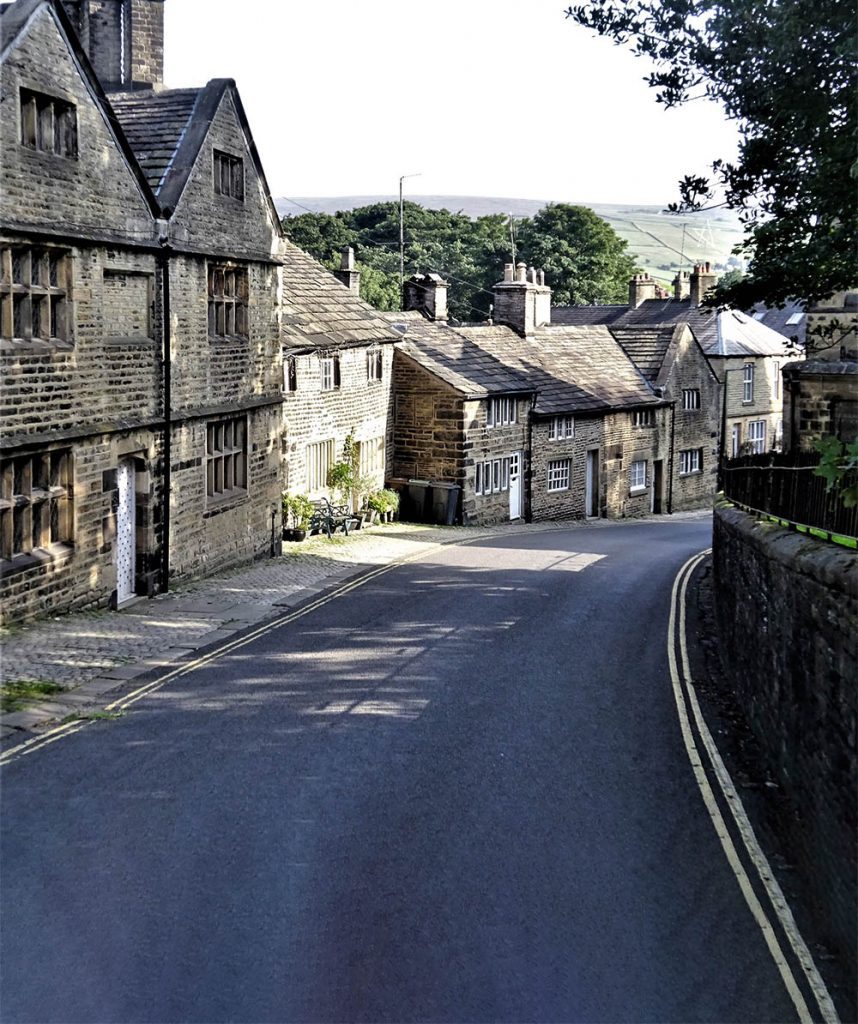
Like Hope, Hathersage and Chapel-en-le-Frith, Glossop was once a vast parish of over 50,000 acres, subsequently subdivided, covering the hills of the western Dark Peak. In 1086 it was part of an even larger entity, the lordship of Longendale, held directly by the king, and it remained as such except for a brief period under Henry I when it was granted to William Peveril. After the Anarchy however, Henry II gave it to the Cistercian Abbey of Basingwerk, Flints (now Clwyd) and they held it until the Dissolution. As a result, Henry VIII granted it to Francis Talbot, 5th Earl of Shrewsbury and it remained largely with his descendants, the Talbots and the FitzAlan-Howards, Dukes of Norfolk, until the twentieth century. Old Glossop sits on a south facing hillside, and originated in the medieval period. The modern town, initially Howard Town, later New Glossop and now just Glossop, was created around cotton mills in the early 19th century through the encouragement of the FitzAlan-Howards (whose coat-of-arms can be seen all over the place) and lies further down, occupying the valley. The name, according to modern reference books, derives from the Anglo-Saxon hop(e) (= valley), suffixed to the notional Saxon name of ‘Glott’ (in the genitive, hence an additional ‘s’), thus ‘Glott’s valley’. However, these references invariably prefix the name with an asterisk, which means it has been deduced by academics from the name’s earliest forms but is unattested by any known personage bearing it. Bearing in mind that the area probably remained under British control until near the end of the seventh century, one might propose a British origin for the first element, like Glôg (= a rock or knoll, appropriate enough hereabouts) or the well- attested British personal name Glywys, with the Saxon suffix added. Such hybrid place names are not uncommon, especially in the North and West and more are being admitted as research is re-defined. Such arcana did not affect our visit on a blazing hot day. Old Glossop is a total delight, and once was centered on the hall, latterly a vast, rather unlovely mansion, demolished by the Council in 1959 (see Country Images May 2018). This lay quite close to the church of All Saints, with a fine park rolling down the hillside. The church itself is an ancient one, and quite substantial, but has suffered numerous rebuildings – no less than five since the beginning of the 19th century, leaving little of the original 12th century church. We actually began beside the stump of the medieval churchyard cross, rather neglected looking, on the south side, by walking up from the church past the former church primary school of 1854 by Matthew Ellison Hadfield (1812-1885), a Glossop man, son of the Dukes’ local agent, Joseph, who, through the patronage of the Howards rose to eminence as an architect here and then in Sheffield as Weightman & Hadfield. He designed much of the new town of Glossop. The school is remarkably substantial, and was converted into several spacious houses three years ago, winning an award. We pressed on past up to the upper road, Church Lane continuing NW until we reached ‘the opposition,’ as one elderly local called it, the splendid late Regency Catholic church (also dedicated to All Saints) by M. E. Hadfield of 1836, although it looks almost earlier, with its neat classical villa of a presbytery beside it. It was the private chapel of the (staunchly) Catholic Dukes of Norfolk until 1925, despite the hall also having had an attached chapel. We then pressed on along Church Terrace until we reached the main (Woodhead) road, where we turned left down the hill into Glossop proper. Woodhead Road morphs into Norfolk Street, and for half a mile one passes through a leafy suburb with houses either side ranging from late Victorian to inter-war. Further down, things change: opposite the corner of Kent Road is a pair of stone built houses, very pretty, in an unexpected cottage orné style, followed by a substantial mid-Victorian terrace, with further terraces beyond on both sides. This continues for another country half-mile until suddenly the descent steepens and the road widens. On the right is the very striking Manchester, Sheffield & Lincolnshire Railway’s classical station of 1847 (by the omnipresent Hadfield, naturellement). The noble lion crest of the Howards atop the parapet attests to the fact that the 13th Duke personally paid for the one mile branch line from Dinting that terminates at the rather grand station itself. The line (later the Great Central, then 1923-1948, the LNER) is today still operating and long electrified. Opposite the station a very tall sub-Jacobean Conservative club of 1909 with a first floor angle gallery upheld by a stumpy fat column with stiff leaf capital. Further down, on the corner of High Street, we found the early Victorian Norfolk Arms Hotel, very welcoming, where we paused for much needed sustenance. This, essentially, is the grandly planned centre of Howard Town, later (New) Glossop. We proceeded along Henry Street to Norfolk Square behind the pub, where Tesco have tactfully adapted the station’s good shed, and passed, on our right, an Italianate building, now shops, and a hidden Masonic Hall, its modest entrance amidst a stone residential terrace looking almost furtive in its discretion but, from the notices advertising the availability of a large hall for weddings, funerals and bah-mitzvahs (as it were), we deduced that behind lay an edifice of noble proportions, invisible to us. Opposite lay sloping Norfolk Square itself bosky and with elegant buildings in the usual honey-coloured Dark Peak millstone grit on all sides. The NE corner is host to a tall Jacobean Liberal Club of 1914 by Paul Ogden, with blue plaque honouring Hon. Mrs. Mary Partington MBE a philanthropic ex-Mayor of the town and daughter-in-law of the largest employer in the Borough, Edward, 1st Lord Doverdale). Beside it is a splendidly Belle Epoque war memorial in bronze with winged victory (by Vernon March of Hadfield’s old practice)
Bowes Museum – Barnard Castle
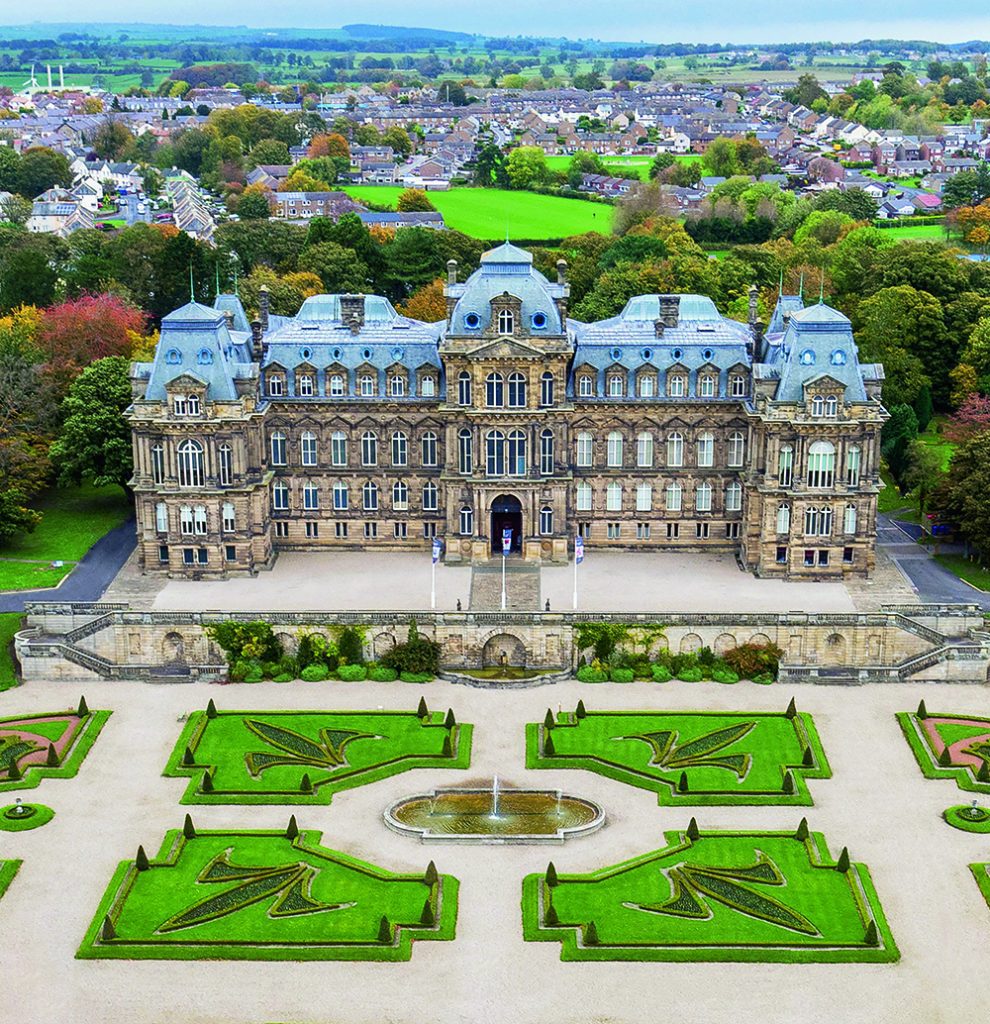
When Dominic Cummings, Prime Minister Boris Johnson MP’s political aid made his controversial dash to Specsavers in Barnard Castle, it is doubtful he had the time to visit the Bowes Museum. This was a pity, because it is nearby, on the outskirts of the town. If he had managed the short diversion away from the town centre, he and his family would have been rewarded by a trip round what is arguably Britain’s most unique museum. It is not simply the collections of treasures within Bowes Museum that is the attraction. The result of a lifetime’s collection by a philanthropist couple, it is it’s venue that first hits the senses, making jaws drop and eyes widen. The reason? No matter how well prepared visitors might be, here in the heart of the Durham countryside is a French château. It was built for John and Joséphine Bowes in order to display a lifetime’s varied collection of European fine and decorative arts. John Bowes was a wealthy landowner with coal mining and shipping interests – through family connections he was an ancestor of the late Queen Elizabeth, the Queen Mother. His French wife Joséphine also inherited wealth. A talented amateur artist, she became a moderately successful actress on the French stage. From all accounts the relationship was a happy one, despite their inability to produce a family, probably due to John Bowes catching a venereal disease during one of his European journeys. Even though their individually accrued wealth suggested an introduction into high society, Joséphine’s Bohemian background did not meet the snobbish Victorian standards of the day. Such was their joint affection that they were able to ignore this snub allowing them to devote their energies by increasing a joint art collection along with planning a suitable home for it. Together they worked tirelessly, developing their unlikely plan to open a French-style, purpose-built museum in rural Teesdale. Sadly both died before it was opened in 1892, but were buried in the museum garden. A collection which John started in his youthful travels around Europe grew steadily, so much so that he had to employ a team of specialist agents to scour major exhibitions. His working relationship with his agents grew on mutual trust, especially when he accepted their suggestion to move on to the work of up and coming artists. This seems to have worked and as a result, the galleries at Bowes now hold paintings ranging from 17th century Dutch and Flemish masters to Impressionists and English landscape masters like J.M.W. Turner, a policy continued by recent purchases of modernistic works. One of the results of this policy based on mutual trust was that many paintings now worth hundreds of thousands of pounds, were frequently bought for as little as £10. Although their purchase price is uncertain, two large paintings by the Venetian artist Canaletto were bought this way. They are displayed alongside works by el Greco and Francisco Goya, just a selection of the famous artists whose work adorns the walls of Bowes Museum. Paintings by Joséphine Bowes mingle at Bowes Museum along with those by better known artists, but they can claim to be there by their own quality and not simply due to her influence. Joséphine worked tirelessly alongside her husband, each keeping to the idea of building a museum in England where anyone could enjoy the results of the Bowes couple’s ambition. For a time the collection was held in the Château du Barry near Louveciennes west of Paris, the one-time home of the mistress of Louis XV, which John Bowes gave to Joséphine as a wedding gift. During the Second Revolution (les Miserables is set in this era), an attempt was made to use the château as a store for military equipment. Concerned about the safety of his prized collection, John Bowes managed to pay off the authorities. A French architect who specialised in designing museums was employed to design the building housing the Bowes collection. It was planned to build on the site outside Barnard Castle, but unfortunately for the Bowes couple, although comparatively small the site was divided into several small parcels, each owned by a separate person. John must have had almost bottomless pockets, for after extensive negotiations, he managed to start building his dream museum. As Joséphine did not relish the thought of crossing the Channel, she kept her visits to England to the bare minimum. However, she braved the hazardous journey and arrived in Barnard Castle in time to lay the foundation stone, and turning to her husband, said ‘I lay the foundation of our dream. You John, will lay the cap stone’. Three stories high and built of locally quarried sandstone, building Bowes Museum, more château than municipal began in 1869 and, costing around £100,000 (equivalent to £9.3 million in today’s money), was ready to receive its valuable collection by 1892. Far sighted as well as being a philanthropist, John Bowes left a substantial legacy to help with the future running of the museum; but by dying comparatively young, this was something neither of the Bowes could predict, and what is there is for all to enjoy. In the heart of rural County Durham there now stands a light and airy building housing a well-run museum and art gallery, open for all to enjoy. Entering through the imposing wrought iron gates, visitors can wander past the well-kept parterre garden, onward to the steps climbing to this unexpected addition to the local countryside. To the left of the main doors, a heraldic shield with three archer’s bows makes a pun on the name Bowes. The ground floor is divided, on the right, the reception and shop area, then, to the left two rooms, one for toys enjoyed by children in Victorian times, the other a small area given over to prehistoric items such as an urn found in a neolithic grave, or enigmatic cup and ring stones. Alongside these curios is a Penny Farthing bicycle and of all things, a
Celebrity Interview – Jenna Russell

She’s a regular in the West End where she won one of the most prestigious awards in showbiz, she’s worked on Broadway and she took over as one of the main characters in the BBC soap EastEnders. Now Jenna Russell is coming to Nottingham. The actress and singer will play French cabaret performer and chanteuse Edith Piaf in Pam Gems’ play with music Piaf at Nottingham Playhouse next month. When the playwright came up with the work in 1973, it was shelved because she was told the central role “needed a strong singer and a dramatic actress in one”. Since then Jane Lapotaire, Elaine Page and Imelda Staunton who played Piaf at Nottingham Playhouse in 1981 have risen to the challenge of taking on the role. So can Jenna pull it off too? “We’ll see! I’d like to think I can. I’ve always loved being in things where I can sing but the character is more important than making a beautiful sound. “Something like Piaf is a great opportunity to inhabit an amazing character and go through the highs and lows dramatically with her and also get to sing. It’s a play with a lot of music but it’s Piaf’s voice we hear.” Speaking from her home just outside Canterbury, Jenna comes over as warm, upbeat and passionate about theatre. She’s relishing the thought of returning to the stage after more than a year now that coronavirus restrictions are being lifted. She’ll be performing what she says is a dream part: “It’s not often you get those roles where the character is so front and centre. They scare the living bejeebers out of you because there’s no time off really and they’re a big ask. “But once you’ve done all the hard work in rehearsals and once you’ve learned the beast and tamed it, they’re the best jobs to do because you have that joy of walking out on stage and knowing you’re going on this journey with the audience for the next two-and-a-half hours and guiding them through this extraordinary woman’s life.” Nottingham Playhouse artistic director Adam Penford met Jenna when he was working at the National Theatre. In 2011 Jenna appeared in Alan Ayckbourn’s Season’s Greetings at the National and the pair became friends. A few years later they met again over lunch and Penford said he wanted her to play Edith Piaf at the Playhouse. “I’d loved working with him and told myself ‘he’s one to watch’. He’s doing such a brilliant job at Nottingham and he’s been amazing in the pandemic, trying to keep the arts alive in the area,” says Jenna. Piaf will be the first major production when the Playhouse reopens. Another reason for Jenna to accept the role is that she will be reunited with Sally Ann Triplett. They’ve been friends since they were 20 and will be performing together for the first time since they appeared in Sondheim’s Follies in the West End 30 years ago. Sally played Judy Garland in Amanda Whittington’s play My Judy Garland Life at Nottingham Playhouse in 2014. For the past few years Sally has been working in New York but has returned to Britain permanently. Jenna says it’s “brilliant” that Sally will also be in Piaf: “She’s an amazing actress and extraordinary singer. How lovely to get to go back on stage in that gorgeous theatre with your best pal by your side. “It’s going to be such a lovely way to go back to the job I love so much and she loves so much. We’re really excited about that.” Lockdown meant that Jenna whose partner is the actor Raymond Coulthard was able to spend more time with her 12-year-old daughter. But now Jenna is itching to get back on stage. “It’s been tough but I think it’s been tough for everyone, hasn’t it? Literally overnight I lost a year-and-a-half’s worth of work. I was in a very lucky position of having three big theatre jobs lined up which is unheard of in my line of work, so it’s a shame that only one of those, Piaf, has come back. “Fingers crossed, we can keep slowly moving forward and get some more work and be able to do what we love doing.” Jenna Russell was born on 5th October 1967 in London but grew up in Dundee. Her career began as an understudy in Les Misérables and later she took over the role of Fantine. She had a stratospheric rise after that, playing the Floor Manager in a couple of episodes of Doctor Who before appearing in the West End revival of Stephen Sondheim’s Sunday In The Park With George. That earned her the 2007 Olivier Award for best actress in a musical. The following year Sunday In The Park With George went to Broadway, with Jenna being nominated for a Tony Award for her performance. She says that was an “extraordinary” time: “I’d been trying very hard for years to get pregnant and had no joy. I did actually manage with IVF to get pregnant when I was in New York. So that whole time is very special. “I was also doing Sondheim who’s my all-time favourite composer and my biggest inspiration as an actor. I was lucky. Every now and then a little bit of magic happens and that was Sunday In The Park With George. It transcended all expectations.” Many people remember Jenna for taking over from Susan Tully as Michelle Fowler in EastEnders. She stayed for 16 months before leaving to pursue other work. She slips into a Cockney accent as she remembers that show. “It was good fun. It was hard work. The scheduling on that show is so full-on and it’s very hard to keep up with friendships when you’re working 12 hours a day, then you’ve got four hours of travel on top of that, and then you’ve got 17 pages of dialogue to learn that night for the next day. “I did enjoy it but I missed theatre
Lost Houses of Derbyshire – Field House, Spondon

Those familiar with the local photographic collections will perhaps be familiar with a photograph of this lost house’s south front labelled ‘Spondon Hall’ and this indeed, is a title to which Field House was attached from time to time, too. In its decline, however, it had become derelict, a natural playground for adventurous children (before an obsession with health and safety curtailed most of the riskier pleasures of childhood). It was locally known a Devas’s, and pronounced ‘deVASSes’ (instead of ‘Deevas’, as is correct) as the late W. H. Brighouse informed me. The house in my photographs was not, however, the first on the site, which appears to have had a long history. The land would seem to have belonged to a farming family called Soar, who appear to have become freeholders. Ellen, a co-heiress, married in 1687 Isaac Osborne of Alvaston (1688-1738), also a farmer. His ancestors came from Elvaston, where lived the earliest traceable forebear, William, an Elizabethan yeoman farmer and tenant of the Stanhopes. Ellen died having had three sons, whereupon Isaac re-married in 1693, Elizabeth, daughter of William Leaper of Osmaston by whom he had another son and a daughter. He became very prosperous, and is thought to have been the builder of the first house on the site, which I assume was a substantial farmhouse. His great grandson, another Isaac (1745-1796) was a London merchant who later was appointed a governor of the Bank of England. He retired to Spondon House (on which see Country Images Lost Houses for April 2018) as his next brother’s third son William was then living at Field house, which he had inherited from his father, the local butcher, in 1784. As a third son, he would not normally have inherited the family home, but both his elder brothers had made lives for themselves elsewhere, Jacob as a wool broker in Basinghall Street, London and Isaac in Georgswalde in Bohemia (now Czech Republic) having married the daughter of a mediatised Count of the Holy Roman Empire, Carolina von Salm zu Schlukenau. Thus it was that this William in 1818 sold the house and went to live elsewhere in the parish, dying unmarried in 1835. The purchaser of house and about 25 acres of land was Bryan Thomas, the second son of John Balguy of Duffield Park (pronounced ‘bawgy’), he was a descendant of the Bulguys of Derwent Hall, who had become an Alfreton coal-owner but who professionally was a barrister and a very eminent judge. Bryan Thomas Balguy (1785-1857) was also a barrister, and in 1818 was appointed Town Clerk of Derby, which is why he needed a house within striking distance of the Guildhall. The house he built was very much up-to-the-minute architecturally, being of two storeys, and with its entrance and main façade facing south west. This side was embellished by a pair of full height round bays topped with conical roofs and lit by wide tripartite windows with Neo-Classical friezes over them and the central bay was embellished by a Doric portico. The nearest equivalent was the west front of Egginton Hall, which was done in very similar style, albeit designed by Samuel Wyatt 38 years earlier. The height of the cornice above the first floor windows suggests that part of the house had an extra half-storey worked in, probably over the service accommodation as was common for local Regency villas. The side elevations were perfectly plain, and the house looked out onto 13 acres of carefully landscaped parkland. The drive from Church Road was what is now Park Road; what the owner of Prospect House, built a little earlier, thought of its proximity to his north side, I don’t know; he cannot have been that pleased. Having built his house, Balguy decided, about twenty years later, to move to Ockbrook Manor (another lost house—watch this space!). He let Field House to William Legh Clowes (1781-1862), a Lancashire cotton magnate who inherited Broughton Hall, in Lancashire, but who moved to Derbyshire on his marriage to the daughter of Revd. Robert Holden of Aston Hall and initially built Stoney Cross House for them to live in. Having moved to Field House however, Stoney Cross was sold. Later, in 1857, when Balguy died, Holden bought the house and park for his daughter and her husband to live in. Meanwhile, their eldest son, Samuel followed his father south, buying the Norbury estate from the FitzHerberts in 1881. Nevertheless, the death of his father obliged William to move back to Lancashire, and Field House was again let, this time to Frederick Arkwright (1806-1874) who, by 1864 was calling the house The Hall, which was confusing, because the Richardson family’s stuccoed villa further down the hillside was also Spondon Hall (see Country Images Lost House August 2016). Nevertheless, his father, Peter, died two years later and Frederick inherited Willersley Castle to which he retired. This left the freehold with Robert Holden’s son Edward, of Aston Hall, whose daughter, Anne Shuttleworth, had married Horace Devas (1826-1903) the younger son of Thomas, a London businessman living at Dulwich in 1857. The family, which believes itself to be of Hugenot extraction, was from Cawood in Yorkshire. Horace Devas was an executor of the will of Edward Holden, from which it is confirmed that the house and grounds were bestowed upon his wife by his father-in-law. Anne subsequently set up home there with Horace in 1866 – hence the colloquial local name for the place. When Horace died, their barrister son, Edward Thomas Devas JP inherited, but he died only a year later, aged only 45, although his mother remained in the house until her death in 1924. One innovation during the Devas years was the transfer to the west end of Park Road, of the magnificent stone gatepiers, formerly pedestrian entrances to St Mary’s Gate House in Derby, designed by James Gibbs. This did not include the actual iron gates themselves, which were put into storage and later re-erected in Derby Cathedral. Quite why
St Kilda – An Enchanting Island In The West

A few years ago while I was exploring the Hebrides, I stood on top of a small west facing hill. The weather was unusually calm and sunny, with a low mist skimming the sea. As I gazed out over the Atlantic, a sudden clearing in the mist revealed what I can only describe as a fairy king’s castle. Peak upon peak seemed to rise from the sea, seeming to float on the air. This could only be the mythical island of St Kilda and its sea stacks that rise from the depths of the ocean to offer breeding space for countless sea birds. Then and there I vowed that one day I would reach uninhabited St Kilda, a vow I have twice managed, once on a fortnight’s National Trust for Scotland working party, and once on a day trip in a small boat from Harris. This account is mainly based on the latter. Gradually a group of shattered peaks rose from the sea ahead of us as we butted our way through the ten-foot high north Atlantic swell. The day was perfect for a trip which started an hour or so before from Leverburgh at the southern end of the Hebridean island of Harris. We were travelling on Orca II, a state of the art boat capable of 29knotts, but then cruising at a steady 19knotts to help make life a little more bearable for those in our group of twelve who were already suffering from ‘mal de mer’. Overhead the cloudless sky was cerulean blue, while at sea-level a light mist added to the mystery of our destination. Eventually the peaks resolved themselves into a group of sea-stacks, rocks reaching almost a thousand feet directly from the sea, and on whose ledges tens of thousands of gannets, fulmars, kittiwakes and guillemots make their precarious nests, while tiny shearwaters and petrels who fish far out on the edge of the Continental Shelf make their nests in burrows alongside clown-like puffins whose tiny wings are more suited to swimming beneath the waves. We sailed into the sparse shelter of Village Bay to land on Hirta, the main island, passing the tiny outlying island of Boreray and its attendant Stac Lee and the highest sea stack in Britain, Stac an Armin (average height above sea level 662ft). Swarming with birds and covered by centuries of their guano, landing on any of them seems impossible, especially when one learns that St Kildans frequently visited them to catch sea birds, the islanders’ staple diet. The story of a group stranded on Stac an Armin for several months when an epidemic broke out in their absence borders on the edge of incredulity. Disembarking for us was not without its excitement, climbing down into the pitching dinghy that took us on to the island’s tiny jetty. Uninhabited except for a small permanent garrison of army technicians manning the radar station which monitors test rockets fired from the island of Benbecula to the east and snooping Russian spy ships; the island’s summer population is increased by a Nature Conservancy Warden and N.T.S working parties. A haven for wildlife, the archipelago of St Kilda is all that remains of a volcanic complex erupting millions of years ago. Its oceanic isolation and the fact that it was not covered by the ice-sheet which smothered most of the rest of Britain make it unique among the Hebridean islands. Classed as a National Nature Reserve, along with the thousands of sea birds, it supports a distinctly unique wren and field mouse. Scraggy Soay sheep which roam over Hirta and some of the larger outlying stacks are a primitive breed that has probably existed for many hundreds – perhaps thousands of years. Minerals in the soil and the moist Atlantic winds dictate the low growing plant species, modified by wind, grazing, and salt spray in winter and huge quantities of bird droppings. Not only are the flowering plants of interest to botanists, but the fungi and lichens are also important. In summer the cliffs are alive with immense teeming colonies of breeding sea-birds, and the gannetry on Boreray is the largest in the world. No one knows when the first people settled here, but there is history in every stone: some structures date from the Stone Age while others are probably from Dark Age, Viking or Medieval periods. It can be said with reasonable certainty that humans lived on St Kilda continuously over the past thousand years, and probably much longer. For centuries a small community existed here, isolated from the outside world but almost as well adapted to its environment as the seabirds forming a major part of their diet. Where the title of St Kilda came from is unknown, for while there are archaeological relics of early missionaries’ cells and the Irish St Brendan the Navigator’s saga speaks of a visit to the ‘Island of Birds’, there is no record of anyone by the name of St Kilda ever living here. The first thing confronting a visitor is the group of army buildings that sit uncomfortably next to the old chapel, school room and factor’s house. Aware of its intrusion, the military does try to help keep the purity of the island intact and visiting N.T.S working parties can enjoy hot showers. Supplies of perishable food is also stored in the army’s massive refrigerators. Beyond this complex is the real St Kilda, a long row of mostly single-storied cottages at right-angles to earlier ‘blackhouses’, the primitive single-windowed and skin-doored, turf-roofed cottages that once provided accommodation throughout the Highlands and Islands of Scotland. The houses date from the 1860s, replacing the blackhouses and were once the most modern houses in the Western Isles. Six of these have been re-roofed to provide simple accommodation for visiting working parties. Organised on the crofting system, each house had its own strip of surprisingly good land running down to the sea, while behind the ‘street’, further ‘quality’ land was