
Crich itself had a population hovering around 3,000 for much of the 19th and early 20th centuries, fed initially by lead mining and later by quarrying, not to mention spin off industries, like bobbin making (for the cotton mills of the Derwent Valley). The lead industry went back well into the Medieval period and indeed, the manorial history of the parish is immensely complex, with several subdivisions of what was originally a large hunting reserve – hence Crich Chase. This is a phenomenon we also find at places like Darley Dale and is a sure sign of the richness of the lead deposits, here in the vast limestone dome which forms a geological island in the surrounding millstone grit horizons, and upon which Crich is perched. Lead made fortunes and broke them repeatedly, as workings flooded and new ones emerged. Hence, Wakebridge, Plaistow, Wheatcroft, Coddington and Fritchley all represent subdivisions, although only Wakebridge produced a family enriched by lead and only Fritchley survives as a distinct separate entity.
Crich Common is set on the top of a narrow ridge, where the now closed King’s Arms sits, first recoded in 1846. Nearby is the Wesleyan Methodist Chapel in which, we are assured, John Wesley preached in 1766, making it the doyen of the Crich chapels. The Market Place is the throbbing hub of the village and is pretty busy weekdays and then the weekends sees the influx of walkers. The Baptist Chapel was erected in 1839 but rebuilt to the design (and effort) of local builder Isaac Petts in 1877. In the centre here are the village shops still serving a community which has grown considerably over the years with new housing estates cropping up on the edge adding to the already congested road structure.
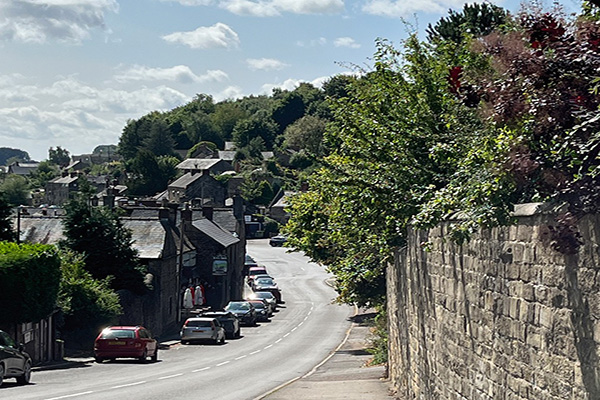
Villages once had numerous public house but now only one pub remains in the village centre, The Black Swan. Interestingly the house next door, now residential, used to be the White Swan. Animal names seemed to be very popular back then. However it cranked up a bit in Fritchley with the Red Lion! In the centre of Crich is a glorious Arts-and-Crafts house called ‘Roskeen’, rather lower than the road, with a stone ground floor and a once-timbered pair of hipped gables (unforgivably stuccoed over now) flanking an oriel. This was built, possibly by Percy Currey, for the aristocratic Dr. George Godfrey (Bosville-) MacDonald JP (1861-1935) a former Page of Honour to Queen Victoria. He was grandson of the 3rd Lord MacDonald of Slate, an Irish peer, although a Scotsman and a descendant of the Lord of the Isles. For 39 years he was the local GP, not to mention a County Councillor and Alderman. On his retirement, his daughter continued the practice for another twenty years.
Moving up Bowns Hill from the village centre we come onto Cromford Road and the Cross, an 1871 replacement designed by London architect Thomas Harris and carved by the ever-industrious Mr. Petts. This replaced a Medieval original, which had become much decayed. Enjoying it is not without its dangers, being in the midst of a busy junction with poor visibility. Behind it, another splendid Arts-and-Crafts building, the former Jovial Dutchman inn, founded in the very early 19th century and rebuilt with superimposed Venetian windows and angled porch around 1908. Regrettably, it closed in 2009 .
Beyond again, a small enclave of decent stone houses by the fine parish church, beyond which is the National Tramway Museum, founded in 1955 and laid out by the distinguished and unconventional London architect Roderick Gradidge, subsequently much expanded and with a car park in Cliff quarry, one of the greatest of the limestone quarries of Crich, and also riddled with old lead mine workings. From the road, may be seen the fine Palladian stone façade of the Derby Assembly Rooms, a collaboration between 5th Earl Ferrers, Joseph Pickford with Robert and James Adam, and which should never have been demolished.
The road forks to the left here where on the right is the Cliff Inn a popular village pub. On Plaistow Green Road sits Crich Stand. This notable landmark was first built as a hunting tower by Francis Hurt of Alderwasley in 1788, was rebuilt in 1851 and in 1923 was moved back from the fast receding edge of Cliff Quarry and reconstructed entirely to the design of Lt. Col. Alfred Brewill DSO (1861-1923) of Nottingham architects Brewill and Baily, previously architect of over 200 model cottages in New Bolsover. This was in order to raise a monument to the fallen of the Sherwood Foresters’ (Notts. & Derbys.) Regiment, and Brewill’s involvement was eminently appropriate too, as he had been until 1918 C.O. of the 1st/7th Bn. Sherwood Foresters. It was closed to motorized visitors but we walked up to it where the views to the North West and North East are incomparable.
Up on The Tor are panoramic views in all directions. One way is Nottinghamshire (where the land goes boringly flat!!) the other back over into Derbyshire where the land takes on more interest with its undulating nature. I know which way I’d go! However one thing is for sure Crich has delightful history, sits in a beautiful area and has all the amenities that you could wish for a butcher a baker and ….well, there used to be a candlemaker because I’ve seen the nails where they used to hang the candles! In the centre of the village there’s everything you need and just up off the square there is a doctors surgery and chemist. If you are the active sort you don’t really need to drive anywhere as everything’s just a ten minute walk away. Chatting to an old Frichley resident he explained they used to walk up into Crich for provisions and the kids would stop for a fight under the oak tree! Now the cars just vie for a parking slot! Heady days indeed.