Haddon Hall – A Sleeping Tudor Beauty

by Brian Spencer “What we see today is basically the unaltered fortified manor house developed between the late 12th century, and 1620 when the last and minor ‘improvements’ were made” One autumn evening a few decades ago, driving home along the A6, just short of the entrance to Haddon Hall I was stopped by a police barrier, complete with bollards and flashing blue lights. Unable to see any problems ahead or behind, I sat there and waited for developments. The answer soon became clear when a large black car drove quickly past and turned left into the hall’s entrance. As the car overtook me, I got a glimpse of its passenger, the then young Prince Charles, the Prince of Wales. Apparently, he and his sister Princess Anne used the castle when visiting Derbyshire and needing overnight accommodation they slept amidst Tudor grandeur! Their signatures together with that of their grandfather HRH King George V, are etched in the plaster above a small fireplace in the Earl’s Apartment. That their visit must be a privilege no one could deny, but who would turn down the chance of staying in this romantic relic of time gone by. What we see today is basically the unaltered fortified manor house developed between the late 12th century, and 1620 when the last and minor ‘improvements’ were made. Throughout that time Haddon Hall was owned by only three families, the Avenels, the Vernons and the Manners. It was the Avenels from Northamptonshire who built the original house, and it was lived in permanently until the Manners more or less abandoned it when Sir John Manners, 9th Earl of Rutland was created the 1st Duke of Rutland in the early eighteenth century, and the family moved to the much grander Belvoir Castle, leaving Haddon Hall suspended in time. Before that time, Haddon had been owned by the Vernons for ten generations between 1262 and 1514 with Sir George Vernon’s legendary parties which could last for weeks, earning him the title of ‘King of the Peak’. His daughter Dorothy Vernon became the best known female family member. When she eloped with Sir John Manners by crossing the pack horse bridge below the house, her escapade laid the foundations of another legend; romantic though it may be, the trouble with it is that the bridge did not exist at that time. However, one way or another, she did marry Sir John Manners, and so the Manners dynasty are still the owners of Haddon. For almost three centuries Haddon Hall remained empty and almost but not quite unloved until the 10th Duke opened the house to visitors. Little is known about the origins of Haddon, but there seems to have been a small manor house based on Saxon foundations either on the site of the present building, or nearby. The estate on which it stood stretched almost as far as Sheffield. Together with farming and lead mining, from entries in the Domesday Book of 1086 it sounds as though whoever owned the estate became very rich. The Avenels acquired the property in the 12th century, originally being tenants of William Peverel, one of King William the Conqueror’s knights. How they managed to expand these interests can only be guessed, but we can assume that their wealth grew by hard work and perhaps more than a little grovelling at the feet of their lord and master, William Peverel. What we do know is that the first mention of a house and chapel stood on the site and were thought to have been built around the mid-1100s. This was when it was mentioned in the marriage settlement of Avice Avenel, William Avenel’s eldest daughter, to Richard de Vernon in 1189. Haddon remained with the Vernon family until it passed to the Manners when Dorothy Vernon married Sir John Manners in 1567, with whose family it has remained ever since. Visitors entering the Haddon estate walk in through the gatehouse away from the car park on the opposite side of the main road. Beyond the gatehouse, the gravelled drive winds its way, over the beautiful River Wye before dividing in front of the excellent café and tea rooms. The hall sits high above to the right, on an imposing limestone outcrop. Built from local stone Haddon looks just like the setting for a Sleeping Beauty pantomime. A weathered oak door opens directly on to the gritstone flagged surface of the lower courtyard and in its right hand, south-east corner, the Tudor chapel projects like a bastion on an impregnable fortress wall. Fading yet still vibrant frescoes line the chapel walls and a jumble of box pews fill what little space the tiny nave can provide. To one side is the poignant stone effigy of a young boy, nine year old Lord Robert Charles Manners, known as Lord Haddon. This one is the copy of the sculpture now in the chapel at Belvoir Castle and was carved in 1894 by his grief-stricken mother. If Lord Haddon had lived, he was destined to become the 9th Duke of Rutland. The sloping gritstone slabbed yard is surrounded by a complex of mysterious doorways and time worn steps. The first door on the left of the entrance door gives access to a small room where many of the odds and ends found when it became necessary to lift centuries old floors during maintenance work are displayed. The museum is full of everyday items ranging from a remarkably well-preserved shoe, to a still readable child’s prayer-book. There are even accounts of worker’s wages, such as what a skilled craftsman was paid for three day’s thatching. Steps on the north-east side of the courtyard lead, on the left, to the kitchens, where the banquets prepared for the enjoyment of Sir George Vernon earned him the title, ‘King of the Peak’. We can imagine him and his guests warming themselves before a roaring log fire in the nearby Banqueting Hall. These feasts were legendary, especially when
Lost Houses of Derbyshire – Stapenhill Hall
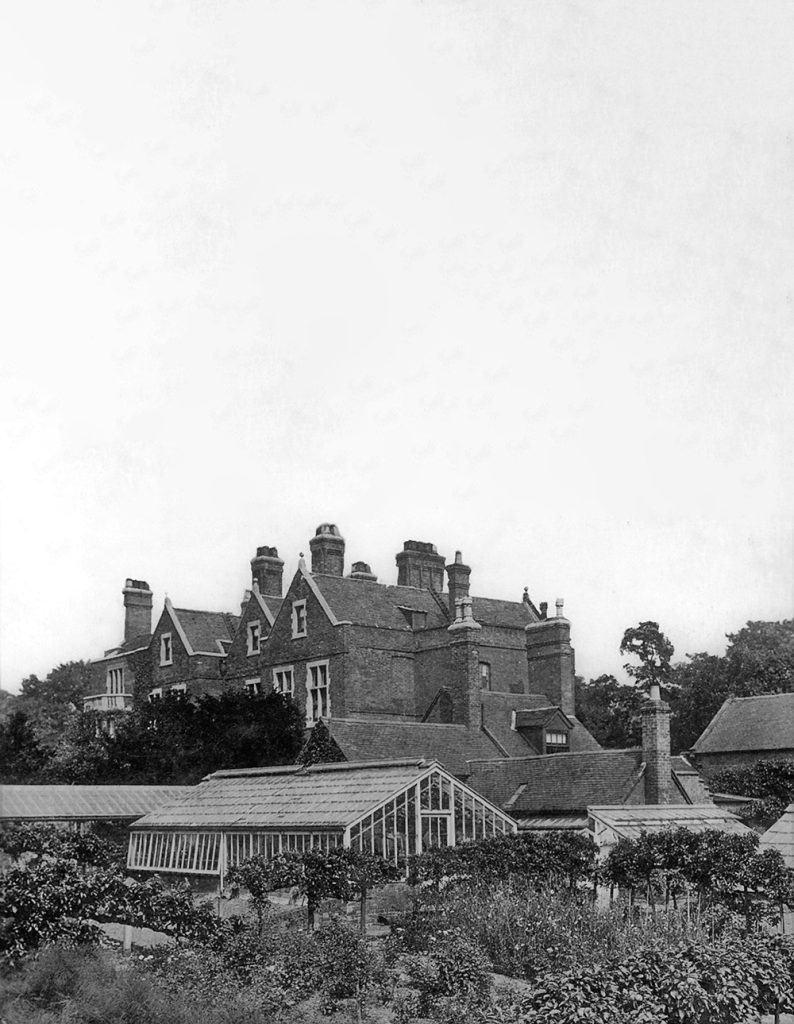
By Maxwell Craven Derbyshire lost more parishes to Staffordshire than it gained under the local government reforms of 1887 and thereafter: Clifton Campville, Croxall, Edingale, Winshill and Stapenhill among them. The desire of the Borough Burton-upon-Trent to increase rating revenue, for instance, added to a sort of municipal tidy mindedness, resulting in the transfer in 1894 of Stapenhill and Winshill to that Borough as well. There was some logic in this, as Stapenhill and Burton face each other across the Trent, the former on a bluff and the latter upon water-meadows prone, since the fourteenth century climate anomaly and the ‘little ice age’ which followed, to flooding. Even by 1894, the great and good of the Borough tended to build opulent villas there (mainly brewers or their well remunerated legal advisors), giving them splendid views west and south west over the river and town. Here, the brewers could keep an eye on their works from the comfort of their smoking room banquettes. Until 1538, Burton was dominated by its Abbey, founded by the Saxon grandee Wulfric Spot in 1004. Their land holdings grew to include part of Stapenhill, enhanced in 1192 by bequest on the death of its long-standing lord, Bertram de Verdon. According to the Staffordshire Victoria County History, there was a capital messuage at Stapenhill by the time the abbey was dissolved which, in 1546, was acquired with the rest of the abbey’s property, by William, 1st Lord Paget of Beaudesert, whose family were to dominate the history of Burton for the next four centuries, rising in eminence to become Marquesses of Anglesey. The Abbey’s leading tenants of the estate were the Abell family, originally recorded at Ticknall in the early 14th century, and who continued in occupation under the Pagets. John Abell was tenant at the dissolution, and his family must have built the first hall. His descendant, George Abell had his coat-of-arms confirmed in 1611, but his son Robert decided for reasons of religion (he was a Puritan) to migrate to America and settled in Massachusetts, where his family continued to flourish. The house as recorded on an early map and later in 1731 by Samuel and Nathaniel Buck, was a relatively simple L-plan brick house of two storeys and attics with an extension added to its rear. The only clue we have to the successors of the Abells as tenants is that Edward Hunt was taxed on nine hearths there in 1670, indicating that the house was of a pretty reasonable size. Nothing much can be discovered about Hunt, who was probably the person who married Dorothy Parker at Lichfield in 1659. It may be that he was steward to 6th Lord Paget, an eminent diplomat and consequently rarely in Staffordshire. However, thanks to Derbyshire historian William Woolley, we know that the house was renewed or replaced in the late 17th century by Hunt’s successor Charles Blount, who, he stated in 1713, ‘… had an estate here and not long since built a pretty good house on the banks of the Trent., which runs under it, who sold it to Paul Ballidon, Esq.’ Charles Blount was the younger son of Sir Henry Blount of Tittenhanger, descended from the Blounts of Blount’s Hall, a long-vanished house in Burton itself. The family, which also had Stenson House for a while, were a junior branch of the Medieval Blounts, Lords Mountjoy, of Barton Blount. The transaction implies, also, that the property had become detached from Lord Paget’s estate by that time, too. Ballidon married Sarah, daughter of Sir Thomas Gresley of Drakelow, Bt., at Stapenhill in 1715, suggesting he was already in residence by that date, but he died in 1729 without leaving any surviving issue, being followed by his widow in 1736, both being interred at Derby, where Paul’s grandfather (another Paul) had been a merchant and his great-grandfather, a mercer, had been Bailiff in 1574. The family took their name from Ballidon, in the White Peak, where one Peter de Ballidon was recorded as early as 1201. It has proved impossible to identify exactly what happened then. There was a cousin, Robert in London and others at Trusley, so one or other branch of the family probably inherited the estate, and perhaps sold it, but to whom is a mystery, although Paul’s will would no doubt make matters a little clearer. Stapenhill Hall next appears on record in 1833 when John Levett (of the family then living at Wychnor Hall) was the owner and also in residence, as a notice in the Derby Mercury assures those interested in the house and 15 acres of gardens, that he would be available to show them round. Clearly the Levetts had acquired the estate and John lived there while his father, Theophilus, was alive, moving to Wychnor once his Stapenhill residence was let. The new tenant was Thomas Allsopp of the brewing family, who later moved to The Mount at Newton Solney. Yet, ten years previously, the Levett family had sold the estate (but retained the house and gardens) to banker and brewer Joseph Clay in 1823. The Clays were directors of Bass, who had been building up a portfolio of property in Stapenhill from 1817 when Joseph had acquired the Stapenhill holdings of Thomas Lea, bankrupt, against a mortgage of £1,280 and, also through marriage with Sarah, only daughter of John Spender of Stapenhill. His eldest son Henry, soon afterwards bought the house as well into which he moved, although he much later settled grandly at now derelict Piercefield Park, on the edge of Chepstow racecourse. He thereupon rebuilt the house, subsequently re-named and described as ‘Stapenhill House…a handsome mansion’. The rebuilding, completed by 1857, was fairly drastic, providing the south (garden) front with three stone coped gables and fairly deep mullion and transom cross windows also in stone. To the west there was an extension of another wide bay, carried towards the rear by a further four bays, the central pair, like the central bay of
The Lost Houses of Derbyshire – Culland Hall

by Maxwell Craven It is perhaps quite a stretch to envisage the sheer antiquity of the site of Culland Hall, were you to visit the place today, the splendid gardens which are occasionally open to visitors and which are well worth visiting. Indeed, the present house is an agreeable neo-Georgian brick mansion, much in the later style of Sir Edwin Lutyens, and was built for the late Col. Sir Edward Thompson (1907-1994) – of Marston, Thompson & Evershed, brewers of the incomparable Pedigree ale – in 1939-41 to the designs of George Morley Eaton PRIBA of Derby who indeed died in office whilst building was going on. These works, however, necessitated the demolition of the previous house, by then apparently exceedingly dilapidated, having been in use for some generations as a farmhouse. The place gets its first mention in a charter of 1220, when it was granted to Nicholas de Caveland, second son of Henry de Osmaston and grandson of Eutropius of Brailsford . Thus, both Eutropius’ son and grandson had taken their surnames (then something of an innovation) from the place settled upon them by inheritance. Eutropius, in turn, descended from the Domesday tenant, Elfin (correctly Aelfwine), one of the few Anglo-Saxon grandees to retain their estates through the upheavals of the Conquest. And, of course it tells us how the place name Culland was rendered in the 13th century: Caveland, meaning ‘the land of Cufa’, an attested personal name, and presumably a long-forgotten pre-1066 owner, seemingly of Norse descent. This family continued there for a couple of generations and, one must assume, built a capital mansion, for which no direct evidence survives, although a moat was traceable in the 1930s, a short way from the present house. This modest estate had passed by 1380 to the Montgomerys of Cubley, then a very powerful and influential family, and was settled on a younger son, Thomas, who was recorded there also in 1401. Some time prior to 1470, the estate and presumably the ancient house, was sold or passed by inheritance to the Shaw family, whose origin is not clearly understood, and remained with them until 1497 when Thomas Shaw died. His successor was his brother, Robert, who was disbarred by being a lunatic: people with mental disability were in those days deemed incapable of administering property and were thus prevented from inheriting by statute. Thus in 1519 after a number of lawsuits, the heiress, Joan, brought the estate to Sir Ralph Shirley of Brailsford, Shirley and Staunton Harold, upon whose younger son Francis it was settled, only for him to dispose of it, before 1600, to one James Draper. The heralds’ Visitation of Derbyshire tells us that he was previously of Dockenfield, Hants., although in reality, this village is in Surrey, nearer to Farnham. The 1634 heralds’ visitation of the county informs us that arms were borne without authority and that his wife was Mary, daughter of a former London pewterer living at Bradley called John Morrey; the 1662 Visitation, contrarywise, calls her the daughter of the somewhat grander John Merry of Barton Blount. Whoever she was, they had a son called Thomas who died in 1646 leaving, by Dorothy, daughter of Robert Port of Ilam, two sons and four daughters. The eldest son was Robert (1625-1689), and he is reputed to have built a new house, of which the stable block survives, albeit extended and slightly altered in the nineteenth century. It is of red brick with Keuper sandstone dressings, gables decorated with small ball finials, flush quoins, oeil-de-boeuf windows and a plat band, now listed grade II. We may safely assume that the new house was similarly constructed and was probably a gabled, E-plan house with end gables flanking a central two storey gabled porch. It was assessed on 6 hearths in 1664, so it was only of modest size. Robert Draper married Elizabeth, daughter of Richard Harpur of Littleover Old Hall (see Country Images of June 2014) but there were no surviving children and on his death his brother Thomas, a Coventry businessman, was passed over (or had died without issue) and the youngest daughter Prudence, succeeded, having married George Newall of Windle Hill in Thurvaston. It was in his rime that William Woolley described the house in 1713 as ‘a pleasant seat – a small manor on a hill about one mile south west of Brailsford….and pretty good enclosed land.’ This period also saw the drawing of an estate map by the ubiquitous Thomas Hand (dated 1709) showing the house with two storeys and attics and three gables, all facing south west across a small park with a miniscule lake, still discernable on the 1922 6 inch OS map. The estate then ran to a modest 4191/2 acres. A generation later and George Newall had sold the estate to his cousin John Port of Ilam Hall and in 1794, the whole lot was sold to Derby lead trader William Cox of Brailsford Hall (builder in 1809 of the Derby shot tower), whose family owned it from then until the end of the Victorian era. Cox, a great improver, decided that the house should henceforth be run as a tenanted farm as part of his Brailsford hall estate (see Country Images April 2019), and decided to reduce and extensively rebuild the hall again, early in the nineteenth century. He re-orientated the main part of the house, providing two brick parallel ranges running east-west with gabled ends, stuccoed, and leaving only one range of the older house which, oddly, was retained and, being orientated SE to NW, gave the post-rebuilding plan a rather odd look. The new south front was given superimposed Regency tripartite windows flanking a central pedimented entrance with a single sash above. There were lower extensions to the east and west, that to the west being very much lower, probably older, and was presumably a service wing. The stables lay behind, with other ‘model’ farm buildings provided to the north, now amply
Lost Houses of Derbyshire – Old Foremark Hall
The estate at Foremark, where once the invading Vikings over-wintered in 783-784, was granted to Nigel de Stafford,a (genuine) comrade-in-arms of the Conqueror and ancestor in the male line of the Stafford, Longford and Gresley families. His family’s later sub-tenant was a junior member of the powerful de Ferrers family, whence it passed through an heiress to Bertram de Verdon, a substantial south Derbyshire land holder, in the later twelfth century. In 1387 the de Verdons sold it to Sir Robert Franceys, one of whose descendants two centuries later married the heiress of his close relations, the Franceys family of neighbouring Ticknall. The family seat then was at Knowle Hill, on a plateau at the top of the west edge of the ravine, in which lay the later house there, which I wrote about in these pages just over three years ago. It is presumed to have been a timber framed courtyard house; the surviving remnant of the present house lies on the footprint of the east range of its predecessor. Jane, daughter and heiress of William Franceys of Foremark married in 1602 Thomas Burdett of Bramcote – not the Bramcote down the end of the A52 from Derbv in Nottinghamshire, but that near Polesworth in Warwickshire, albeit not so very far from the SW edge of Derbyshire. The Burdetts, who originated at Lowesby in Leicestershire, had been at Bramcote since 1327, but the couple decided to live at Foremark in an old stone house that the Franceys family had built in Queen Elizabeth’s time. Thomas was High Sheriff of Derbyshire in 1610, and in 1619 was created a baronet, taking his title from his ancestral estate at Bramcote – mainly because his father-in-law was still alive at that time, and to be ‘of Foremark’ would have been more than a trifle presumptuous! It was their son Sir Franceys, who seems to have set about rebuilding or enlarging the house at the Restoration. He also replaced the parish church of St. Saviour at the same time, positioning it a few yards due east of the house, to serve almost as a domestic chapel as well as for spiritual nourishment of the villagers of Foremark and Milton. We are fortunate in that a painting, attributed to Jacob Esselins and believed to be of this house, was sold at Christie’s in May 1998. It was painted around 1665, so the building was then largely new, although very traditional in style, probably dictated by the portions of the existing house that Sir Franceys wished to include. The house we see was of locally quarried Keuper Sandstone, U-plan with four straight coped gables, the central pair recessed over the great hall – almost certainly a hangover from the Franceys’ house – divided by a chimneystack. The western cross wing terminated in a matching gable with six and three light mullioned windows, whilst its counterpart of the east of the façade was clearly of the later build, with mullion and transom cross windows throughout. The west front also appears to have had two further gables like the other, coped and with ball finials. The stables (replaced in the 1720s by the present range) were also on this west side and the whole ensemble was set within a wall pierced by a pair of imposing gate piers (clearly of Sir Franceys’ day) from which one descended into the forecourt. In 1713 William Woolley described it as ‘large and convenient with a large well wooded park and coney warren adjoining.’ In 1662 it was assessed on a substantial 24 hearths for tax purposes. Regrettably, there is no hint as to the interior, bar an enumeration of the rooms in an inventory. The church (listed grade I) may have been begun during the Civil War, for a sundial dated 1650 graces the exterior but, unlike Sir Robert Shirley at Staunton Harold, Sir Franceys clearly did not risk continuing until the return of better times; the building was sufficiently complete to be dedicated in 1662. There are two other sundials, too, and the four bells are by George Oldfield and bear various dates between 1660 and 1668. The east end has the arms of the family above the Gothic window, surrounded by positively Elizabeth carved strapwork, despite the late date. Inside, there are box pews, a delightful arcaded oak screen, probably locally carved in a style well out of date by 1660, a medieval font, a timber altar with a later Hoptonwood stone top and in 1710 ironsmith Robert Bakewell added a pretty communion rail, and a splendid pair of iron gates under an elaborate overthrow at the east end through which the Burdetts had to pass on their way to worship. The gallery was only installed in 1819. Whilst Sir Franceys Burdett’s house stood, the three, house, park and church, could be read together as a coherent ensemble, and in a particularly fine setting. Sir Robert Burdett, 3rd Bt. was a long serving MP and was thrice married, although of his five sons only one survived but even he managed to pre-decease his father by two months. Hence, by the time of his death in 1716 aged 76, his younger brother Walter was expected to succeed to the title, but Sir Robert seems to have been a game old soul, for Elizabeth, his widow, was pregnant when he died in the January, and was duly delivered of a boy in May, named after his father and who succeeded at birth. This Sir Robert came of age in 1737, and it is thought that the fête champêtre depicted that year by Thomas Smith of Derby in front of the ancient heritage by the river at Ingleby on the estate was held to mark his coming-of-age. The caves there were enlarge at about this time to enable such convivial events to be made more convenient, just as Knowle Hill was demolished and rebuilt as a folly by Sir Robert in the 1760s for similar reasons. The year after this
The Lost Houses of Derbyshire – Pilsley Old Hall

The last lost house about which I wrote was Coney Green Hall, bought in 1774 for £4,000 by Thomas Wilson, who also acquired Pilsley Old Hall, just over two miles away and still in North Wingfield parish, so it seemed logical to move right on to chronicle what we know about the latter. The Old Hall at Pilsley was a superb example of a minor Derbyshire manor house: seventeenth century in date, compact, gabled and sturdily built. It was deservedly listed II*, and was by no means too large to make a viable home for a modern family and by the time of its demise in 1965, it was in tatty shape but in reasonable overall repair. Its loss, therefore, prior to the 1968 Act came into force on 1st January 1969, which would have afforded it better protection, seems from today’s viewpoint well-nigh indefensible. The house was built of roughly coursed coal-measures sandstone and with a stone slate roof, topped by four stone chimneys, latterly with brick tops, neatly emphasising the hearth tax assessment of four hearths chargeable in 1670, although no doubt hearths were added to the bedrooms later. It consisted of two parallel ranges, running north to south, giving a twin gabled façade, each gable surmounting two bays on the principal floors and a central attic light, all originally being mullioned, probably the larger ones with single transoms. The windows had moulded surrounds and there was an unpretentious central entrance. The west side sported a ladder staircase window, lighting a fine quality Regency timber staircase (a replacement no doubt, for a more substantial original oak one) with a stick balustrade, triglyph carved tread ends over a Vitruvian scroll and a curled mahogany rail. Indeed, the tread ends are sufficiently old fashioned for one to suspect the staircase was perhaps at least a couple of generations earlier and was perhaps merely fitted up with a new balustrade by the Wilsons, possibly because the original one had become damaged. The east front was blind for two thirds of its length, ending with another staircase light, presumably for the secondary stair, and surviving superimposed two light mullioned windows beyond. Inside, the house was spacious and clearly intended for a gentleman rather than to act as a farmhouse, with a number of distinctive chimneypieces, most of which managed to survive into the twentieth century, that in the parlour even being flanked by a pair of arched niches complete with fielded panelled doors. Others boasted bolection mouldings, and some were of Hoptonwood polished limestone as, inevitably, were the cantilevered staircase and the floors in the hall and kitchen. Apart from modest cornices and dados, little superfluous ornament was applied and if there was panelling (highly likely), it had all gone by the time the Royal Commission of Historic Monuments for England photographed the house. At the time of Domesday, Pilsley was held in chief by Walter d’Eyncourt whose seat, Ayncourt, lay nearby (latterly a moated site, lost to coal mining in the later 19th century) and remained in the senior line of that family until 1442 when Robert, 7th Lord d’Eyncourt of Pilsley died without leaving any children. His barony fell into abeyance between the descendants of two aunts, and the estates passed to the then all-powerful Lord Treasurer, Ralph, Lord Cromwell, whose seat was Wingfield Manor. In 1456, he too, died without leaving issue when Pilsley passed to William 7th Lord Lovell of Tichmarsh. The son, Lord Lovell, Holland & Grey (of Rotherfield), was later attainted for high treason in 1484, when the estate reverted to the Crown. The estate at Pilsley then came to the Leakes of Sutton Scarsdale, although for whom it was built, probably c. 1630, is unclear: either a younger son, or for the estate’s bailiff or agent. Certainly, one junior branch lived at nearby Williamthorpe Hall and another might easily have been ensconced at Pilsley. Nicholas, 4th Earl of Scarsdale, spent a colossal sum rebuilding his main house at Sutton Scarsdale with one of England’s Baroque masterpieces (see May’s County Images), gambled heavily, dying without issue and essentially bankrupt in 1736, when it was sold to Richard Calton of Chesterfield a lawyer, who completed in 1743. He it was who probably converted the main fenestration to sashes in plain surrounds; the glazing bars were fairly thick, which invariably betokens an earlier eighteenth century date. His descendants lived there until the late 18th century when it was sold, along with Coney Green Hall, to Thomas Wilson, from a Nottinghamshire family snobbishly described in Throsby’s edition of Thoroton’s History of Nottinghamshire as ‘rich graziers.’ The fine regency staircase and other improvements were probably the work of the Wilsons, who, readers may recall, also set about making alterations to Coney Green as well. In 1850, William Henry Wilson, a land surveyor, was living there, and it was then that his family sold it to John Sampson a local brick and tile manufacturer. Later the Sampsons, in the person of the son, Luke, sold it again in 1880 but with only 23 acres, the remainder remaining in the hands of the Sampsons until the mid-1930s when, on the death of Thomas, Luke Sampson’s son, it was all sold up. The purchaser of the house, however, was E. A. Storer and in the Edwardian period, it was let to Granville Chambers, and later sold around 1930 to Mathew Eyre Wilde, JP who let it to Solomon Cutts. Post war, the last owner was F. Gardener of Littleover, but the house had fallen empty by the early 1960s, and architects Bestwick, Bowler and Hagg successfully applied for consent to demolish, and it came down on 13th August 1968, to be replaced – you guessed it! – by a new housing development. Why the developer could not have divided this venerable old hall into a pair of very pleasant period residences and built new houses, preferably out of local stone to a good design, beyond the immediate surroundings is a mystery; the
The Lost Houses of Derbyshire : Coney Green House – North Wingfield

The name Brailsford is a common one in Derbyshire (not to mention elsewhere), and received added lustre through the knighthood granted to Shardlow-born Sir Dave Brailsford in 2012 for services to cycling (notably Olympic cycling). As Brailsford is an unique place-name, it is generally accepted that all people of this name descend from the ancient knightly family of that name, who descend from Elfin (otherwise Aelfwine or Elsinus) de Brailsford, a man of Anglo-Saxon ancestry who, unusually, held the manor of Brailsford when Domesday Book was compiled in 1086. Fortunately, they are well documented, even in this early period, so we know much about the younger sons and their posterity. Eventually, Brailsford passed from the family with the death without male issue of Sir Henry Brailsford in 1356 when the estate passed through his daughter Joanna to Sir John Basset of Cheadle and from the Bassets eventually to the Shirleys. Robert de Brailsford, second son of Nicholas, Aelfwine’s son, called himself de Wingerworth, having inherited through marriage an estate there and other land in the area including North Wingfield. Sir Engenulf de Brailsford, a great-grandson of this Robert was living in 1232 and 1259 and left two sons, of whom, the elder William, was granted house and land at Tupton (probably Egstow) and other land at North Wingfield by Sir Henry, the last of Brailsford, and with his wife Agnes he settled there. His posterity acquired an estate at Seanor two miles to the east (nothing seems to remain of the house) and members of the family are found at Little Brailsford in North Wingfield, and The Hill there. Thomas Brailsford of Seanor married Penelope, daughter and heiress of John Clay of Crich and their third son, Thomas is described as being ‘of Coneygree’ in a list of freeholders of 1633. His son of the same name, a doctor, later sold Seanor and settled at Coney Green (as the name later became). He was assessed for hearth tax on a substantial seven hearths in 1670, and in 1681 (if we are to believe the record of a datestone from the house) rebuilt the house, dying in 1720. The next we hear of the house is a notice in the Derby Mercury for 31st July 1772 for its sale by Francis Brailsford with an estate of 110 acres, its ‘grounds within a ring fence and coal under the greater part of the premises.’ The buyer, probably keen to invest in mining, was Thomas Fanshaw of Brough, but clearly his plans came to nought – perhaps he couldn’t raise the necessary finance to start mining – and two years later the house and estate ‘convenient for a gentleman’s family’ was again sold, this time to Thomas Wilson, who paid £4,000 for both Coney Green Hall and Pilsley Old Hall (on which watch this space!) Wilson was a member of an old-established local family, and was already a coal-owner, so we may be confident that he was well funded in his endeavour. It was, without doubt Wilson who re-fronted Dr. Brailsford’s old house, with a classical façade of locally quarried and ashlared coal measures sandstone, probably the seam known as Top Hard Rock – much sought after for building. The result was a slightly bizarre mix of Palladian with Baroque overtones, and was probably composed by a local builder using a pattern-book. There must have been some ornate pleasure grounds surrounding the house too, for a pair of lakes in a small park-like enclosure still remained according the 6 inch OS map surveyed in 1878. There was also a courtyard surrounded on three sides by farm buildings to the SW of the house, too. As we only have one image of the house (a photograph dated 1883) it is impossible to assess how much of Dr. Brailsford’s house remained, but the likelihood is that most of it did. The new façade was of five bays, a particularly wide central one breaking forward slightly with rusticated quoins at the angles under a modillion cornice and plain parapet. This probably fronted a set of spacious new rooms flanking a notably wide hall, a fact that can be deduced from the width of the central bay of the house. The thoroughly wayward entrance is tripartite, with the door’s fanlight rising through an open pediment (very Palladian and out of date by 1774) but both that and the sidelights were embellished with rusticated surrounds best known as Gibbs surrounds, after the Baroque architect James Gibbs who first used them, and which can be seen on Derby Cathedral, which he designed in 1723. Above that is a Serlian (‘Venetian’) window matching the entrance in width, but strangely plain after the bravura treatment of the doorcase below. Otherwise, the fenestration is notably plain except for discreet key-blocks. The only architect operating locally who made much use of Gibbs surrounds was Edmund Stanley of Chesterfield, who used them in 1754 on the entrance of Lea Hall, but this is a much more disciplined piece of architecture. Working with Joseph Pickford at Ogston Hall just over a decade later, and in Palladian mode, seems to have cured him of this sort of thing in any case, hence the suggestion that we are looking at the work of a local builder cherry-picking things from a builder’s pattern book. One suspects that the hall was quite a grand affair and it probably had a columned screen on its far side with Dr. Brailsford’s Restoration staircase rising behind. This would explain why Wilson’s homonymous son decided to further rebuild the house in 1811 which feat he marked with a second datestone which read: At this remove one can have little idea as to what Thomas, junior had done, but it probably involved ‘modernising’ the rear range. Either way, he retained the 1681 date stone in the fabric. By 1827, the house had passed to his son William and by 1843 his brother Thomas Wilson III had the house, and the demesne was
The Lost Houses of Derbyshire – Fenny Bentley Old Hall

When travelling to Buxton from Derby, as we did in May to visit the annual Buxton Antiques Fair, we usually go via Ashbourne and the A515 rather than the A6, which is slower, if more direct. This takes us through Fenny Bentley and one of the delights of passing that village is to be able to refresh oneself at the Coach and Horses (usually on the way back) and the other is to catch sight of the Old Hall, situated on a corner of the road just beyond the pub, as one sweeps up the hill towards the railway bridge. What one sees is the arresting sight of a gnarled old square three storey stone tower with a couple of superimposed doorways facing the road, shielded on the west by a remnant of cyclopean walling. Attached, behind, is a 17th century house of two storeys with a wide attic gable. The ensemble is delightful and arresting, and the tower marks the surviving vestiges of another lost Derbyshire country house, described by Samuel and Daniel Lysons as ‘once a large castellated mansion’ At Domesday, Bentley was held as an outlier of the King’s manor of Ashbourne, but by the 1180s it appears to have become constituted as a separate manorial estate, and was held by Richard de Bentley. Presumably his family built a capital mansion there, probably moated (the present site is said to contain remnants of a moat), but the passage of the estate and family are confusing in the extreme, and after John son of William de Bentley, who was also of Broadlow Ash nearby, we hear no more of them at Fenny Bentley, and the manor appears to have been divided, probably between two coheiresses, one marrying a Beresford of Beresford, a spectacular site overlooking the Dove, slightly to the west (possibly with an intervening generation of Bassets), the other, it would seem, a Bradbourne of Bradbourne. By the fifteenth century, we find a capital mansion being held at Fenny Bentley by John Beresford, who was also of Newton Grange, a couple of miles to the north, and also now a farmhouse. His son Thomas died in 1473, leaving Fenny Bentley to his son Aden and Newton Grange to his other son, Thomas. By this time the manor house, of which the surviving tower was once part, had been built. As the Beresfords were an important family, the likelihood is that the house was built around two courtyards, like Haddon and now Norbury, which was discovered to have been on this scale by archaeological excavation in 2009. The surviving fragment has been canvassed as a gatehouse, but if so, how to explain the remaining stub of wall running westward from it, and the fact that until the 18th century there was a second, similar tower to its east? Furthermore, both towers were crenellated, as the Lysons (writing in 1817) attest. The supposition must be that the towers marked the outer courtyard of a stoutly defended house, and Dr. Anthony Emery has pointed out a similarity to the surviving tower of Smisby Manor. The superimposed internal doors on the west side, along with the wall stub suggest a two storey north range of the outer courtyard having once stood here with the tower at the angle. The house passed down through the generations of Beresfords until Olivia Beresford married John Stanhope of Elvaston and their daughter brought it in marriage to Charles Cotton, whose son, another Charles, was the likeable poet and intimate of Izaak Walton, who fished in Cotton’s section of the Dove. He fell hopelessly into debt (partly through backing the King in the Civil War) resulting in its ultimate sale to the Jacksons of Stanshope, Staffordshire. Whilst Charles Cotton lived at Beresford Hall, the old manor house was something of a burden, and he seems to have reduced it and let it, ironically to Mrs. Beresford, mother of the then Beresford of Newton Grange and Compton (Ashbourne), who was assessed for tax on only eight hearths there in 1670, which suggests that probably an entire courtyard had been de-commissioned. Nor did the Jacksons have any use for the old house once Mrs. Beresford had died, so they sold it to the Recorder of Derby, Sir Simon Degge (1612-1703), of Abbot’s Hill House in Derby a year or two before 1680. He also had a small ancestral estate at Stramshall in Staffordshire, and one wonders if he had any intention of using the house himself. Nevertheless, he spent some money on it. It would appear that he demolished all the medieval house except the two towers and built the present rather high quality farmhouse between them. The portion to the west behind the tower may have been fashioned in the 18th century from a fragment of the old house, too. Degge’s work bore his initials and the date of 1680 (no longer visible) and the symmetry of the design: taller ceilings on the first floor with rooms lit by one four and two six-light mullioned and transomed windows with a four light window in matching style lighting the attic above. The retention of the surviving tower was originally to provide a newel staircase which leads into the principal chamber which has chamfered door jambs surviving from the original house, and a south facing room was fashioned on the tower’s first floor lit by a full width mullioned and transomed window. Despite the present simplicity of the central entrance, one did not, in the third quarter of the 17th century, build a suite of grand rooms on the first floor with rather meaner service accommodation below for a farmer to enjoy. Clearly this was no farmhouse, and it seems likely that Degge intended to use it perhaps, as a summer residence. Sir Simon’s grandson, Dr. Simon Degge FRS, FSA was an antiquary, who excavated at Repton amongst other places, but on his death in 1724, the house and estate were sold, being bought by the descendants
The Lost Houses of Derbyshire – Glossop Hall

The Glossop Hall that was demolished in 1958-59 was an unlovely house of titanic proportions, once set in a spectacular wooded park. Unlovely it may have been, but it had an interesting history and was itself at least the third house on the site, although it probably included portions of the fabric of at least one of its predecessors. The manorial estate of Glossop passed at the Dissolution from the Abbey of Basingwerk to the Talbots, Earls of Shrewsbury & Waterford, of whom George, the 6th Earl had the dubious fortune to have married Bess of Hardwick, who spent much of his fortune building prodigy houses like Worksop Manor and Hardwick. At this stage we have no knowledge if there was a manor house at Glossop, especially as all the families mentioned so far were firmly seated elsewhere. This situation appears to have continued until the death of the 7th Earl of Shrewsbury, who left a crop of daughters but no sons, amongst whom his estates were parcelled out. Much of the Derbyshire land went to Lady Alathea Talbot who in 1606 married Thomas Howard, a grandson of the Attainted 4th Duke of Norfolk, who went by one of his subsidiary titles, the Earl of Arundel, although Charles II made his son Earl of Norfolk, and his grand-son had the Dukedom restored to him by reversal of the Act of Attainder. The couple’s son Henry Frederick Howard, a Catholic, like all his family, was fairly prolific, producing at least five sons, of whom the youngest was Bernard, (1641-1717) who actually lived at Glossop and in all probability built there a new house on rolling parkland west of Old Glossop. From his time there long survived a chimney-piece dated 1672 and a priest’s hole, which survived later rebuilding. His son also Bernard (1674-1713) married a lady with a house situated in a less climatically inclement part of England, and moved out in 1712, settling a lease for life on his cousin Lady Philippa Howard, a daughter of the 6th Duke of Norfolk. This was because her husband, Ralph Standish of Standish, near Wigan, was a younger son and they thus needed a house. Thus the couple with their three sons and three daughters settled at Glossop, but clearly wanted a more modern house, so began to replace or rebuild Bernard Howard’s Jacobean house in 1729-31. Work stopped in the latter year, probably with the house mostly complete, when Lady Philippa died, leaving Ralph with a single surviving child, a daughter, Cecilia, born in 1699 and by this time married to William Towneley of Towneley Hall, near Burnley and living away from home. He continued to live part of the time at the house but on his death in 1755 aged 84, the house and its vast moorland estates reverted to the main Howard line in the person of Henry Howard, (1713-1787) who resumed using the house, but only as a shooting box in the season. At this stage, the house itself bore the name Royle Hall after the ancient name of the pastures west and south of the old village on which it had been built. A sketch of it taken in the later 18th century shows a three bay house with a hipped roof, a single bay extension to the south and another to the north, but much lower and probably the small domestic (Catholic) chapel suggests that the house started off as a simple William-and-Mary (that is, rather old fashioned for its date) house of two storeys and attics. In 1827 the diarist James Butterworth visited the area and wrote: ‘At a small distance from the village stands an ancient building called Royle Hall, but now named Glossop Hall. It serves as a retreat during the shooting season, there being plenty of game here; Round it are planted large firs, and in front a very extensive hill is covered with firs of many years growth, through which are pleasant roads.’ And by the 1780s the house was only permanently inhabited by the rather aristocratic agent Charles Calvert with the estate bailiff Thomas Shaw inhabiting the service wing. Calvert had moved on by 1797, however, when the role was taken over by Matthew Ellison, who first re-named the house Glossop Hall. The Ellisons were a Staffordshire family and Matthew had three sons, one, Francis, adopted, and four daughters. Whilst the eldest, Thomas sired a long line of Glossop solicitors, and Frank founded a mill in the town, later living at Park Hall, Michael succeeded as agent at the Hall and he by his son, Michael Joseph Ellison. Meanwhile, one of the daughters, Mary, had married Joseph Hadfield of Lees Hall nearby and their son was Matthew Ellison Hadfield, of whom more anon. Bernard Edward FitzAlan-Howard was in occasional residence in 1815 when he succeeded a distant cousin as 12th Duke of Norfolk. At first, having inherited the house, he extended and remodelled it to the designs of London based family architect Robert Abraham (1774-1850). This consisted of extending northwards a further five bays, the extension to include a new, grander, staircase, but it was done in matching style, complete with attic dormers and banding between the storeys and of small limestone ashlars with millstone grit dressings. Abraham also provided a fine new pedimented stable block set around a courtyard, to the west of the house, embellished with a Wren-like tower and walling replete with rusticated piers topped with ball finials. On the Duke’s death in 1842, the estate went to his second son, Lord Edward FitzAlan-Howard, later (1869) created 1st Lord Howard of Glossop. Not satisfied with the house his father had created, he decided to embellish the whole starting in 1850, and this time employing his agent’s cousin, Matthew Ellison Hadfield (1812-1885) as architect. Hadfield had been articled to Woodhead and Hurst of Sheffield before working for P F Robinson in London. He returned to Sheffield to set up in practice in 1832, taken John Grey Weightman as
Lost Houses of Derbyshire – Spondon House

Spondon House was a fine Georgian mansion, in reality a secondary seat on the Locko estate of the Drury Lowes. Yet it was not without presence, and its history not without interest. All accounts of the house, the building records for which are absent from the Drury-Lowe archive at the University of Nottingham Library, aver that it was built as a dower house, and its plain, well-proportioned appearance suggest that this event took place in the last quarter of the 18th century. The house itself, as built, was of brick, a single pile with three bays and two and a half storeys, gable ended with prominent kneelers, with a central arched entrance under a broken pediment, standing in landscaped grounds. By the time of the first known illustration of it – a lithograph of c. 1840 – the ground floor windows flanking this door had been modified with canted bays under perfunctory hipped roofs, part of a Regency makeover which included the addition of a lower, two bay matching wing on the SE angle, still of two and a half storeys. The north side, too, apart from (probably) two ground floor tripartite windows, was quite devoid of fenestration. In the mid-Victorian period, the house was extended yet again by a two storey wing with service accommodation on the NE side. This included the provision of the second staircase and the moving of the main entrance from the centre of the original range to the angle of that and the Regency SE addition, making way for a conservatory, very like that of Spondon Hall, along the south front. The new staircase was lit by an octagonal, conical top-light with a shallow roof topped by a jaunty ball finial, sitting a little awkwardly on a flat section of roof where the two additional ranges met, at the east end of the main range. The first Lowe of Locko, was John (1704-1771), eldest of the four sons of Vincent Lowe of Denby by Theodosia, a daughter of John Marriott of Alscot, Gloucestershire. John married his mother’s niece, Sydney Marriott, herself the sole heiress of the family’s Gloucestershire estate, but they had no issue. His next brother, Vincent, had pre-deceased him unmarried, whilst the next, Stead Lowe, migrated to America, leaving a son, Stead. The youngest brother, Richard (1716-1785) therefore succeeded John at Locko in 1771. Most genealogies sanitise the family history at this point, having him die unmarried but, late in life, he did marry, his bride being his long-standing maîtresse en titre, Ellen Leyton, previously mother by him of three daughters. On Richard’s death, however, the estate reverted, not to the American Stead Lowe, junior, as one might expect, but to William Drury, a Nottingham-born London merchant, whose grandmother had been Vincent Lowe’s sister, and in 1790 he assumed the additional surname and arms of Lowe by Royal Sign Manual. He then set about greatly enlarging the reasonably modest provincial Baroque Smith of Warwick Locko Hall, but died in July 1827 leaving only a daughter and heiress, Mary Anne, who had run away to get married at Gretna Green in August 1800. Why the skulduggery – which drew down the displeasure of her parents – is unclear, because her swain was entirely suitable: Robert Holden of Nuthall Temple and Darley Hall (1765-1844). Indeed, the Holdens were of rather more distinguished lineage than the Drurys, and just as well off! Spondon House, being so plain and simple, was probably built for the widowed Ellen Lowe and her three daughters, which would suggest a building date of 1785, which looks entirely right. Possibly William Drury wanted nothing much to do with poor Ellen, and Spondon House would have been provided with the minimum of ornament and a lowish cost, probably built by the Locko estate foreman using a plan and elevations from one of the many well-illustrated builders’ manuals then available. The rooms inside, according to a late friend who was educated there, were quite plain and the staircase (albeit moved, as noted above) was typical of the period, being timber with mahogany rail and stick balusters. It is not clear when Ellen Lowe died but, by 1801, runaway Mary Anne and Robert Holden were in residence, and they not only re-named it Aston Lodge (after the Aston-on-Trent estate from which these Holdens sprang) but set about enlarging it. They appear to have put in the windows either side of the entrance and also added the substantial, but slightly lower range to the right of the entrance. However, by 1814, Aston Lodge, as it now was, became vacant yet again, which must suggest that, with the then recent improvements wrought to Locko by John Dodds and William Lees of Derby, there was room for two households there. Thus in that year Spondon House was let to Miss Edwards who founded an ‘Academy for Young Ladies’ which flourished there until 1844. That was the year Robert Holden died, and Miss Edwards was obliged to re-locate to Derby, so that his widow Mary Anne could move in, her son William Drury Holden (thereafter Lowe) having succeeded to Locko. For her, without doubt, was the NE extension built, resulting in the new entrance, conservatory and moved staircase with the accompanying strange roof arrangements at the east end of the house. Yet in the event, she died only five years later, in 1849, leaving Spondon House (as it was once more) vacant. In 1854 a new lease was acquired by Revd. Thomas Gascoigne, who founded a prep school called ‘Spondon House School for the sons of Gentlemen’ there. He was joined in 1874 by Revd. Edward Priestland, who married his daughter and later took over as proprietor and headmaster of what, under his enthusiastic guidance, was to become one of the best schools of its type in the area; the Australians even played their cricket team in 1898! So much so, that following Priestland’s retirement, and under his successor, C. H. T. Hayman, it amalgamated with Winchester
The Lost Houses of Derbyshire – Willesley Hall, Ashby

Until the local government reforms of 1888-1889 Derbyshire did not sit inside a single boundary; it has detached ‘islands’, mainly to its south, created in the Saxon period by assarting – clearing of woodland by men of Derbyshire in un-adopted regions. The settlements so created, once the County system had become established in the mid-10th century, tended to become detached parts of the area (county) of the people who had initially created them. Several counties had them. Derbyshire itself boasted Appleby Parva, Chilcote, Clifton Camville, Donisthorpe, Edingale, Measham, Oakthorpe, Ravenstone (the most southerly), Stretton-en-le-Field – and Willesley. Since 1889 they have been divided amongst Leicestershire and Staffordshire. Several of these ‘islands’ had substantial country houses, and indeed most of them have vanished, some almost without trace. Willesley was probably the grandest though. The place itself was one of those granted by the Mercian grandee Wulfric Spott to the Abbey of Burton in his will, but post-Conquest it was divided between the de Ferrers Earls of Derby (later the Duchy of Lancaster) and the Abbey. The manorial estate was initially tenanted under them by the de Willesley family who built a chapel, before passing it on to the Ingwardby family and then, also by inheritance, to the Abneys of Ingleby, who eventually united the estate. These families had few properties outside Willesley, so it is likely that there was an historic manor house, probably on the site of the house that was demolished in 1953. Unfortunately, nothing is known of its early appearance. The later house, which formed the core of the later one, was described by William Woolley in his History of Derbyshire (1713) as ‘a good seat’, with the Lysons’ brothers (1817) adding ‘The manor house which is in the form of a letter H, appears to have been built in or about the time of Charles I’ – that is the period 1625-1649. It was taxed on 16 hearths in 1670 suggesting that it was a substantial building. The earliest picture is an engraving of 1820, showing a substantial brick house of two stories and attics, with an eleven bay façade, the projecting cross-wings at each end of the main block being of three bays. The gables were elaborately shaped, rather similar to those of contemporary Thrumpton Hall, on the County’s Nottinghamshire border, and these may well be original to c. 1630, suggesting its builder was George Abney or his son James. However, the late Professor Andor Gomme, looking at the heavily stone-clad rusticated façade with its Ionic pilasters enclosing a swagger pedimented doorcase, was confident in attributing these later features to a fairly drastic 1720s rebuilding by Francis Smith of Warwick, architect of Sutton Scarsdale, a house which it closely resembles in these details. Smith, judging from some later accounts, also opened out the interior to create a double height hall and installed a fine timber staircase behind it, whilst at the same time endowing the gables with slim Baroque urn finials. The windows were deepened, sashed and given stone key-blocks. The rhythm of the façade has much in common with another work by Smith, Stanford Hall on the Leicestershire-Northamptonshire border, just off the M1. The rustication probably owes its inspiration to another Northamptonshire house, Lamport Hall, where a similar treatment was meted out to an earlier house by Wren’s follower, John Webb from 1655. A landscaped park of 155 acres was created, including a modest lake, and this may have been later and attributable to William Emes (1729-1803), a locally based follower of Capability Brown. The man who commissioned these works was probably not Sir Edward Abney (died 1728), a senior retired judge, who has been blind for the last twenty years of his life, but his son, Sir Thomas (1691-1750). And so matters rested until 1791 then Thomas Abney of Willesley, the last of his direct line, died, leaving an only daughter, Parnell, married to a member of an illustrious neighbouring family, Maj. Charles Hastings, a French-born natural son of Francis, 10th Earl of Huntingdon, whose chief seat was then Ashby Castle. Thomas, who had a distinguished military and diplomatic career was raised to a baronetcy in 1806, assuming the surname and arms of Abney-Hastings by Royal Licence. During the Napoleonic Wars he entertained at Willesley numerous officers of the French navy and Grand Armée with whom he felt to a degree at home, being a fluent French speaker and the son of a Parisian actress. He was also a prominent Freemason, as trait he shared with many of them. His younger son, Francis (born at Willesley in 1794) was a distinguished naval architect and commander. He was recruited by the Greek insurgents, financed by the Byzantine grandee and banker Prince Paul Rhodokanakis-Doukas, to oversee the building and to command the Karteria, the first steam powered warship ever to see action. At her helm, he effectively reduced the threat of the Ottoman navy and, despite being carried off by disease, like his friend Byron, at Missolonghi in 1828, made a considerable contribution to the liberation of Greece. His bust in bronze may still be seen there. Unfortunately Sir Thomas shot himself in 1823, and the estate passed to his elder son, the 2nd baronet. He later set about enlarging the house. The south front acquired a pair of small gables over the bays flanking the entrance and a coat-of-arms above an inscribed tablet was placed between them. The formerly plain west side was much extended, with similar gables, but largely lower and irregular, extending back to the small stone chapel, founded by Michael de Willesley before 1270, but later clad in stone and embattled some years before. But the changes did not stop there. A medium sized manor house was about to become a major seat, for the north side, where there was previously a re-entrant courtyard, was replaced by a three storey square plan diapered brick tower ending in four ogee topped pinnacles at the angles, all joined by a pierced stone balustrade,