Taste Derbyshire – The Porcini Remained Elusive
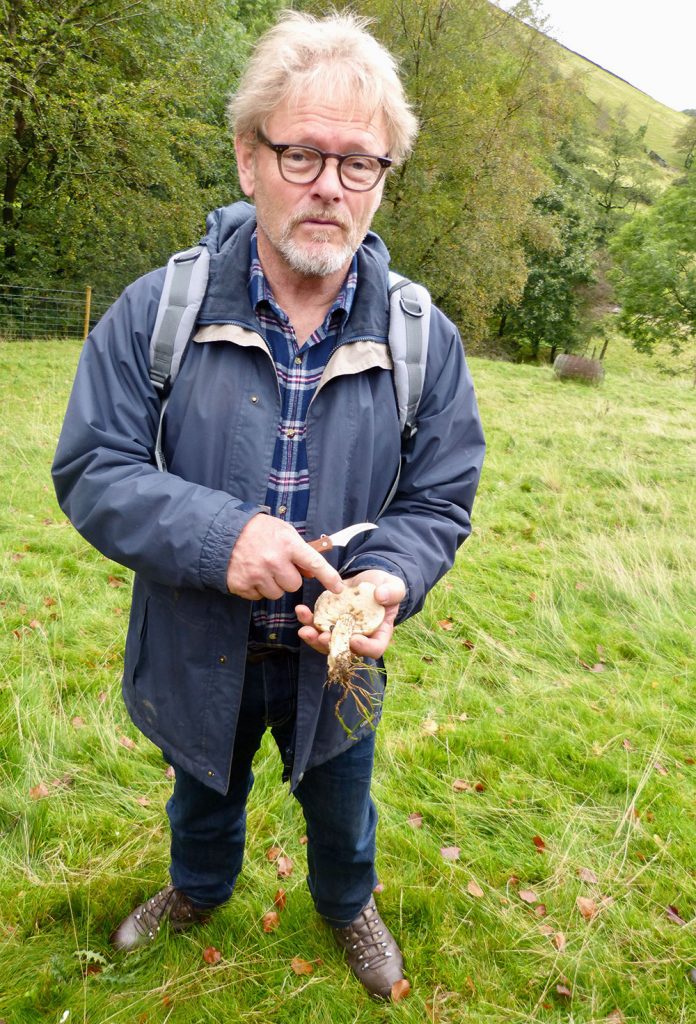
Foraging for food in the Derbyshire Peaks may sound idyllic but, when the clouds are ominously heavy with rain, there is only one thing in nature’s larder which could drag me from my bed on a Sunday morning. In short, you can leave sweet chestnuts and sloe berries to the birds and bees. I want mushrooms. In spite of severe weather warnings, it seems I am not the only one answering the magical, mystical call of the wild mushroom. It warms the cockles to see fellow hunters and gatherers shuffling along in head-to-toe waterproofs waiting at the designated meeting spot; a car-park in the High Peak village of Hayfield. A total of nine hardy souls have ventured to take part in a ‘Funghi Foray’ – a four-hour adventure combining fresh air, al fresco dining and fascinating facts with Bengt Saxmark and his wife Deb Hampson of New Mills; self-confessed fanatics who run a wild mushroom business called Get Funghi. The couple are eminently qualified to help people like Jayne Fowler and husband Rob find out how to spot the good (edible and delicious) from the bad (edible but tasteless) and the down-right ugly (poisonous enough to wage a deadly war on your internal organs). “Rob and I go walking a lot with our dog and we’ve seen loads of mushrooms and often wondered if they’re edible,” says Jayne, of Chapel-en-le-Frith. “Our daughter bought us the event as a Christmas present as she thought it would be a good starting point for us.” Fortunately, our little party could not be in safer hands. Bengt, who hails from Gothenburg, has been keen on foraging for mushrooms since he was a boy and qualified as a mushroom consultant from Sweden’s Umeå University in 2006. “People are right to be cautious but it’s better if we encourage them to learn rather than scare them away,” he says. “Most of the ‘poisonous’ mushrooms aren’t fatal but will make you feel awful or give you dreadful stomach ache. If you are not 100 per cent sure, leave it for the maggots.” Two of the UK’s deadliest mushrooms belong to the amanita family; for this reason, Bengt begins every session by pointing out their common features which can include white gills below the cap, a ring on the stem and a sock or vulva at the base. “We will concentrate on beginner’s mushrooms which are almost impossible to mix up with anything else – unless you are colour blind,” Bengt explains while directing the group over a stile and into an open field. “A good beginner’s mushroom is the bright yellow chanterelle. Underneath the cap are ridges, not gills. There is no poisonous mushroom that looks like this.” My suggestion that poisonous mushrooms look dangerous – red and covered with white spots – is quickly dismissed. While there is a red, spotty mushroom (the fly agaric), Bengt insists nature’s warning signals don’t always help when it comes to mushrooms. “For instance, there is a mushroom with blood red sponge that turns blue when you cut it that is actually delicious,” Bengt says. “I took out a group of Italians who were convinced a mushroom is safe if it tastes good. Not true. The best way to start is to go out with an expert, do your homework, buy a book (Bengt and Deb recommend ‘Mushrooms’ by Roger Phillips) and make sure it is up-to-date. Mushrooms are often being re-classified.” It is only fitting that the first ‘spot’ of the day – a field mushroom on a field too far away to pick – belongs to Pete Camp and son Scott, of Congleton, who are attending their third foraying day. “My friends might say I’m becoming a mushroom bore,” Pete laughs. “Last year, I found a crop of porcini in Eyam, enough to make a nice starter for four on a crostini. Another time I came across what was almost certainly an edible scarletina bolete mushroom. I was 90 per cent sure but there was a ‘what if’ so I didn’t eat it.” At the start, our biggest problem seems to be distinguishing mushrooms from leaves. The first edible mushroom close enough to pick, a crop of waxcaps, are rejected as old and slimy. Undeterred, one of our intrepid bunch, Jameela Mian of Ashby, clambers over to a fallen log to investigate what looks to be brown ears growing on the bark. “Honey fungus – it is edible but not pleasant to eat,” says Bengt. “It’s often found at the base of trees and it attacks wood and plants so it’s not a friend to the gardener. It sounds sweet but the taste is slightly bitter and can upset the stomach.” Just when it looks like our baskets will remain empty, novice mushroom hunter Tara McGuirk strikes edible gold. “It’s called a hedgehog mushroom because it has soft spines under the cap,” says Bengt. “It has a firm texture, tastes slightly peppery and is very aromatic and it’s absolutely delicious. If it’s creamy white coloured and has spines instead of gills so it can’t be confused with anything else. It’s a beautiful mushroom.” Tara, who has travelled from Birmingham to take part, is clearly thrilled; “Do I get a certificate?” she laughs. Amazingly, the mushrooms, both edible and extra-ordinary, just keep on coming. In the next field along, Scott and Pete find a maitake; an edible mushroom also known as ‘hen of the woods’ because it resembles the feathers of a sitting hen. This find is followed by a flock of other mushrooms including one with the appearance of a filmy eye-ball. “A parrot waxcap,” Deb says. “Lovely to look at but far too slimy to eat.” As Bengt’s basket begins to fill, someone asks if there is a limit to the amount of mushrooms a forager can take. “Picking a mushroom does not damage it as 100 per cent of the mushroom’s mycelium (root-like fibres) is underground. We pick the fruiting body so it’s
Restaurant Review – The Sanam Tandoori Restaurant
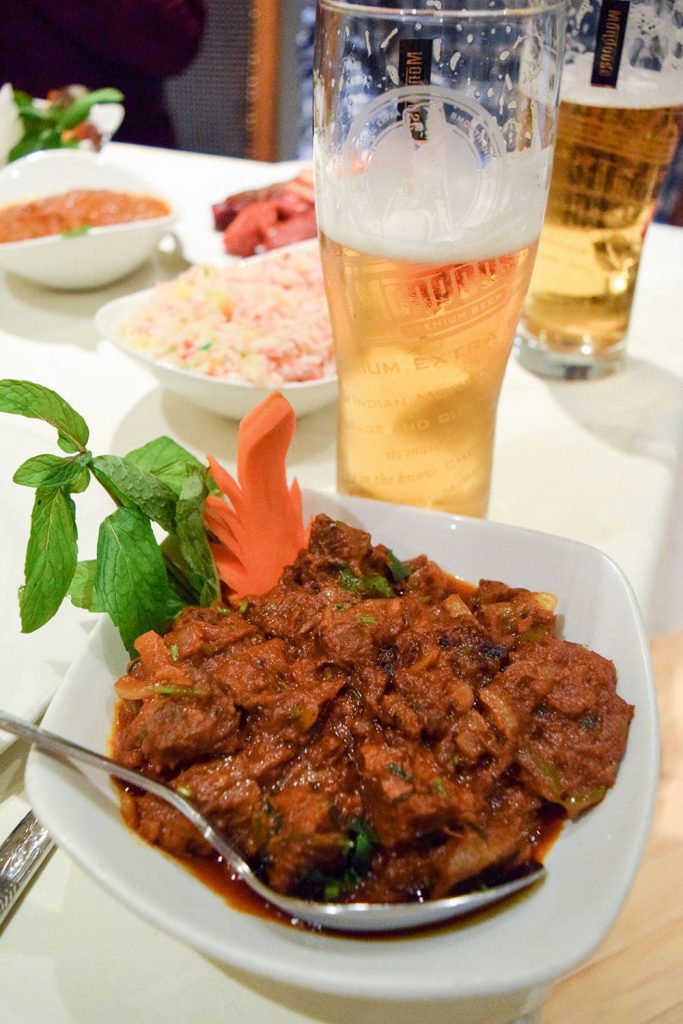
Cooking in a traditional way has always been the priority at the Sanam on King Street Alfreton, and for the past 25 years they have stuck to that premise. Over that period of time they have seen restaurants come and go, some change hands. Their philosophy of providing quality food at a fair price has stood the test of time and they are immensely proud of their track record. The chef was trained in the art of blending spices by a leading international chef which explains the extensive and mouthwatering menu on offer at the Sanam. There’s everything on the menu you’d expect but straying onto the ‘chef’s specials’ section if you fancy something a little more exciting will really excite your taste buds. The sauces at the Sanam are rich in flavour and there’s plenty of substance to them. The Mirch Masala dish is full of strips of stir fried chicken with peppers, onions, tomatoes, ginger, garlic and a subtle tweek from the chef to add that special zing. The ginger is delicate in flavour and doesn’t overpower the meal. The blend of spices ensures a very balanced flavour. You get what you pay for where food is concerned, and the Sanam has that fine balance of quality food at a very reasonable price. Having dined regularly and had numerous takeaways from the Sanam it can be difficult to pick something new from the menu and not default to old favourites and so it was good to be able to chat to a chap who had come to fetch his takeaway and find out what he enjoyed. It was annoying to find that he had ordered the same as me! So no help there. Fish dishes at the Sanam are very popular and having taken the grandchildren along for an evening meal one the chef prepared a delightful salmon dish which they polished off with aplomb. Oh, they did have some fries too! The starters at the Sanam include regular favourites such as: Chicken Pakora, Daryayi Bazran served with a delicate mixed nut chat, fresh salmon marinated in fresh dill yoghurt, garlic and chefs special spices and roasted in a tandoor. Adraki lamb chops, juicy slices of lamb chops, marinated in garlic and spices, cooked in a tandoor and served with salad and sauce. Mains include:Jalfrezi Chicken a firm favourite of mine, the characteristic of this dish is the puree made of tomatoes, green peppers and onions which is then poured over the curry. Perfect. All in all a cracking night out is assured. Advanced booking is always a good idea. Call 01773 830690 00
Restaurant Review – Shapla Spice
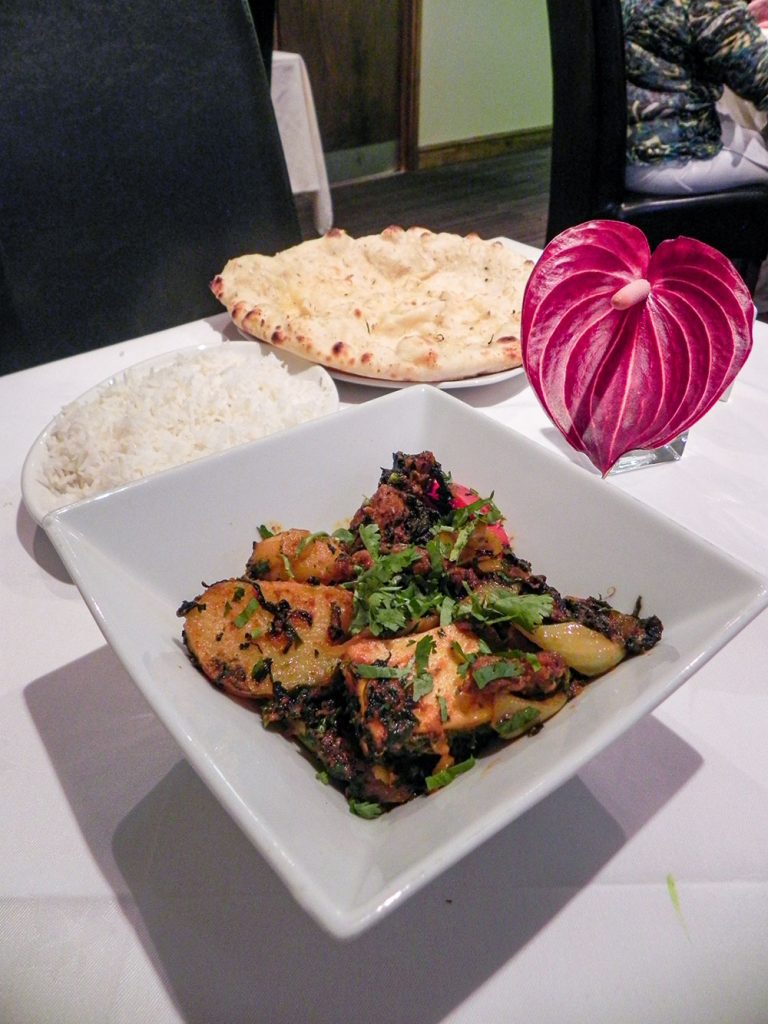
Shapla Spice is one of the longest established restaurants in Ripley, Derbyshire. I must admit I drive past Shapla Spice almost every day and always thought it was a take away, how wrong was I? It was on a pleasant Friday evening that my partner and I were booked in to dine, it was then that we realised looks can be deceiving, as inside it is quite contemporary with about 30 covers, tables with white linen and modern leather chairs, soft lighting and an Anthurium flower on display on the table which was a nice touch, the tables are nicely spread out as well, so you don’t feel people are on top of you. We were greeted on our arrival by Ali the owner, who is incredibly passionate about the restaurant and the food. He went on to tell us that his brother in-law is the chef as well as his business partner and that the vision they have for Shapla Spice is to be bold and adventurous with the food, while at the same time providing a first class service. Shapla Spice is not licensed, so do take your own alcohol, they serve soft drinks though so you’re ok there. Let’s face it, sometimes it’s nice to take your own bottle of wine and not pay the inflated price when you receive the bill. After perusing the menu for a starter, I opted for the Shapla Kebab which is chicken and lamb tikka with salad, stir fried and rolled in thin bread, this was most unusual, as in all my time writing ‘dining out’ reports I have never tasted anything like this, it had a sweet, tangy taste with a hint of coriander and the bread it was wrapped in, was very light and not stodgy at all. I would say that this starter is enough for two though, as even with my partner helping we could not finish it, which was a shame because it tasted beautiful. For our mains I asked Ali to choose for us, I do this quite a lot when dining at Asian restaurants otherwise you end up ordering your old faithful, so sometimes it’s good to widen out and go for a dish you would not usually choose. I had the Bahari Jalfrezi, this was a lamb, spinach, potato and paneer dish served in mustard oil with crushed garlic and sliced green chillies. I found this dish to be medium spiced; the spinach and lamb with the mustard oil gave this meal a deep warmth with subtle hints of garlic. This dish is what I would call a dry dish so if you like more sauce with your dish go for the Doi Turka; a chicken tikka dish cooked in a rich garam masala marinade sauce, this dish was quite spicy which came as a shock to my partner as her old faithful is usually chicken korma but that did not seem to put her off as she ate it all. The sauce is of a creamy nature due to the natural yogurt it’s prepared with, this combined with the chillies gives a nice balance and being a masala sauce makes it a firm favourite. One thing you must try is ‘Daves’ special chips, you will not find these anywhere else as it was created by Shapla’s own chef, I wont tell you about them, I will let you find out for yourself why its a firm favourite with the locals. The Nan breads are cooked in a clay oven which makes such a difference, as otherwise you can end up with stodgy lumps of bread that end up being a meal all by themselves. Thankfully ours were light and well buttered. I recommend you go for the Kulcha Nan but I won’t tell you why, just order it for yourself and enjoy. Overall we found the dining experience and the food very pleasant, it’s worth noting the prices on the menu, not one of the meals is over £10, my Bahari Jalfrezi was £7.95 and my partner’s Doi Turka was the same price, so you can see it is very reasonable. Shapla Spice is of a size that you could book the whole restaurant for your own private function, which I know Ali would be happy to accommodate. Its also worth noting that Shapla have a Amber Valley Hygiene rating of 4 they are so proud of this that they even invite you to see the chef at work in their spotless kitchen. So if you’re looking for some new Asian dishes to try of good quality then the Shapla Spice is the place to head to. 00
Product Test – Skin Academy ZERO

Skin Academy has just launched the UK’s most eco-friendly beauty range, Skin Academy Zero. Skin Academy Zero is the first mass market, 100% natural, 100% recyclable / recycled packaging and sustainable skincare range that is set to shape the future of the beauty industry. The innovation sets a new environmental standard in the beauty industry, creating a product range which champions green, ethical practices in both how the products are made and how they are packaged, whilst not compromising on their quality and benefits to the skin. The range of six products feature; a night cream, a day cream, an eye cream, facial scrub, facial wash and hand cream, which are all made from 100% natural ingredients. There are zero artificial ingredients, fragrances or preservatives, zero parabens and zero SLES / SLS. The brand really is Zero by name and zero by nature and the entire product range is Vegan friendly too. Holly Wagman, NPD Manager for Skin Academy who is behind the pioneering launch said: “The concept comes from extensive research in to the sustainable beauty industry which we found to be practically non-existent! The formulation has taken us years to perfect but we are thrilled with the results of Zero. We are bringing to market the ultimate nourishing and deeply hydrating formula packed with 100% natural and sustainably sourced actives, all packaged in reusable, recyclable tubes made from sugar cane ethanol and cardboard boxes. “Our intention was to create a stand out range that allows consumers the luxury of natural, premium skincare at affordable prices, without damaging the environment. Our tagline for ZERO really is our brand ethos; we want our consumer to feel beautiful and confident in his or her own skin, recognising the importance of self-care whilst still helping provide an environmentally friendly future for all. “It’s ‘’Your Skin, Your Planet’’, so why can’t we care for both at the same time? We feel confident we can help customers make the conscious choice to drive sustainable skincare and protect our planet at the same time.” 00
Modern Collectibles – UK WW2 Propaganda Booklets
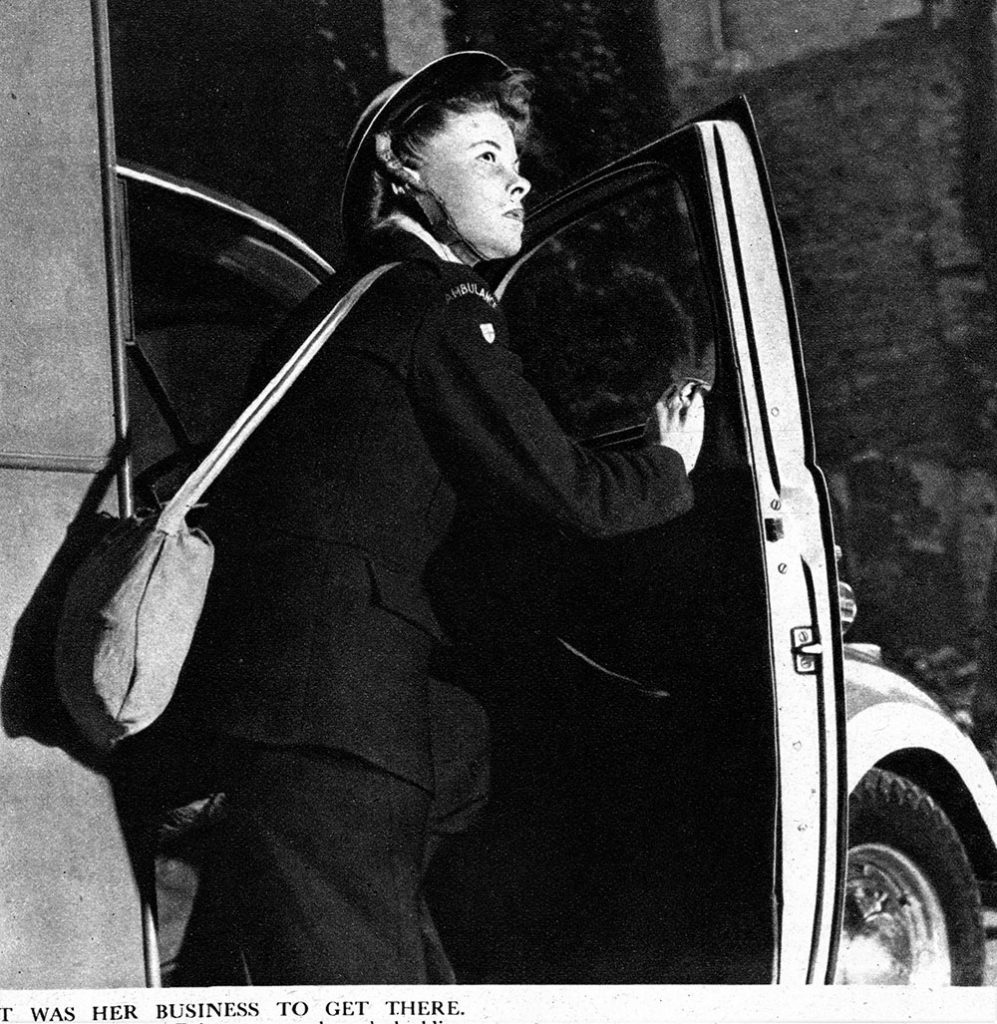
When I was quite small in the late 1940s, I recall leafing through some paper bound booklets of quite substantial length, packed full of pictures of the war at home, on land, on sea and in the air. I was riveted by them, fed by tales of how it all felt, for it was very green in the memories of my parents, grandparents and various aunts and uncles. One, called the Battle of Britain August – October 1940 thrilled me, simply because aircraft thrilled me. Another, called Front Line 1940-1941 became a favourite because it contained a photograph of the lady who was then my nanny, called by me ‘Tatty’. In fact she was called Maude, and was recruited to the war effort in London because she could drive, not a universal accomplishment for women in those days. Thus with the blitz in full swing, Maude drove an ambulance. The auxiliary nurse who went with her as her crew was my grandmother, Margery, and their bond was strengthened by the horrors and fatigue of those grim months. Maude’s bachelor flat was soon bombed out and thereafter, at Granny’s suggestion she lodged with us. Thus, inside the publication in question, one of the morale-raising booklets published by the Ministry of Information throughout the war, was included a photograph of Maude, complete with tin hat and gas mask, at the door of her vehicle looking anxiously up at the night sky, dramatically captioned ‘It was her business to get there.’ Pity they missed Granny, though! Their worst time, funnily enough was not in the blitz proper but during the V-1 bombardment in late summer and autumn 1944 which unleashed the worst devastation they ever saw and stretched them to the limit. When I was born, with the V-1 threat safely over, she stayed on as my nanny for four or five years before entering the family properly by marrying an uncle who worked at GCHQ in Chislehurst. Astonishing how the war brought people together. What gives a book popular appeal was the question posed by the officials of the Ministry of Information’s Publications Unit during 1941. The way that it was answered led to the creation of these well-produced and well-written booklets and resulted in sales numbering in the tens of millions. By the end of the war, Ministry books were an established part of the country’s reading. Indeed, by collecting every one of the fairly lengthy series, one might accumulate a complete history of the Second World War from the British point of view. The Ministry’s internal discussion over popularity began with the publication of a book which proved to be its most successful. The Battle of Britain, written by the popular author Hilary Saunders, was revised by the Ministry after it became a surprise best-seller in March 1941. The Ministry-edition boasted a superbly designed illustrated cover, eye-catching diagrams and action photographs. It sold 4.8 million copies in Britain in the six months following its release. A version published by the RAF lacked pictures and although much rarer comes in at about the same price in top quality condition: £12-£18. The Front Line, one can buy in good condition for between £6 and £10, and indeed I paid £4 for a tatty copy just to scan Auntie Maude in to illustrate this article! At Bamfords we invariably sell them in groups or with other items, but as a rule of thumb about £2-£5 a copy would be the calculator, although retail for copies of most titles in good condition vary from £20 to £40. The Battle of Britain’s success was followed by that of the 126 page Bomber Command. This paperback was based on interviews with returning aircrew and promised to tell the story of a battle unlike any ‘fought before in the history of mankind;’ it quickly sold 1.25 million copies. Today even a scruffy edition will make £5-£8, a good one £15-£20: 310 today. The rarest one was an unillustrated booklet called How Hitler made the War, which was a cleverly arranged collection of actual foreign office documents 1933-1939 published in extract which speak entirely for themselves. It showed how Nazi Germany reneged on its Pact with Poland, and the final chapter, written by Sir Nevile Henderson (the British ambassador to Germany), is on Hitler and Hitlerism, demonstrating that Hitler had ‘made this war’ and should bear full responsibility. The scale of suffering and sacrifices that civilians were likely to experience persuaded the Government in 1939 that, although the war that Britain had declared against Nazism was widely acknowledged as being inevitable, it would still require explanation, hence this booklet and two others along the same lines. Neither were there any pictures in these – W H Smith told the Government (incorrectly as it turned out), that nobody would want to buy it; How Hitler, was a snip at 3d (1.25p), but such is its rarity that a copy in pristine condition will set you back well north of £30. The Battle of Britain like its successors, used a mixture of texts, maps and images to create a narrative. They were intended to be cheap, their content was to be ‘dramatic, human, [and] lively’, and they were to be heavily illustrated and drew inspiration from contemporary illustrated magazines like Picture Post and Illustrated. Generically these tomes were and are called ‘Official War Books’. Titles like Coastal Command, His Majesty’s Minesweepers (around £22 now), Roof over Britain and Transport Goes to War (which I loved, as it was mainly about trains, another enthusiast I enjoyed as an infant – £10 today) aimed to ‘tell the British war story’ by providing insight into particular parts of the war effort. Each book (of which in some cases there was more than one impression, sometimes with a different cover) was based upon at least one of the main themes of Ministry propaganda, eg. the laudable ‘the projection of Britain as a progressive, efficient, equalitarian democracy’; they were also regarded as a good
Celebrity Interview – Rick Wakeman

At the age of 70 most people probably think about taking life a little bit easier. But not Rick Wakeman. Even after three heart attacks because of an unhealthy lifestyle and at one point being given only 24 hours to live, the keyboard virtuoso is still going strong. He’s just finished his first solo tour of the United States and Canada in 13 years and is now undertaking a 12-date tour of England to promote his latest album. It’s difficult to know how many albums he has to his name: the keyboard player, songwriter, author and television and radio presenter has released more than 90 as a solo artist as well as a number with contemporary rockers Yes. He’s also put out a few with his own rock band The English Rock Ensemble, which includes his son Adam on keyboards. So why does he carry on? “It’s my privilege to be able to play on stage to people,” Rick told me during a break in his American tour which he said went “extremely well” and was “most enjoyable”. He added: “I have the best job possible because the great thing is – it isn’t a job!” Rick is one of the few people who can truly be called a legend. Wakeman fans in Derbyshire will get the chance to see him in The Grumpy Old Christmas Show when it visits Buxton Opera House, a venue that Rick has played several times before. “I love playing there and I’m fond of Buxton too. I always try to arrive early so I can have a wander around. “Audiences are pretty much the same everywhere you go. That’s the joy of being able to do what I do; you’re able to visit so many different places and meet so many nice people. I have very good friends in Buxton who I always look forward to meeting up with.” Rick officially became grumpy when he joined the conversational-style television series Grumpy Old Men in 2003. So it was fairly predictable that he called his trip to the United States The Grumpy Old Rock Star Tour. “That was exclusively for America really and the Christmas show is called Grumpy Old Christmas to match my grumpiness! There’ll be elements of grumpiness as I talk about some of the things in the festive season that drive me nuts and I’m sure I won’t be the only one! “Most of the music will come from the new album Portraits although a few other pieces will find their way onto the set as well as a few surprises.” The new offering features 14 tracks made up of 22 classics. “I unashamedly have to say I’m thrilled with the finished product,” said Rick. “It’s just piano playing lots of melodies that everyone knows but in a totally different way. You’ll certainly recognise them all but I wouldn’t try to sing along!” Richard Christopher Wakeman was born on 18 May 1949 in Perivale, London. When he was seven his father paid for him to have weekly piano lessons which lasted for 11 years. In 1968 he secured a place at the Royal College of Music with the intention of becoming a concert pianist. He left the following year to become a full-time session musician, playing on David Bowie’s Space Oddity among many other songs. The money was good but he felt he wasn’t getting a chance to be part of the music. So he joined folk rock group Strawbs. After a couple of years he left when he faced “one of the most difficult decisions” of his career: whether to join Bowie’s backing band The Spiders from Mars or Yes. He thought the prog rock band would give him more career opportunities. Altogether he’s been part of the group five times. Its latest line-up, known as Yes Featuring Jon Anderson, Trevor Rabin, Rick Wakeman – otherwise known as ARW – will tour for the last time next year. There are “so many reasons” why Rick has kept going back to Yes but “my fun with ARW will be the last. Everything comes to an end and it’s reached that point for me. “Travelling does tire you but I try to pace myself as best as I can and will continue to do so as long as my health hangs in there!” Shortly after joining Yes, Rick also pursued solo projects. His first three concept albums, The Six Wives of Henry VIII, Journey To The Centre Of The Earth and The Myths And Legends Of King Arthur And The Knights Of The Round Table, were his most successful. His lifestyle, though, proved problematic. He suffered three heart attacks in his twenties due to smoking and heavy drinking. He quit smoking and in 1985, after being taken ill during a tour of Australia, he stopped drinking; he’s been teetotal ever since. So what’s his health like now? “Not bad at all, to be honest. I continually struggle with my weight but apart from that I wake up breathing every day and long may it continue as I’ve got loads still to do in my life.” Rick made a name for himself not only for his unmistakeable, highly complex music but also his long hair and his flamboyant capes. His wicked sense of humour, charm and geniality have led to his being signed up for programmes as diverse as Just A Minute on BBC Radio 4 and Have I Got News For You and Watchdog on television. Despite that, does the music come first? “I suppose it does really. But I love doing all the other stuff as well. At the end of the day, I always end up sitting at the piano.” Married four times and with six children, Rick lives with journalist, writer, director and actress Rachel Kaufman in Norfolk. They wed nearly eight years ago. How big a role does Christianity play in the life of the man who learned to play a church organ and who was a Sunday
A visit to Yorkshire Sculpture Park

A short drive from Junction 38 on the M1, leads to the well-signposted way into the Yorkshire Sculpture Park (YSP), where scores of massive, mainly metal, sculptures dot the landscape of the 500 acre Bretton Estate not far from Wakefield. Well placed in an open landscape for the best effect, there is everything from Barbara Hepworth’s ‘Family of Man’, to Henry Moore’s massive bronzes, and quirky exhibits such as the larger than life sized man reading his mobile phone, this is called ‘Networking: uphill from this is the Chinese dissident Ai Weiwei’s group of animal heads apparently in conversation, then a rabbit headed woman’s body made from chicken wire made by Sophie Ryder; and just outside the café, is a life sized version of Albrecht Dürer’s Rhinoceros drawn in 1515. I found the piece called ‘The Cave’ by Mark Suvero the wittiest. It looks as though it is made from bits and pieces of cast off JCB machines, as it is quite likely, for Suvero was a construction worker at one time. Bretton Estate was acquired by Wakefield Council and converted into the sculpture park in 1977, but the estate has a longer and fascinating history. Originally awarded to one of William the Conqueror’s knights for his services at the Battle of Hastings, lands in Bretton and West Bretton including the estate are listed in the Domesday Book of 1086, but by 1158 it was settled by the de Bretton family. Through changes of ownership following convenient marriages, the estate passed through three interconnected families, the Dronsfields, the Wentworths and the Beaumonts. It was the Dronsfields who built up the estate on the banks of the River Dearne, living there until 1407 when it passed to Elizabeth Wentworth, wife of John Wentworth; she bequeathed it to her son Richard and the Wentworths lived at Bretton for the next four centuries, with the house passing through the male line until 1792. The first documented house probably half-timbered, was built by Sir Thomas Wentworth around 1508. The estate continued to prosper until the Civil War when its Royalist owner another Sir Thomas, was imprisoned after the Battle of Naseby. Following the Restoration of the Monarchy, King Charles II made him a baronet in 1664. It was yet another Thomas, the 5th Baronet who by employing the landscape gardener, Richard Woods, a talented contemporary of ‘Capability’ Brown to develop the gardens and park in the mid to late eighteenth century. Although Thomas never married, he had an illegitimate daughter, Diane to whom he bequeathed Bretton. Through her marriage to Colonel Thomas Beaumont an MP for Northumberland the estate became owned by the Beaumonts, later Wentworth Beaumonts for the next hundred years or so. Like many estates before it, Bretton became a drain on its owner’s finances and gradually it was sold piecemeal, first to West Riding County Council, and eventually in its present form to Wakefield Council. Around 1949, the house became Bretton Hall Teacher Training College, later merging with the University of Leeds, specialising in music, the arts and drama. While the mansion has been neglected to some extent and is currently in line to become a hotel, the rest of the park is now an imaginative open air sculpture gallery, with the added bonus of new buildings for the YSP Centre devoted to displays of individual artist’s work and restaurant and café facilities. The 500 acre Yorkshire Sculpture Park is open daily throughout the year. Allow at least three hours to do justice to a visit. 00
Walk Derbyshire – Carsington Pasture & The High Peak Trail

5 miles (8km) of minor road and field path walking with one steady 252 foot climb (77m). Moderate. RECOMMENDED MAP: Ordnance Survey Explorer Map Sheet OL24. 1:25000 scale; the Peak District, White Peak Area. PUBLIC TRANSPORT: Your Bus service between Ashbourne and Matlock calls at Carsington Water Visitor Centre and Carsington village every hour on weekdays and Saturdays. Two hourly service on Sundays and Bank Holiday Mondays. CAR PARKING: Accessed from the B5035 Cromford to Ashbourne road. Sheepwash car park is opposite the farm lane into Carsington village. Alternatively, use Carsington Water Visitor Centre car park if planning a longer walk. REFRESHMENTS: Miners’ Arms in Carsington village and café/restaurant facilities at Carsington Water Visitor Centre’s New Leaf Restaurant. This walk combines popular routes by linking them with a little used path. Here the view across Carsington Water leads on across the north Midlands Plain, almost to Leicestershire. Starting from Sheepwash car park, the way is first through Carsington village to Hopton. This is where the only serious climb in the walk follows a little used path up to the High Peak Trail. The trail is followed, parallel to the moorland road from Wirksworth to Brassington, until the two routes diverge. A sharp left turn at this point leaves the trail, then crosses the road to reach the popular path crossing Carsington Pasture. Its wind turbines now stand where our prehistoric ancestors once farmed, or later inhabitants delved for lead. This path eventually reaches Carsington village and its welcoming pub. At Carsington a decision must be made, either to return to the car, or continue along the reservoir path into the Visitor Centre for a short stroll to Stones Island, and then walking back the same way, or perhaps catching service bus no. 110 Ashbourne to Matlock via Carsington. The charming village of Carsington nestles in a sheltered valley above Carsington Water. The reservoir was opened by HM the Queen in May 1992, and contains when full, 7,800 gallons of water, sufficient for the needs of three million people in the north Midlands cities. Carsington village’s tiny church though much ‘improved’ in Victorian times, actually dates from the 14th century, outdating its yew by more than three hundred years. Hopton, the second village, more a hamlet with a manor house, passed through on the walk, surrounds the one-time home of Sir John Gell who led his band of locals on behalf of parliament during the English Civil War. One of the Gells fancifully named the road he created to link Cromford and the coach road at Newhaven, the Via Gellia. He did this in an attempt to make people think the road was Roman in origin. Certainly the Romans inhabited the locality, basing their lead smelting on Lutudaron, a place yet to be discovered, but thought to be somewhere between Carsington and Wirksworth. Hopton Hall is famous for its snowdrops blooming every spring and the garden. The flower garden on the far side of the house from the snowdrop beds is sheltered by the delightfully named ‘crinkle crankle’ wall. Built in a wavy line for both strength and to create sun-arbours, you will pass it early on during the walk. There is an urn in the courtyard of Hopton Hall which Sir William Gell brought back as a souvenir from his Grand Tour visit to Pompeii in 1832. THE WALK 1. Leave Sheepwash car park, and cross the main road. Walk up the narrow lane opposite and cross the Miners’ Arms car park in order to reach the road through Carsington village. 2. Turn right and walk along the minor road for a little under a mile. 3. Go past Hopton Hall and its crinkle crankle wall. 4. Continue to follow the road downhill and then up for another half mile. Keep going forwards by bearing right at the road junction in the dip. 5. Leaving the hall and cottages behind, the road cuts through woodland. 6. Where the road begins to bend sharply to the right in order to join the main road, do not go forwards, but turn left at the corner of the wood on your left. 7. Bearing slightly right and using stiles to keep to the right of way, begin to climb the hillside and enter the first of a series of fields by crossing the woodland boundary wall. 8. Cross the wall at the top right hand corner of the first field and immediately turn half right to cross into the third field. 9. Cross a walled farm track and then, still climbing, looking out for stiles or gaps in boundary walls, climb up through five fields. 10. Cross over a narrow minor road and walk through the last four fields by following their boundary wall on your right. 11. Next to an old farm building, turn sharp left and walk up to the High Peak Trail. 12. Turn left along the trail. Follow it parallel to the Brassington road for around 1¼miles. 13. Where road and trail diverge, turn left to leave the latter. Go through stiles on both sides of the road in order to enter the vast expanse of Carsington Pasture. 14. With the wind turbines on your right, follow the boundary wall across the undulating and steadily descending grassy path. 15. Keep to the path where it zig-zags down the steepening slope. 16. Cross a stone stile and follow the narrow lane past a series of cottages. 17. Bear left along the road through Carsington village and turn right at the Miners’ Arms pub. 18. From the pub follow the farm lane you used in the first part of the walk, this time gently downhill to the main road. 19. Cross the road in order to reach Sheepwash car park. A LITTLE BIT EXTRA TO THE WALK If you still have the time and energy to walk another mile or two, the waterside path from Sheepwash car park to Carsington Water Visitor Centre is a delight. Simply
Celebrity Interview – Tara Fitzgerald
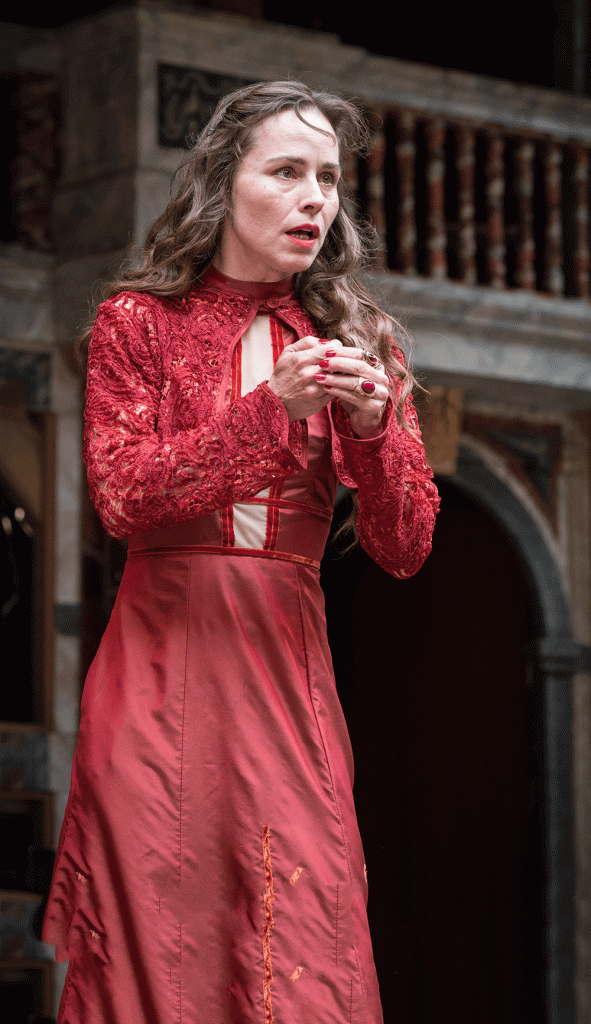
‘Prism is at the Birmingham Repertory Theatre from 3rd – 12th October and at The Theatre Royal, Nottingham from 21 – 26 October’Tara admits she always gets nervous: “It’s always been the same as far back as I can remember. Excitement and the desire for something to be good are the drivers and inevitably make me nervous. As long as I stay nervous I’m fine. Anxiety isn’t welcome” She’s recognisable for her roles on the big screen in Brassed Off and on television in Waking The Dead and Game Of Thrones. Now Tara Fitzgerald is teaming up with Derbyshire-born actor Robert Lindsay for one of the theatrical highlights of the year which is coming to Nottingham. Lindsay is reprising the part of Jack Cardiff, “the man who made women beautiful”, in Terry Johnson’s play Prism. Tara plays two roles, Cardiff’s wife Nicola as well as Katharine Hepburn, the Hollywood star who worked with the legendary director and cinematographer. The play features Cardiff who is suffering from dementia looking back over his life and the films he’s made. When I spoke to Tara during the early stages of rehearsals for Prism, she was still examining her two characters and how they fit into the play. But she was quick to praise playwright Terry Johnson who also directs Prism. Her deep voice is mellifluous as well as unmistakeable “Terry’s writing is fantastic and very exciting to work with. It has a sort of visceral quality and it’s funny, as Terry’s work often is. If we do it right it will also have real pathos. But Terry never becomes sentimental. He’s a very fine wordsmith.” Tara whose deep voice is mellifluous as well as unmistakeable says she is already loving the play: “It’s a real treat to be able to play two characters. Terry’s writing is so beautiful you want to honour it.” She is also relishing the opportunity to team up with Robert Lindsay again. They both appeared in the Terence Rattigan play In Praise Of Love at the Theatre Royal, Bath last year. It was directed by Jonathan Church, formerly associate director at Derby Playhouse and assistant director of Nottingham Playhouse in the 1990s. Tara says it’s a “real pleasure” to be working with Lindsay. Tara Anne Cassandra Fitzgerald was born on 18 September 1967 in Cuckfield, Sussex. She came to international attention in 1993 when she starred with Hugh Grant in the Australian comedy Sirens. She appeared in a stream of independent films during the 1990s, most famously Brassed Off in 1996 alongside the late Pete Postlethwaite. She played Gloria Mullins, a young woman working for British Coal who’s sent to her home town of Grimley to determine the profitability of its pit. “People talk about it as being one of their favourite films,” remarks Tara. “It still has so much relevance, as I suppose the best pieces of art do. Everyone believed in it. It wears its heart on its sleeve, so it chimes with people.” The previous year Tara had won the New York Critics’ Circle best supporting actress award for her role as Ophelia in Shakespeare’s Hamlet opposite Ralph Fiennes. On television she appeared in 32 episodes of the BBC1 series Waking The Dead as forensic scientist Eve Lockhart and also in the spin-off drama The Body Farm. If you’re a fan of the TV fantasy drama series Game Of Thrones you won’t need me to tell you that Tara played Queen Selyse Baratheon, wife of the Lord of Dragonstone and claimant to the Iron Throne. The character killed her daughter before hanging herself. Tara considers herself lucky to be able to move between the different media of theatre, film and television. She found Game Of Thrones to be “phenomenal” because she was a fan of the series when she got the role. “I was just over the moon. There was such talent everywhere you looked, both the cast and crew. It was a great thing to be part of and something I can feel so proud of. Even if you haven’t seen Games Of Thrones you know it. And you know culturally the impact it’s had globally. This sounds a bit grandiose but I think it was the start of a television revolution.” There’s also been a revolution in theatre, with actors being cast in roles no matter what their gender, race or age. Tara feels she has benefited from this change. “It feels like people are just much more open-minded. It’s a time of reinvention. People are looking at projects with fresh eyes, which is great. “There’s just been this zeitgeist,” observes Tara, an intellectual who thinks carefully about everything she says. “The change has been so swift and so huge. But I still miss in film – not so much on TV – representation of women of a certain age, women who are my age basically.” Tara has recently been working on a major ITV period drama, Belgravia, written by Downton Abbey creator Julian Fellowes. “That had the most wonderful roles for older women who are the drivers of the story.” Lady Macbeth at Shakespeare’s Globe Tara had at one point become frustrated at a lack of interesting roles for mature actresses and had started to direct. Yet she has had a range of major parts in the past few years including playing Lady Macbeth at Shakespeare’s Globe and Bella Manningham in Patrick Hamilton’s Victorian chiller Gaslight in Northampton. She found acting at the open-air Globe in London “extraordinary” because “the main house isn’t like anywhere else. For me it was a big learning curve, the immediacy of the space and the interaction that you inevitably have with the audience. “Usually when I go out onto a stage there’s some sort of a wall. They call it the fourth wall. And so you’re enclosed in your make-believe land. At the Globe you’re not. You come out on stage and you can see every face in the house. People are very active and alive
The Lost Houses of Derbyshire – Greenhill Hall, Norton
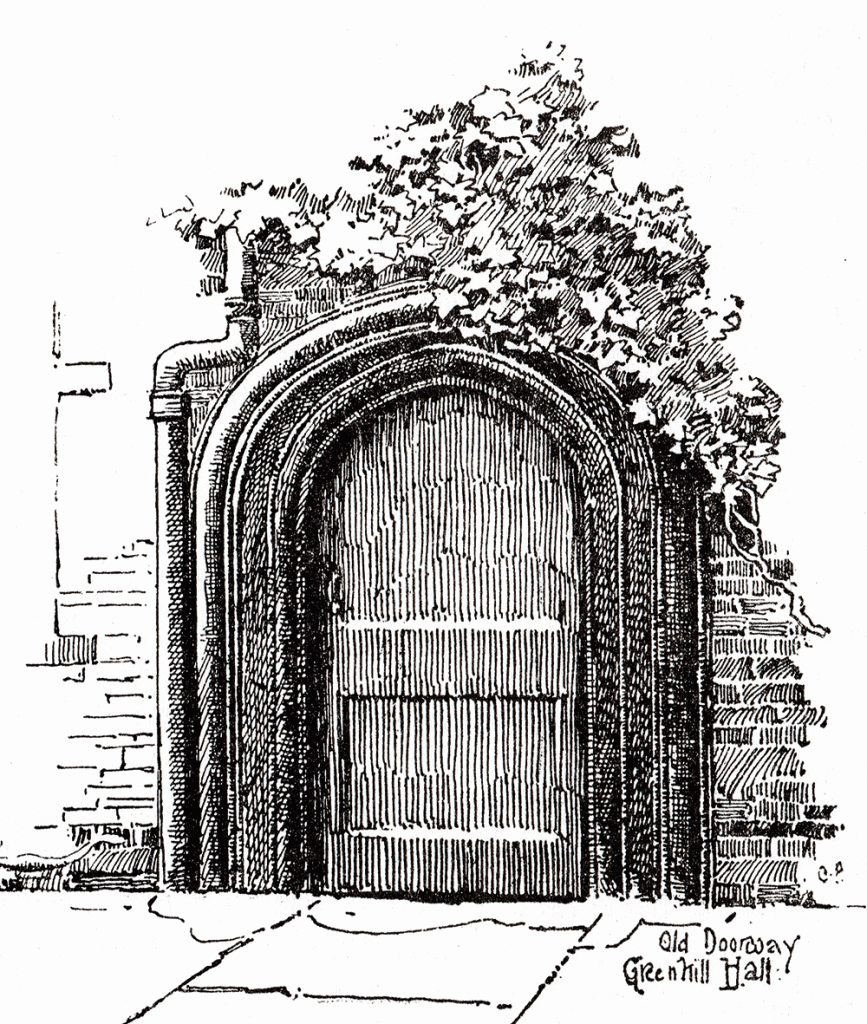
When I write about Derbyshire, I do tend to stick to the historic borders of the County, the land of which has been eroded (and less generously replenished) ever since County Councils were first formed in 1888. Although we have gained the Seals (Over and Nether) in the south and Fernilee to the north west, we lost all the ‘islands’ of Derbyshire that were once immured in Leicestershire: Measham, Ravenstone, Donisthorpe, Stretton-en-le-Field, Oakthorpe, Clifton Campville and Appleby Parva, not to mention Edingale, Chilcote and Croxall in Staffordshire. Since then, large settlements outside the county have hungrily seized parts of Derbyshire just to increase their rates income: Burton had Stapenhill and Winshill, for instance, and so in the same spirit, Sheffield gobbled up Beauchief and Norton, two of our most historic villages. They tried to get their hands on Dronfield, too, in 1974 but were successfully rebuffed! Thus, I make no excuses for writing about Greenhill, a township (hamlet) of Norton, in which until 1965 stood a most venerable small manor house called Greenhill Hall. Generally speaking, smaller manor houses which managed to survive the first three decades of the twentieth century have tended to enjoy relatively assured futures, but this has not been the case for those which have fallen within the destructive ambit of Sheffield City Council, as Norton did. Little Norton Hall, Norton Lees Hall and Norton House have all passed into oblivion. Of these, Greenhill was the most important, although its listing was never higher than II. Although the exterior dated from the later sixteenth century, the house had a much earlier core. This became only too clear as the house was demolished, revealing a three bay timber framed great hall of fourteenth century date, only matched in Derbyshire by West Broughton Hall in Sudbury. The Tudor exterior boasted a delightfully irregular gabled façade of coursed rubble of Grenoside sandstone from a local outcrop. The Tudor arched door is flush with a gable to the left, whilst two others were to the right, each slightly advanced from the main façade and with fine six-light stone mullion and transom lead paned windows under short hood-moulds. The gables were straight and un-coped, with the usual array of diamond-set stacks above the stone slate roof. The SE front was ungabled, and much plainer, built in two stages, the NE part being fractionally lower than the portion adjacent to the main front, the whole being of four bays with a second (garden) door at bay three and with fenestration all of three light mullions, the lower windows being noticeably deeper than those above and having similar short hood-moulds. The upper windows (or at least some of them) had flat mullions and surrounds instead of moulded ones, suggesting later alterations – perhaps the replacement of the original timber windows. It was within this that the substantial vestiges of the original timber framed house lurked. Inside there was a beautiful ‘Sheffield School’ ribbed and rosetted plaster ceiling in the parlour, called the ‘Oak Room’ from its lavish period panelling, which indeed stretched to other parts of the house. Indeed, the Oak Room ceiling went to Cartledge Hall not so far away in Holmesfield and can still be admired. There were also fine period over-mantels, one armorial. To the NW was a later, nineteenth century wing of no great pretension, but sufficient to make the house reasonably spacious and to afford an element into which modern (for the late 19th century!) plumbing could be inserted. The earliest certain family to have a capital mansion on the site was the Mowers, also of Barlow Woodseats, William de Mora (as the name was originally spelt) being in possession in 1384. He was a tenant of the Abbey of Beauchief, nearby. A descendant left a daughter and heiress, Joan, of Newbold, who married James Bullock of Unstone in 1586 as his second wife. James was a local man, his father John, living on The Green at Greenhill but, despite the Mowers actually having long held a lease on Greenhill Hall, John had actually acquired the lease (of twenty one years) from the Abbey in their stead in 1533. However, the Dissolution of the Abbey came about within three years, and he promptly bought the freehold as well. James Bullock’s father died in 1579 at a great age, and seems to have undertaken the first stone rebuilding in the 1560s. His son and heir, another James (1580-1632) inherited in 1598 and added the gabled front and also extended the SE side. On his death it passed to his son John and from him to another John, who died without issue in 1699. Yet the second James Bullock became involved in iron smelting at Staveley, where, on the death of his grandson, John Bullock (1627-1699) the enterprise passed to a cousin by marriage, Godfrey Froggatt. As a result, the hall at Greenhill was let to Thurstan, third son of Arnold Kirke of Whitehough Hall, Chapel-en-le-Frith, for he had married Francesca daughter of Jerome Blythe of Norton Hall, nearby and produced a large family, of whom Gervase, the eldest went to London and became a successful merchant of the Staple, trading at Calais. He married a French lady and had five sons, four of whom continued their father’s business whilst the youngest, James, ran the estate at Greenhill and occupied the Hall. The eldest three sons, David, Lewis and Thomas, led an expedition to Canada in 1628, in which they were up against the wily French leader Samuel de Champlain, eventually wresting Quebec from him and David receiving a personal grant of Newfoundland from the King. His relations with de Champlain, though were formidably courteous, de Champlain calling him ‘Capt. Quer’ and indeed, with the family being semi-domiciled in France, this is how they were spelt there, too, just like the Williamses who served the Kings of France in a later era, whose descendants are called Quilliams! This Canadian enterprise was later referred to as the ‘First British